Reply To:
Name - Reply Comment
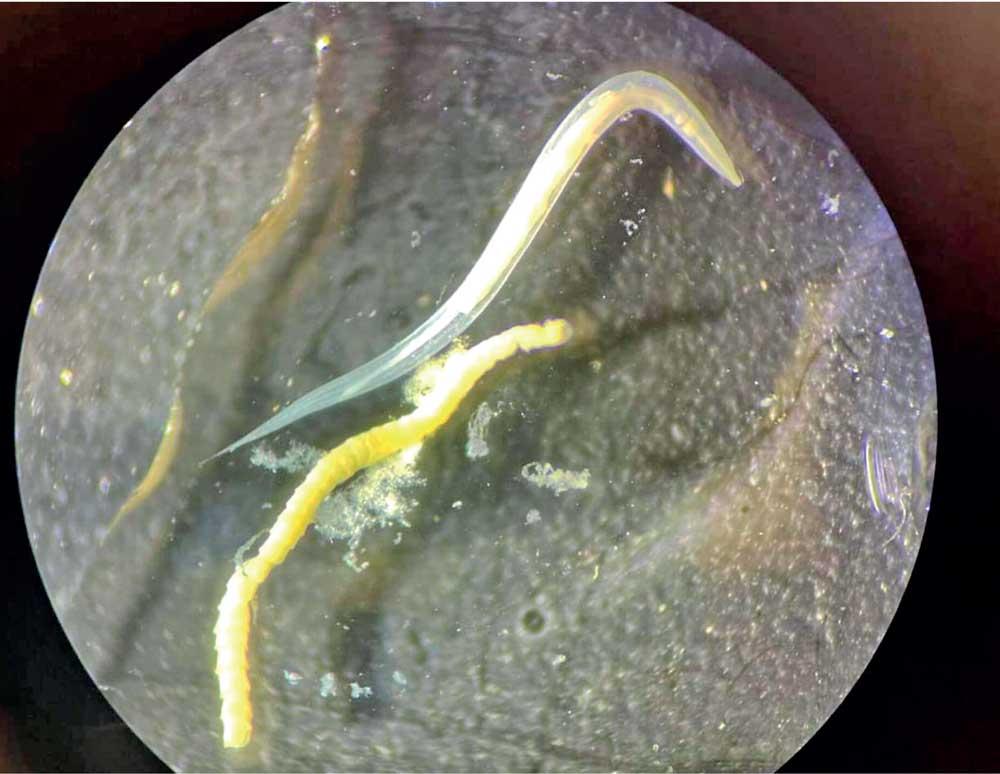
A microscopic image of a Bertiella Tapeworm next to a Pinworm
 |
| Dr. Suranga Dolamulla, Director of the MRI speaking at a media briefing held at the MRI on Monday |
By Zainab Hussein
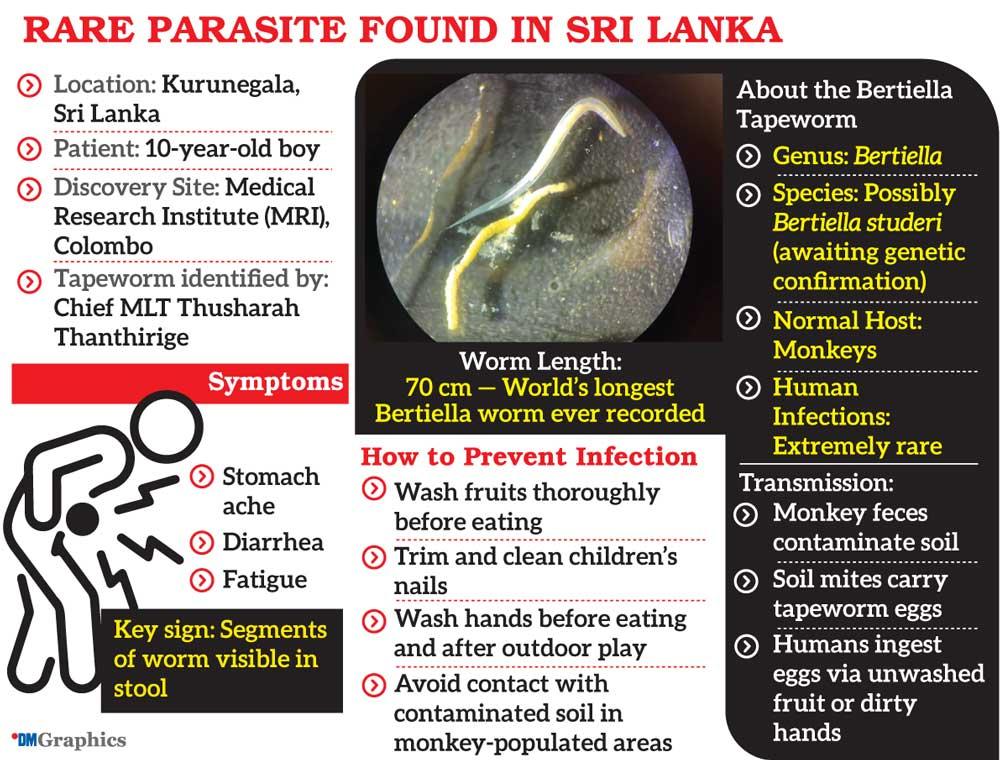
An extraordinary discovery was made by the Parasitology team of the Medical Research Institute (MRI) when they found a parasitic worm belonging to the Bertiella genus. Commonly known as ‘Monkey tapeworm’ the parasitic worm which rarely infects humans was found in a 10-year-old boy in Kurunegala, and is the longest Bertiella worm (70cm) reported globally, according to available data.
Longest ever documented
Dr. Suranga Dolamulla, Director of the MRI, stated that according to recent research, the longest Bertiella worm ever documented measured approximately 40 centimeters. However, the specimen which was examined exceeds this considerably, measuring up to 70cm in length.
“The worm was found inside a 10-year-old boy from Kurunegala. It was detected by Chief Medical Laboratory Scientist, Department of Parasitilogy, Thusharah Thanthirige who further collected the specimens of the worm over a span of three months and combined it at the laboratory. Microscopic examination of the eggs confirms the worm as belonging to the Bertiella genus. However, to determine the exact species—whether it is Bertiella studeri, which is known to infect humans, or another closely related species—we are now proceeding with molecular and genetic analysis. These tests are currently underway at the MRI in collaboration with expert partners. Further details will be shared once definitive results are available,” Dr. Suranga explained at a media briefing held at the MRI on Monday (26).
The Head of the Department of Parasitology and Consultant Virologist, Dr. Rohitha Muthugala explained that this type of human infection is extremely rare, as the natural hosts of this tapeworm species are typically monkeys. When monkey feces contaminate the soil, mites can carry the tapeworm eggs, which may then infect fruits and soil they come into contact with. This phenomenon is more common in areas such as Kurunegala and Anuradhapura, where monkey populations are dense.
Symptoms and preventive measures
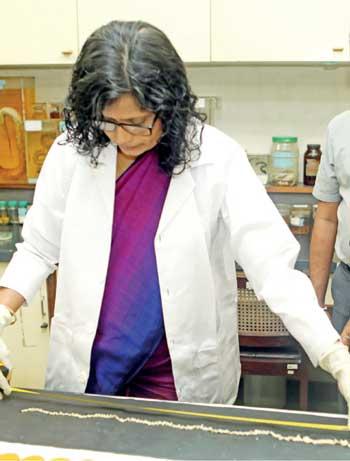 |
| The longest Bertiella Tapeworm was detected by Thusharah Thanthirige, Chief Medical Laboratory Scientist, Department of Parasitology of MRI |
Dr. Rohitha went on to discuss the symptoms of the infection and the preventive measures that should be taken to avoid parasitic entry into the human body.
“The symptoms are fairly common and include stomach ache, diarrhea, and fatigue as the worm is known to depend on the nutrients of the host. However, the infection is often identified by a unique sign: as the tapeworm grows, segments of it break off and are excreted by the host. Parents, in particular, should seek medical attention immediately if they observe this abnormality in their children. Fruits should be thoroughly washed before consumption. Additionally, if children are playing on the ground, their nails should be trimmed and their hands properly washed to prevent the ingestion of tapeworm eggs with food,” he advised.
“Moreover, this tapeworm is unable to reproduce within the host, as its eggs are expelled along with the segments of its body. This means that typically only a single worm resides in each host, which helps us confirm that the collected specimens are from the same worm. However, genetic testing will be conducted for further verification,” Dr. Rohitha added.
“While Bertiella infections in humans are extremely rare and typically not severe, this case is significant due to the unusual size of the worm and its potential clinical implications. It also highlights the importance of continuous vigilance, accurate diagnosis, and advanced laboratory capability in our healthcare system,” Dr. Suranga concluded. But he reassures the public that there is no cause for alarm, and that the MRI remains committed to investigating rare and emerging infections with precision.
Pix by Pradeep Dilrukshana