Reply To:
Name - Reply Comment
 While technology has opened new windows of opportunity for women in public discourse, especially activists, journalists, leaders of civil society organisations, and rights defenders, they often face targeted harassment that can undermine their safety and confidence. Such Technology-Facilitated Gender-Based Violence (TFGBV) takes many forms, such as electronic blackmail, sharing intimate photos without consent, publishing private personal information, online sexual harassment, cyber-stalking, grooming, hacking, and hate speech, etc. Similarly, women in politics also face multiple digital threats. Women politicians, whether at the parliamentary level or within local governance, face significant challenges due to violence directed at them through technology.
However, gendered disinformation directed towards women in politics involves the deliberate spread of false or fabricated information or visuals aimed at humiliating, silencing, or discrediting women in public spheres. These disinformation campaigns often draw on misogynistic stereotypes about women’s roles in society, depicting female politicians as untrustworthy, unintelligent, or overly emotional. The ultimate goal is to silence them and erode public trust in their leadership. Gendered disinformation is an emerging form of violence directed towards women that needs urgent attention.
While Technology-Facilitated Gender-Based Violence is very much personal, primarily aiming to harass, threaten, or abuse women through digital means, gendered disinformation seeks to discredit, silence, and create distrust against women by circulating false digital narratives at a societal level. This has larger social, political, and mental impacts. This also involves serious concerns regarding personal safety and health. Gendered disinformation has severe impacts on women’s ability to exercise freedom of speech and the ability to participate in democratic discussions too.
Addressing both Technology-Facilitated Gender-Based Violence and gender disinformation often focuses on educating women in politics about personal safety and digital hygiene without adequately involving platform accountability, exploring policy solutions, and making structural safeguards for women. However, an often-overlooked aspect is the fact that technology is designed in ways that can reinforce patriarchal and misogynistic attitudes toward women in society. Technology’s inherent sexism, particularly the way it amplifies content that fosters controversy or sensationalism through algorithms, further undermines women’s political participation. Very importantly, women who go through harmful gendered disinformation go through severe mental effects, which have long-lasting impacts on their overall political career, as gendered disinformation can push them out of politics entirely.
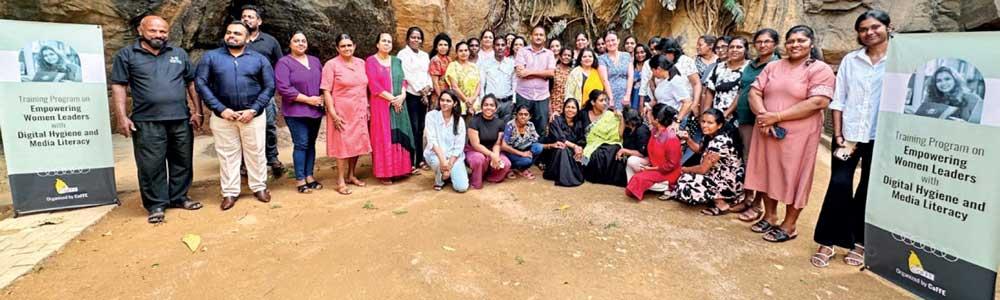
In response, Campaign for Free and Fair Elections (CaFFE), one of the leading election monitoring bodies in Sri Lanka, has started training programmes to promote media literacy, digital hygiene, and security programmes to capacitate 120 women in politics affiliated with local government bodies. CaFFE has planned four such training sessions with the support of The Carter Center. The first training programme was held last week in Matara with the participation of 32 women politicians. During this training, those women were consulted on the impact of gendered disinformation on their political careers. Out of those 32 women, at least 12 said they had faced some form of disinformation. The first trainings were conducted by Shashen Fernando and Dr. Gabrielle, a consultant of The Carter Centre.
Sexualised Disinformation
In one case, a woman politician described an incident where a photo of her with several others, including men, was altered to suggest she was alone with the men and having an affair. The manipulated image was shared widely in WhatsApp groups and on Facebook, leading to the breakdown of her marriage and loss of public support. This disinformation also alienated her from her supporters, with many believing the fabricated story. She explained the deep emotional toll this took on her:“I lost my family, my political support, and my trust. I felt hopeless and discouraged. I did not want to even go to the police. The whole situation caused severe depression”.
Despite the emotional and financial hardships, she returned to politics, though the trauma from this experience still lingers. She shared, “Every time I see my pictures online, I get reminded of the old incident. It creates panic and fear”.
Yet another woman politician described how a fabricated affair between her and a male cabinet minister was spread through social media, particularly via WhatsApp. She said, “I had no idea that something so false could have such a profound impact on my life. I found myself constantly fighting a battle, not with my political opponents, but with these false allegations. People started calling me the ‘wife’ of the minister. It wasn’t just on social media—it seeped into my real life. Family members questioned me, and I lost the trust of many friends and colleagues. I felt betrayed by the people I had worked with for years. Eventually, I had to leave politics for one and a half years. The trauma was so overwhelming that I couldn’t bear to face the public or even attend family events”.
She explained that while she tried to ignore the false stories, they persisted.
“Every time someone shared an old picture of me, taken out of context, it felt like my life was being exposed. I couldn’t block everyone. I couldn’t delete every post. It wasn’t just about defending myself—it was about protecting my mental health. For a long time, I was isolated, unable to even think of returning to politics”.
However, after months of isolation, she found the strength to return. “It was my supporters and friends who encouraged me to come back. Slowly, I regained my energy. But this incident will stay with me forever. It has made me cautious, but it has also made me stronger. I know I can’t let these falsehoods define me”. Another woman with 15 years of political experience shared her encounter with sexualised disinformation. She said:
“People began to spread rumors that I was having an affair with a political leader from my party. I have worked closely with this person, but the nature of our relationship has always been professional. Despite the clear truth, people began sharing these rumors on WhatsApp and other platforms. The constant barrage of these posts made me question my own ability to continue in politics. Every time I tried to explain myself, the attacks would only intensify. It was exhausting, emotionally draining”.
She chose not to let the attacks silence her, though.
“I knew that if I stayed silent, they would win. So, I kept posting on social media, sharing my side of the story, and ignoring the hateful comments. It wasn’t easy, and sometimes, I felt like my whole world was crumbling. But I had to stand firm. If I backed down, it would send the wrong message, not just to my detractors but also to the other women watching. I wasn’t just fighting for myself; I was fighting for all of us.”
One particularly tragic story shared was of a woman politician whose family suffered as a result of gendered disinformation. She explained:
“The rumors about me having an affair with a male politician—who happened to be a friend of my husband—became so widespread that my family couldn’t cope with the stress. My husband was torn between supporting me and protecting his friend. The stress got to him. He became depressed, and, tragically, he turned to alcohol to cope. I watched him destroy himself, and there was nothing I could do to stop it. He lost trust in me, not because he didn’t believe me, but because the disinformation had planted doubt in his mind. In the end, the strain was too much, and my husband’s health deteriorated. He passed away, and people still blame me for his death. This is the price of gendered disinformation—people’s lives are shattered.”
Public Displeasure Against Political Party—Affiliated Women Politicians
Another woman politician recalled an incident where she was targeted with disinformation claiming that she attended a political meeting in exchange for money—Rs 5,000. Posters and social media posts went viral, causing public outrage and threatening her safety. This happened amidst massive public protests against SLPP, which she represented. During public protests, the Aragalaya, she travelled to attend a political meeting as a member of the party, not necessarily taking financial benefit. Due to public tension and protests, she had to stay in Colombo for three days. While she was in Colombo, the social media post, WhatsApp posts, and posters falsely saying that she went to Colombo taking Rs. 5,000 were widely circulated. The post also said she is to come back home soon. While the financial aspect is not significant, the post created public sentiment against her, as she did not respect the public protests against SLPP.
Upon returning, she found that her own son questioned her integrity due to the false information circulating. Despite her family’s efforts to remove the posters, the damage had already been done. The woman explained: “I was mentally frustrated. I couldn’t sleep, and I constantly worried about the safety of my family. It was incredibly difficult, especially with no one to talk to”.
Character Assassination
A third case involved a local government representative who was falsely reported as having committed suicide after the 2019 presidential elections as a result of the loss of presidential candidate Sajith Premadasa. This rumor spread across social media, causing significant personal and political turmoil. The woman politician was pregnant at the time and faced intense pressure, including hundreds of phone calls and public inquiries. Despite the emotional toll, she was advised by her support network to post a video to clear her name. However, the emotional and psychological strain from the disinformation persisted for a long time. She said:
“I had to fight through the shock and the stress. It was difficult, but my family supported me, and I eventually returned to public life”.
The women who went through disinformation said: “I was in a room for five days, closed the door, didn’t want to eat, cried a lot, didn’t want to see the family members and voters because of the shock and shame involved”. On top of this, a popular TV station amplified the falsehood already published in a newspaper.
Another woman politician shared a deeply painful experience of being targeted by a fabricated voice recording.“A voice cut, which claimed that I took an illegal transport license from a minister, was shared all over social media. It was a complete lie. I had never been involved in such a thing. Yet, people believed it. I found myself questioning my own credibility and integrity. It was not just about the political damage—it was about the shame I felt. The voices of my supporters were drowned out by the constant noise of those who sought to destroy my reputation.”
She continued:
“It felt like I was fighting a losing battle. No matter how many times I cleared the air, the rumors kept resurfacing. It took a toll on my family as well. They couldn’t understand why people were attacking me, but the worst part was that I couldn’t protect them from this attack on my character. I stayed away from politics for a while, but I couldn’t hide forever. When I returned, the wounds were still fresh.”
The Power of Solidarity
These personal experiences collectively highlight the profound emotional, psychological, and professional toll of gendered disinformation on women politicians. Yet, despite these harrowing experiences, many of these women found the strength to continue. One woman noted: “When women support each other, we become stronger.” Another echoed: “It’s vital that we stand together for each other despite political differences.” Manjula Gajanayake, an election observer and manager of this programme, emphasised: “These experiences highlight the urgent need for larger mental health support systems for women battling gendered disinformation.” Meanwhile, Manas Makeen, Executive Director of CaFFE, stressed: “It is important to build a larger network of digital hygiene and security support providers to offer timely mentorship for women politicians navigating digital threats.”