 Kamanthi Wickramasinghe
 Reply To:
Name - Reply Comment

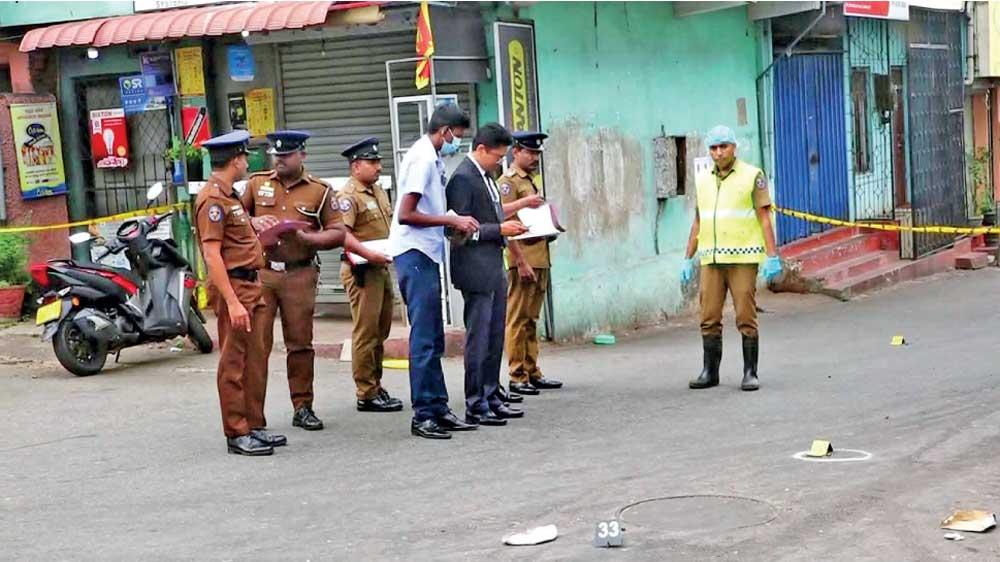
Police inspecting crime scene at Jinthupitiya (file photo)
With 10 shooting incidents claiming the lives of 10 individuals and injuring eight others during the first two months of 2026, people continue to worry a little more about their own security when outdoors. Some of the recent bone-chilling incidents include the murder of a lawyer and his wife in Akuregoda in broad daylight, and a shooting at a salon in Jinthupitiya. CCTV footage of the latter shows how one gunman escapes the scene while accidentally firing his gun again, perhaps due to nervousness. Had it misfired, it may have claimed another innocent life on the street. But according to the Public Security Minister Ananda Wijepala, recent shooting incidents are not a threat to ‘national’ security.
 Small arms proliferation is also a problem in Sri Lanka, which is related to the war. During the armed conflict, successive governments of Sri Lanka armed many paramilitary groups indiscriminately
Ambika Satkunanathan
 Same happened in New Zealand during the Christchurch attack where the government recalled the particular gun, and the government paid owners the value of the gun
Vidya Abhayagunawardena
Urgent call to amend outdated laws
It is clear that at least four acts; Firearms Act No. 22 of 1996, Offensive Weapons Act No. 2 of 2011, Explosives Act and Dangerous Knives Act No. 2 of 1979 requires urgent amendments with regards to fines and penalties.
“Licenses are issued by the Ministry of Defence but penalties and stamp fees are very less and the government should look at amending these acts,” said Vidya Abhayagunawardena, Coordinator for the Forum on Disarmament and Development in Sri Lanka. “When a gun is used by an unauthorised person, the penalty is just Rs. 5000. Under Section 44 (a) the existing penalty is only Rs. 20,000. When there are high penalties and high stamp fees, people may think twice before owning a gun. We need to discourage people from obtaining weapons from the government unless they need it. For some it’s a status symbol. When there is a gun in a house, it’s not a secure place. Besides, we don’t have proper storage facilities,” he told Daily Mirror.
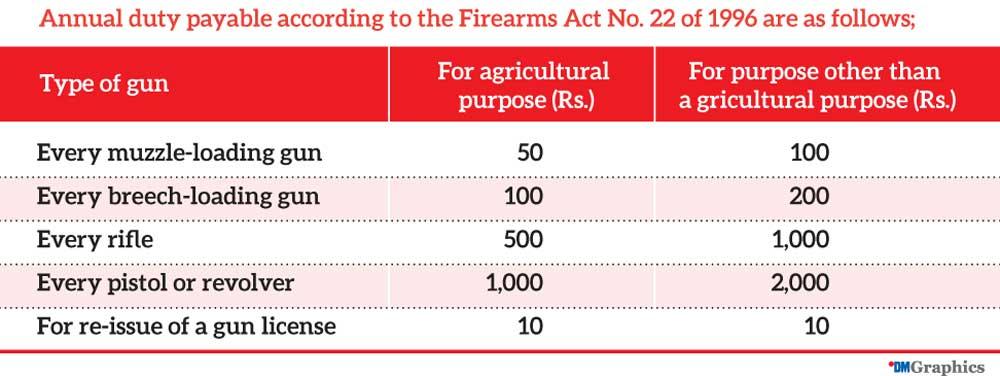
Another important Act is the Offensive Weapons Act No. 2 of 2011 which states that any person who causes injury to any other person with any offensive weapon shall be guilty of an offence not exceeding Rs. 10,000. If a person damages property using an offensive weapon, then again the fine doesn’t exceed Rs. 10,000.
Abhayagunawardena further said that jails are overcrowded and sending people to jail is a burden to the state. “In Sri Lanka and third world countries, suspects tend to reorganise within the jail and one day they will be bailed out. We also don’t have a rehabilitation system for our prisons. In the Sri Lankan context, we evade paying fines and stamp duties. If we are to discipline people in this country, then we need to increase fines. It also increases the country’s revenue and people will be discouraged from commit crimes. The minimum fine for a T56 weapon should be increased to Rs. 500,000. If it involves a crime such as theft, it could go up to Rs. one million. If involved with a murder, it could be Rs. 2 million plus the jail term. If the person is not in a position to pay the fine, then his properties and assets should be transferred to the state. This way, we could discourage people carrying illicit firearms,” he explained.
Abhayagunawardena said that another act that requires urgent amendments is the Explosives (Amendment) Act No. 18 of 2005. In this Act, Section 27 of the principal enactment was amended, increasing the fine for unauthorised possession of explosives to a sum not exceeding Rs. 25,000. But according to Abhayagunawardena, it has to be at least Rs. 500,000.
The Dangerous Knives Act No. 2 of 1979 states that the penalty for wearing a prohibited knife shall not exceed Rs. 50. Penalty for the second offence is Rs. 100. As per the increase of fines act no. 12 of 2005, penalty was increased to Rs. 500. “In Japan, people can buy knives from a shop, but you are not supposed to open it on the spot. If the cover is opened in public the cops can impose a fine of USD 2000 and a jail term. This is the developed world. These four acts relating to firearms, explosives are outdated when it comes to penalties,” he further said.
International gun
control laws
Speaking about the Bondi shooting in Australia, he said that it took only a month for the Australian Parliament to pass new gun control laws. The new laws introduced a national buyback for restricted firearms, require citizenship for gun ownership, and mandate enhanced intelligence-based vetting. “That is the developed world. Same happened in New Zealand during the Christchurch attack where the government recalled the particular gun, and the government paid owners the value of the gun. Then they banned the particular gun and passed the laws,” he added.
“In 2009 the then government dismantled the National Commission on the Proliferation of Illicit Small Arms. When there are vested interests by government entities it is difficult continue such initiatives. Successive governments have failed to take a holistic approach to discourage the distribution of illicit small arms in the country. We don’t see any comprehensive discussions. From amending the previously mentioned Acts to re-establishing the Small Arms Commission are the immediate remedies that could be taken. Back then, the Commission conducted a programme to destroy all recovered illicit firearms at Independence Square,” he added.
Threat to human security
Abhayagunawardena further said that the incidents taking place around the country are beyond national security for us. “It is a threat on human security. We had a threat on national security until 2009 during the armed conflict. The country is now opening up for tourists, foreign investments. But we see local businesses being attacked, and with the drug mafia these issues may escalate. When there are drug hauls you always find automatic weapons,” he said.
He noted that Sri Lanka cannot achieve this task alone, and therefore international and financial support is required to some extent. “So far, no governments have shown any interest to eradicate the proliferation of illicit small arms. We are requesting this government to re-establish this Commission. We have no issues with national security right now.
“We are asking the government to have a public consultation on the matter. The FDD sent a letter to the President in January 2024 highlighting these issues, and we got a response from the Presidential Secretariat in May 2025. We met with some senior officials at the Presidential secretariat and the Central Crimes Bureau at the police department. The way forward is that while amending the aforementioned laws, the government should engage with two international instruments -- UN Programme on Proliferation of Illicit Small Arms and acceding to the Arms Trade Treaty,” he underscored.
More issues with small arms proliferation
According to Ambika Satkunanathan, lawyer and former Commissioner of the Human Rights Commission of Sri Lanka, recent murders through the use of firearms aren’t new. “Research will show that a spate of drive by shootings and assassinations have taken place at different times during the last decade and a half. Such killings are related to shifts of power within organised crime. Shifts of power within organised crime take place when a government begins to crack down on organized crime and/or when organised crime groups change alignment with power centres,” she said.
“Small arms proliferation is also a problem in Sri Lanka, which is related to the war. During the armed conflict, successive governments of Sri Lanka armed many paramilitary groups indiscriminately. There was no record or control of the arms that passed hands. This is evidenced by instances where weapons that were officially issued to state entities have been used in killings. Hence, outdated laws aren’t the core problem, and increasing fines is not going to shrink the small arms market or reduce easy accessibility to weapons,” Satkunanathan told Daily Mirror.
She further said that safeguarding people’s lives requires addressing the small arms market. “It is equally important to tackle corruption within state entities because organised crime and the small arms market cannot thrive without the support of state officials,” she underscored.
Ongoing operations
by the Police
When contacted, a senior officer at the Police Media Division said that the Police are conducting daily crime operations, intelligence operations, road blocks and mobile patrols around the clock to minimise such incidents and to safeguard people’s security.
Several attempts to contact Public Security and Parliamentary Affairs Deputy Minister Sunil Watagala to inquire about amendments made to penalties and fines in existing laws proved futile.