Reply To:
Name - Reply Comment
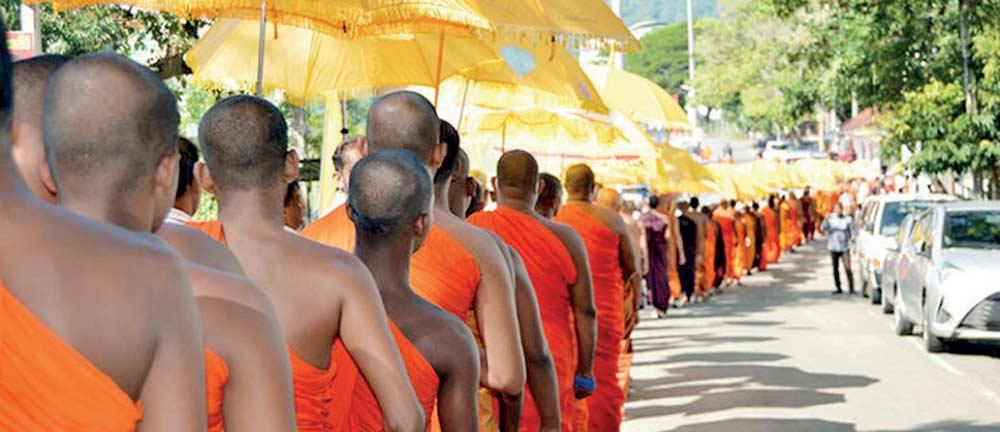
Buddhist monks await in line to attend a conference in Kurunegala
 As expressed in the Dhammapada: “A bhikkhu restrained in all senses is freed from all ill.” How, then, can one, who is full of covetousness and greed, truly be a bhikkhu?

As a Buddhist, I write this piece motivated by a sincere desire to protect the Dhamma. It is essential to clarify that my intention is not to denounce the entire monastic community. Many Buddhist monks live in accordance with the Vinaya rules, embodying the teachings of the Buddha.
Buddhism transcends conventional religious boundaries; it represents a profound way of life and a guiding philosophy. Central to Buddhist thought is the understanding that all living beings are ensnared in the continuous cycle of birth, death, and rebirth, known as samsara. Within this cycle, human existence is regarded as a rare and precious opportunity.
Buddhism teaches that a true comprehension of our existence requires discerning the roots of our suffering, which often stem from attachment, ignorance, and desire. Through deep awareness of these factors, we can embark on the journey toward liberation, or Nirvana, where suffering ceases to exist.
The Bhikkhus, or the Sangha (the community of monks), form the third component of the Triple Gem in Buddhism. They play a crucial role in protecting and propagating the Dhamma and are expected to dedicate their lives to this noble pursuit of liberation. By embodying the Buddha’s teachings, they guide lay followers on their spiritual journeys, encouraging the cultivation of mindfulness and compassion in daily life. This interconnected approach fosters the belief that individual liberation ultimately contributes to the greater wellbeing of the community.
The 227 disciplinary rules serve as a moral guide for Bhikkhus, helping them lead disciplined and ethical lives. These rules necessitates the foundation of monastic life; without them, there is no Sangha, and without Sangha, there is no Dhamma. Maintaining the integrity of Buddhist teachings necessitates that both the Dhamma (the truth) and the Vinaya (the code of conduct) work hand in hand. A shaven head does not alone mark someone as a samana if they lack morality and lead an immoral life. As expressed in the Dhammapada: “A bhikkhu restrained in all senses is freed from all ill.” How, then, can one, who is full of covetousness and greed, truly be a bhikkhu?
The Sangha community comprises diverse characters, each with distinct motivations for entering monastic life. For some, the monastic path is entering monastic life. For some, the monastic path offers answers to life’s complexities, while others feel an innate calling from childhood, seeking deeper understanding beyond material pursuits. While we may hope for all members to embody the ideals of Buddhism, it is unrealistic to embody the ideals of Buddhism, it is unrealistic to expect perfection. Many monks have not yet attained arahantship and continue to grapple with attachments, desires, anger, jealousy, pride, and selfishness. Nonetheless, they are generally expected to adhere to a minimum standard of Vinaya. The core expectation within the monastic community is strict adherence to fundamental rules of conduct and ethical behaviour, as maintaining basic moral discipline is a non-negotiable element of monastic life.
Buddhism is often celebrated for its emphasis on liberation from suffering and moral discipline. However, it is disheartening to observe that some.
However, it is disheartening to observe that some monks do not embody these ideals in action, thereby undermining the principles they are meant to uphold. Some wayward members engage in behaviours that discredit the entire Sangha community, casting a shadow over its integrity. While many monks strive to guide lay followers along this noble path, a troubling number have strayed from their purpose, becoming entangled in worldly affairs and distracted by wealth, social status, and material pleasures. The possession of luxury items and the adoption of lavish lifestyles have tarnished the reputation of Buddhism.
Moreover, some monks have ventured into the realm of politics, contesting parliamentary elections and, at times, resorting to violence and hate speech. This strays far from their foundational purpose of guiding laypeople along the righteous path. By engaging politically, they risk diluting their spiritual mission and distracting themselves and their followers from the code teachings of mindfulness and compassion. Certain others denounce other religions and ethnicities, encouraging discrimination and violence, spitting out obscenities as shown on many social media platforms. Some engage in vitriolic exchanges and publicly attack their peers with harsh and obscene language, which is not only contrary to the teachings of the Buddha but also tarnishes the image of the Sangha community. Certain others engage in public disputes on social media, resorting to obscene language that undermines the dignity of their role. Some resort to thuggery in scant regard for the Vinaya rules. Instances of financial misconduct, misappropriation of donations meant for charitable initiatives, sexual exploitation, and abuse of power have emerged, tarnishing the credibility of the monastic community. Some monks have claimed to possess supernatural powers, attributed to mystical sources. Furthermore, some monks are accused of maintaining inappropriate relationships with women and families.
Temples, in some instances, have transitioned from sacred places of worship to commercial enterprises, prioritising business activities over spiritual guidance. The presence of astrologers, exorcists, and charlatans garbed in saffron robes, claiming the title of Buddhist monks, has only compounded this concern. People have a lot of expectations of monks. The misconduct of some Buddhist monks is a troubling issue that demands our attention and action. Instead of fostering understanding and compassion, such conduct only breeds division and conflict, which goes against the very essence of what Buddhism represents. These actions run counter to the fundamental principles of Buddhism, which emphasise non-violence (ahimsa), compassion (karuna), and respect for all sentient beings.
In light of these concerns, it is crucial for the Sangha community to reflect on its role and recommit to its spiritual mission. For the sake of Buddhism’s integrity and its followers, both monks and laypeople must work together to uphold the true essence of the Dhamma, fostering a community defined by compassion, wisdom, and ethical conduct.
As we navigate these challenges, let us strive for a Sangha that not only protects but also exemplifies the teachings of the Buddha. Only then can we hope to realise the profound potential of Buddhism as a guiding light for ourselves and our communities.