Reply To:
Name - Reply Comment
 Regime change has been a key constituent part of world politics throughout history, but it went high on the agenda of major world powers since the end of World War II and the creation of a bipolar world order with two superpowers clashing with each other.
The end of this bipolar world with the dismantling of the Soviet Union did not diminish the zeal for regime change. Russia lost its appetite for regime after the Soviet empire in Eastern Europe collapsed. The invasion of Ukraine isn’t about regime change. It’s about territorial demands. Moscow doesn’t care who’s ruling in Kyiv as long its conditions for re-drawing Ukraine’s map are met.
On the other hand, the US and its European allies began a new wave of regime change in the Middle East in the unipolar post-Soviet Union era, attacking Iraq and Libya, putting the old playground of Latin America, where CIA-backed coups rather than direct invasion was the norm, in the shade. This process has been taken to new sinister heights by US President Donald Trump who has not only put Latin America, back on the American agenda. He even wants to invade Greenland and Canada.
 According to the Oxford Learner’s Dictionary, ‘regime change’ refers to the replacement of one government by another, particularly when achieved through military force. It signifies a fundamental change in the system or leadership of a country rather than a routine political transition.
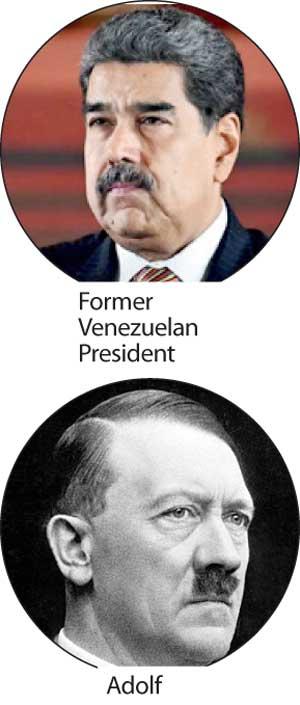
Donald Trump did this by kidnapping the President of Venezuela and his wife but stopping short of putting the Opposition in power, which might have led to civil unrest and disrupted his oil business plan. If we take 20th century precedents, Adolf Hitler brought regime change to Austria by annexing the country, and to Czechoslavakia (Czech Republic) by invading it before he started World War II. His invasion chequerboard was a grand regime change plan with territorial conquest the ultimate goal. Regime change was simply a means to an end.
We can see this phenomenon throughout history, whether its regime change purely for political gains (neutralising a threat and installing a loyal puppet regime in its place), or with the greater goal of territorial conquest. When the Portuguese sent an army to Kandy with their protégé Konappu Bandara (later King Wimaladharmasuriya I) along with heir-to-the-throne Kusumasana Devi, the idea was regime change in Kandy amenable to Portuguese interests along with territorial conquests. That plan backfired. When Kandyan nobles conspired against their king Sri Wickrama Rajasinghe in 1815, their idea was regime change without losing territorial independence. That plan backfired, too.
Now back to our own times. Both the US and Britain realised regime change in Iran by creating civil unrest and a coup in 1953, destroying a liberal, democratic government and replacing it with a dictatorship. The US has destroyed democracies in Latin America (the last to suffer a CIA coup was Chile). South Vietnam was a key Asian ally of the US in the 1960s, but in 1963 the CIA ousted President Ngo Dinh Diem in a coup which killed him.
Dinh Diem was a ruthless dictator. This brings us to a vital question: Is regime change warranted when the leader (often synonymous with the government, too, in such cases) is bad, or rotten, or downright evil? Do the bigger powers have a moral obligation to remove such people and introduce better governance? The regime changers always take the moral high ground. But it soon becomes obvious that the real reasons of coups and wars to induce regime change are more mundane, often tied to strategic economic and geopolitical interests.
The Republican US and ‘New Labour’ Britain conspired together to remove Iraq’s dictator Saddam Hussein. This was a straightforward plan to control Iraq’s oil by the George W. Bush-Tony Blair partnership, backed by the docile 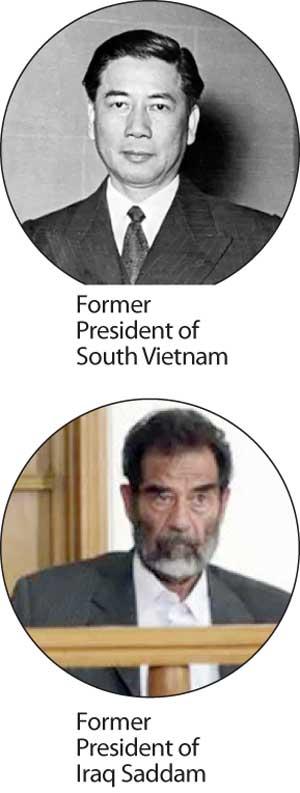 European Union. Saddam played into their hands by invading Kuwait. But the resulting military failure left him a spent force, and his days as a military adventurer were over. But the US and its European allies saw a golden chance to deliver the coup de grace. The excuse they needed to invade Iraq came out of a blatant lie, that Iraq was building ‘weapons of mass destruction’ (in other words, nuclear bombs).
After Iraq was invaded and Saddam Hussein was removed, UN inspectors found that Iraq was nowhere near building a nuclear bomb. But such lies have become the norm for removing leaders not amenable to US and European interests. When he sent American forces to kidnap President Nicolas Maduro of Venezuela and his wife Celia Flores, US President Donald Trump said his goal was to stop the flow of narcotics to the US through Venezuela. This too, is a blatant lie. Ex-president Maduro is not a drug trafficker, and narcotics flow to the US via Mexico, not Venezuela. The goal was to take control of Veneuzuela’s nationalised oil industry while carrying out ‘soft’ regime change.
Interestingly, ‘Time’ magazine said in an article after the execution of Saddam Hussein that he was the last in the line of military adventurers such as Adolf Hitler and Benito Mussolini (or indeed Alexander the Great, though history portrays him in a more benign light) and that tradition was now over. How wrong they were. Donald Trump has resumed that tradition in a spectacular fashion.
As for the argument that Maduro was a dictator just like Saddam Hussein, and that Western democracies have a ‘moral obligation’ to remove such evil characters and introduce better governance to their countries simply doesn’t hold water. Donald Trump was just seven years old when Britain conspired with the US to replace liberal democracy in Iran with a brutal dictatorship. In 1973, it replaced left-wing democracy in Chile with a brutal right-wing dictatorship. Saddam Hussein was brutal, but that’s not the reason why he was destroyed.
In fact, if we think of such ‘moral obligations,’ a long list can be made. There are many countries in Africa, Asia the Caribbean and elsewhere suffering from bad governments. If at all, it’s the UN that should be given a mandate to do something about that. But the world doesn’t turn with such fairy-tale scenarios. The ultimate irony is that the US, biggest champion of democracy in the world, is now run by a President who has stepped right out of a 1984-type nightmarish novel where the world is run by a ‘Big Brother’. One can argue that the US needs regime change more than any other country at this moment, but no one dares mention it.
Trump’s regime change agenda started with Venezuela. Iran came next, requiring all-out war. Cuba, too is high on trump’s list. That will require an all-out invasion.
For the sake of argument, let’s see if Cuba needs any regime change, Donald Trump style.