Reply To:
Name - Reply Comment
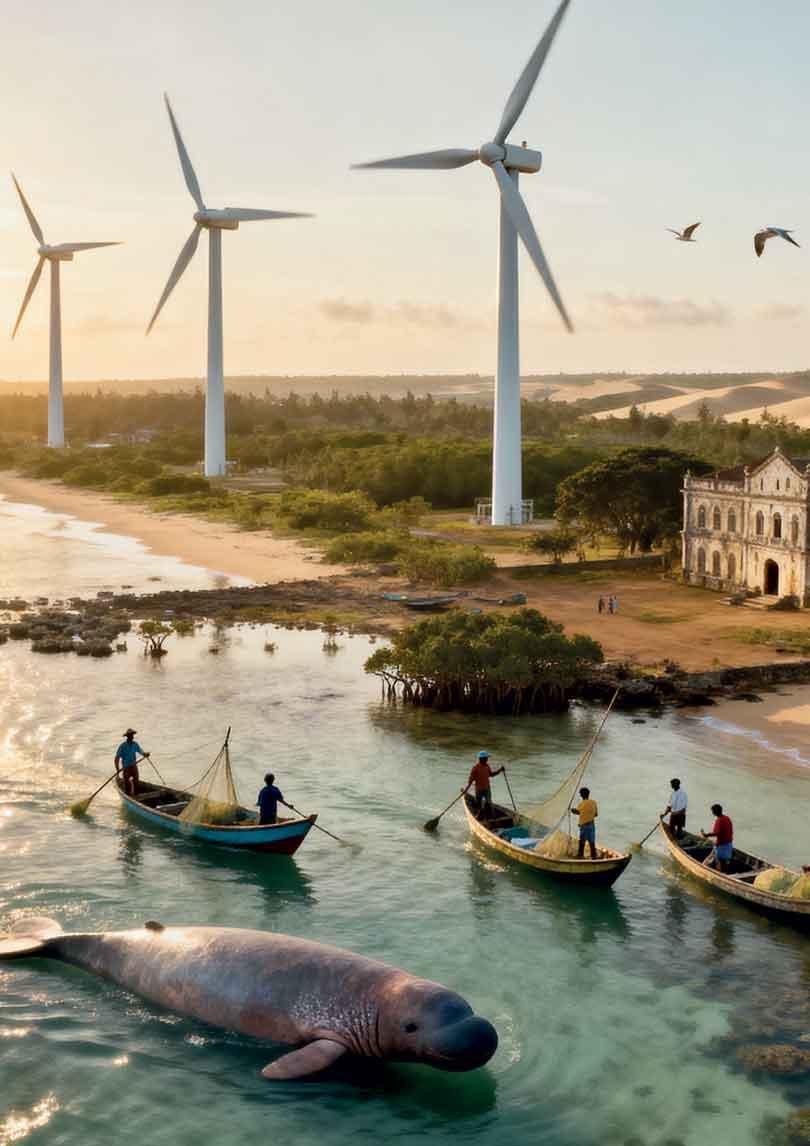
Once a crossroads of empires, Mannar now navigates the promise of wind energy, balancing climate ambitions with the rights and voices
of its coastal
communities.
 Mannar Island, historically a vital trade hub in the Indian Ocean and home to rich marine and cultural heritage, is entering a new era with the Mannar Wind Turbine Project. While the initiative promises renewable energy and national benefits, local residents, primarily fishing communities, have raised concerns over ecological, social, and livelihood impacts.
Historical and Strategic Significance
Mannar, historically, has served as a hub in the Indian Ocean trade network, connecting South Asia with the Roman, Persian, and Arab worlds.
Its natural harbours and rich marine resources, particularly the renowned pearl banks, attracted traders and explorers from as early as the 2nd century CE.
The pearl fisheries contributed substantially to regional wealth and state revenue.
The island was governed by successive powers, including the Naga kings, the Aryachakravarti dynasty of the Jaffna Kingdom, and later European colonial powers. The Portuguese, Dutch, and British each left distinct marks on Mannar’s infrastructure, economy, and cultural landscape. Notably, the British constructed the Mannar Causeway in the early 20th century, permanently linking the island to the mainland.
Mannar’s strategic location also made it a focal point during the Sri Lankan civil war (1983–2009). Its proximity to South India rendered it a key supply route, and the region experienced intense conflict, displacement, and damage to its cultural heritage.
Despite Mannar’s long history of global trade and resource wealth, few signs of its former prosperity remain. Apart from a handful of colonial-era buildings, much of its historical infrastructure has disappeared, likely due to nearly three decades of civil conflict.
A Tamil proverb says “The tree that bears fruit is the one pelted with stones.” This reflects Mannar’s fate: rich in resources, yet heavily exploited and its people often overlooked.
Today, most of Mannar’s population near or under poverty line depends on fishing, with some engaged in agriculture.
Nevertheless, Mannar is ecologically rich, hosting mangroves, sand dunes, scrub forests, coral reefs, and diverse marine ecosystems.
It is a critical stopover for millions of migratory birds along the Asian Flyway and the only Sri Lankan habitat for the endangered dugong (Dugong dugon).
In recent years, Mannar has entered a new phase of development. The Mannar Wind Turbine Project represents a significant step in Sri Lanka’s transition toward promising renewable energy after Hambantota, Puttalam, Palai and Poonahary.
The region’s consistent and strong wind patterns, once vital for maritime trade, are now being planned to be harnessed for sustainable electricity generation.
This project not only contributes to national energy security but also reflects Mannar’s enduring role as a site of strategic resource utilisation.
Wind energy is among the most efficient and eco-friendly power sources, emitting only 11 grams of CO₂ per kWh compared to 510–1170 grams from diesel and 740–1689 grams from coal.
Mannar’s strong, steady winds make it an ideal site for year-round wind power generation. The urgency for such low-carbon solutions arises from rising CO₂ levels, now comparable to those of 500 million years ago, driving climate change and ecosystem disruption. Renewable energy adoption is critical for sustainability.
Public Concerns and Global Parallels
Yet, the implementation of such projects must be carefully evaluated.
If renewable energy developments, such as wind farms, cause ecological damage or harm local communities, their role in combating climate change must be seriously questioned.
While national energy goals are important, they should not come at the expense of the well-being of residents in project areas. Producing electricity for the entire country should not compromise the comfort, health, or livelihoods of those living near the turbines.
The first phase of the Mannar Wind Turbine Project has raised serious concerns about its impact on local livelihoods. Many residents of Mannar Island have questioned whether the project developers adequately considered the social and ecological consequences before installation.
In an era of advanced scientific knowledge and environmental awareness, it is difficult to understand how such concerns could be overlooked.
The protests in Mannar (100th day on 11 Nov) reflect the hardships experienced by the community during the initial phase of the project.
These protests are not isolated. Across the world, wind energy developments have faced resistance from local populations. For example:
In the United Kingdom, protestors in Lossiemouth, Scotland, argued wind turbines would industrialise the scenic coastline, harming the environment and the tourism-dependent local economy.
In the USA Ocean City, New Jersey, protesters placed slogans “stop windmills; save our shore”, on the day of their protest against the installation of wind turbines.
Further the Cape Wind Project, a proposed offshore wind farm was abandoned after 16 years of legal battles and opposition from influential residents concerned about fishing, navigation, and scenic views.
In Norway the protesters with Greta Thunberg forced the Norwegian government to take down 151 turbines in the Fosen region of central Norway that sit on lands that the Saami use for reindeer herding which is a central part of their lifestyle.
In Germany (Bavaria’s 10H Rule) the public opposition led to legislation requiring turbines to be placed at least 10 times their height away from homes, effectively halting new developments in many areas.
The French Academy of Medicine recommended 10h -rule as emissions of infrasound are increasing in proportion with the size of the blades.
In Denmark, the local protesters paralysed major Vattenfall wind farm to abandon what could have become Denmark’s second-largest onshore wind farm.
Further a scientific article titled “Understanding local opposition to renewable energy projects in the Nordic countries: A systematic literature review” highlighted treats the public’s fears, values, and objections as serious, legitimate, and central to the conversation.
It argues that for the green energy transition to be successful and just, policymakers and developers must genuinely listen to and address these public concerns, rather than trying to bypass or overcome them. Mannar Island shares many of these concerns.
As Sri Lanka moves toward low-carbon energy solutions, it is essential to ensure that renewable energy projects do not replicate the same patterns of ecological degradation and social exclusion.
The success of such initiatives depends not only on technical efficiency but also on meaningful community engagement and environmental stewardship.
Environmental Justice
In above mentioned affluent countries, coastal areas are highly valued for scenic beauty, tourism, and real estate. Wealthy residents often influence policy, ensuring any changes, especially those affecting aesthetics or property values.
Even in Colombo, beachfront properties command premium prices, highlighting the economic and aesthetic value placed on coastal access.
This raises a revealing question: Would residents along Marine Drive accept 250-meter-high wind turbines? Likely not, due to fears of visual intrusion, property devaluation, and lifestyle disruption.
In stark contrast, why then are similar concerns dismissed when raised by Mannar’s communities?
Are their cultural and environmental connections to the coast less valid?
Mannar’s coastal zones are home to some of Sri Lanka’s poorest communities, primarily fishing families who depend on the sea for survival.
Lacking political clout, their concerns about environmental impacts are often ignored.
This disparity exposes a double standard in environmental planning, where marginalised landscapes are altered without consent.
It underscores the urgent need to respect local perceptions, ensure inclusive planning, and uphold principles of environmental justice.
Countries like the UK and Norway empower fishing communities, taking their concerns seriously. Sri Lanka must adopt similar principles.
The Mannar Wind Turbine Project highlights this urgency: while renewable energy is vital for climate goals, development must not come at the expense of vulnerable communities.
Projects should guarantee fair distribution of benefits and burdens, meaningful engagement, and recognition of local values, ensuring sustainability and equity go hand in hand.
In September 2022, the then State Minister for Tourism made her first statement after assuming office: to turn dry fish producing Mannar island to a dollar earning night club.
This reflected how the ruling elite viewed a remote, poor community and justified any project under the banner of national development.
In contrast, the new government, with a different outlook, must consult local communities before implementing any national development initiatives.
On November 4, the Sri Lankan Cabinet announced that no future wind turbine projects will proceed on Mannar Island without public consultation.
This decision acknowledges community concerns and marks a shift toward equitable, sustainable energy planning where local voices are respected.
For Mannar, this is the first official recognition of its people’s views. However, consultation alone is not enough. The government must address issues from the first project phase by investigating complaints, clarifying misunderstandings, and providing transparent responses.
These actions will rebuild trust and enable development that benefits both Mannar and the nation.
If project proponents engage in open dialogue, free from hidden agendas, and genuinely consider the needs and concerns of local communities, a win–win outcome is still possible.
This approach should not be limited to Mannar but adopted as a standard for all development projects across Sri Lanka. Public engagement is not optional; it is essential for equitable and sustainable progress.
The government’s recent decision provides an opportunity to win public trust and guide Mannar toward development that serves the common good.
The writer, Dr S. Wijeyamohan, is a Senior Academic at the Department of Bio-Science, Faculty of Applied Sciences, University of Vavuniya