 Kamanthi Wickramasinghe
 Reply To:
Name - Reply Comment
In Sri Lanka, there is no opposition within a local government body. Instead there are councilors and they all sit together. So the concept itself discourages people from fueling divisions among one another. But the main idea is to get together and work towards the betterment of people in their community and to develop plans to upgrade facilities in their wards
During the Presidential Election there were hardly any rejections. During the Parliamentary election there were over 8000 candidates and again there were minimum rejections.
But during a local government election there are more candidates and parties contesting for the seats in a local authority, and as a result there is a tendency to have a high number of rejections. There is a total of 341 local government bodies, and out of them certain Pradeshiya Sabhas such as Elpitiya have conducted their election already. We can’t hold elections as and when we want it
 The upcoming Local Government election is crucial for many reasons. Apart from the fact that it is being held after a hiatus of seven years, local government bodies play a crucial role in engaging the public in the local governance system.
Sri Lanka witnessed a turbulent period in its political history since the last local government election in 2018. Lack of funds to hold elections in subsequent years, lack of finances to print ballot papers and the existing economic crisis discouraged authorities from conducting this important election.
This time, nearly 71,000 candidates are vying for seats in local government bodies. Voters will choose members for 28 Municipal Councils, 36 Urban Councils and 275 Pradeshiya Sabhas. Out of the nearly 71,000 candidates, 8711 members would be elected to these bodies.
Call to transition local governance as an honourary service
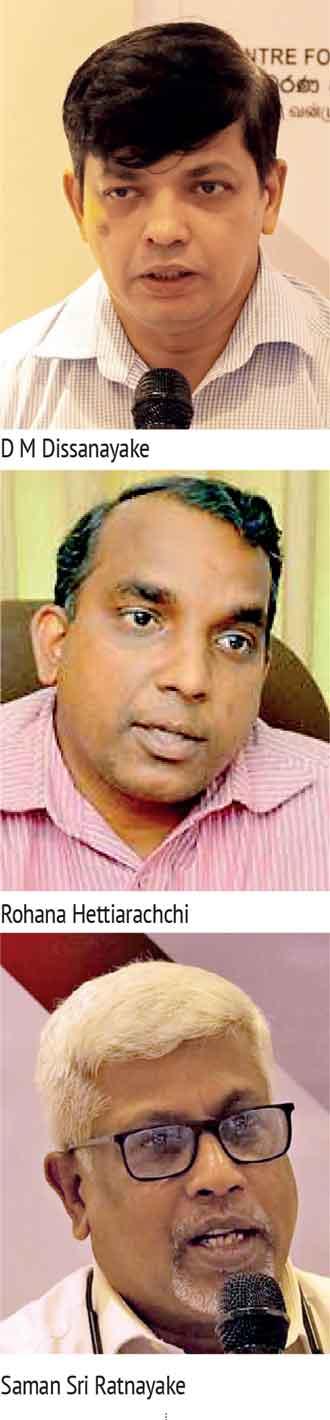
In Sri Lanka, it is common to hear people referring to the local government election as the ‘Little Election’. “But the local government election is the only doorway for people to directly engage with governance,” said D. M Dissanayake, attorney-at-law and Chief of Operations at the Centre for Monitoring Election Violence.
“It is impossible for people to engage in governance via the Executive, Parliament or Legislature. Local governance focuses on the daily needs of people. Therefore, obtaining feedback from people and conducting a local government election according to the feedback from people is paramount.”
He said that in a country like Sri Lanka, local government bodies could do much more service than provincial councils.
“In most countries, it is the local government bodies that provide facilities to people such as metro systems, housing, primary education and other services. Therefore we need to look at streamlining local government bodies to work closely with people and to strengthen these bodies effectively. On the other hand, the functioning of a local government system is crucial for a pluralistic country like Sri Lanka because these bodies could always cater to different identities and promote inclusivity and diversity. Therefore the local government system is a fundamental element of a pluralistic society,” Dissanayake added.
However, the issue at hand is with regards to the type of individuals who get elected to local government bodies. According to Dissanayake, local governance should be transitioned to be an honourary service. He said that it should go beyond party politics or a job that someone does expecting money at the end of the day. Rather, it should be a mechanism to engage people in governance.
“In Sri Lanka, there is no opposition within a local government body. Instead there are councilors and they all sit together. So the concept itself discourages people from fueling divisions among one another. But the main idea is to get together and work towards the betterment of people in their community and to develop plans to upgrade facilities in their wards,” he said.
Example of Bangladesh
The existing local government election is the only method in which we elect councilors to local government bodies. “This time, there were over 200 rejections for nominations, but I believe that nominations shouldn’t be governed by strict laws. If there are errors in the nomination paper, a candidate should have the opportunity to correct the errors and resubmit it. There are grounds to reject a nomination paper in the event that a candidate has evaded taxes or hasn’t paid his utility bills. But the prevailing law doesn’t consider any of these grounds. In a country like Bangladesh, if you haven’t paid your taxes or haven’t settled your utility bills, you can’t contest for an election.
“But in Sri Lanka, even if there are corruption charges filed against an individual which haven’t been proved in courts, that individual could still contest at an election. These are issues that need to be rectified. However, I believe that nominations shouldn’t be rejected due to the failure to submit a true copy of a birth certificate or due to an error in the ID number. The nomination process should be made a bit lenient to encourage new contestants,” he opined.
He further explained about the divisions made within local government bodies due to the mixed representation system since 2012. “There should be a mechanism to discourage such divisions within local government bodies, basically to do away with party politics,” Dissanayake continued. “Since councilors are elected based on their political parties, there is a competition to gain overall power over the local government body. However there are challenges in getting one political party to have control over the local government body due to the prevailing mixed representation system. Even if one party wins all the wards but has fewer candidates, those candidates from defeated parties still have a chance as they could enter from the list. Therefore, even if one party wins all the wards they can’t gain overall power over the local government body,” he explained.
Dissanayake further said that these loopholes need to be rectified by bringing in necessary amendments. On the other hand, when it comes to female candidates, even if they get elected they don’t have provisions to show their performance. He added that if female candidates are being treated differently, legal intervention should be sought to ensure that all candidates are being treated equally.
Significance of your local government authority
Speaking about the significance of a local government authority, Rohana Hettiarachchi, Executive Director of People’s Action for Free and Fair Elections said that one cannot compare the importance of a local government election with that of a Presidential or Parliamentary election. “The local government is a separate unit which is fully empowered legally and financially. What we experience is that local government bodies engage in cleaning, garbage clearing, fixing drains, lighting up the streets etc. But according to the law, a local government body could provide services from the time a person is born until his death.
“It could also initiate factories, schools, transport services, generate employment. They could intervene to uplift the livelihoods of people in their wards. They can even introduce laws. Usually it is only the central government that could formulate laws and local councils could draft by-laws. In Sri Lanka, local government bodies could earn and spend and it could operate as a business model,” Dissanayake clarified further.
Therefore, if a political party or independent group nominates a creative group of individuals to utilise the power vested upon them through a local government body, they certainly have the potential to make a change within their ward.
“It all depends on their vision and commitment. If someone from the opposition assumes power in a local government body and in the event that he’s a creative individual and if he could bring in the resources with the approval of the central government then there’s potential to make a change. There are over 100 local government bodies that are totally independent. The central government would only allocate finances to certain local government bodies that cannot self sustain. Therefore you can’t undermine or undervalue the local authority,” he emphasised.
Impact of people’s political illiteracy on the upcoming polls
Speaking at a recent event organised by the Sri Lanka Press Association, Elections Commissioner Saman Sri Ratnayake said that one of the main reasons for people’s political illiteracy is due to lapses within the formal education system.
“Subjects such as civic engagement and participation, politics and democracy are not included in our education system. It is a voluntary subject. This subject includes lessons about the Constitution, fundamental rights of citizens and other topics. We made many attempts to include these subjects into the school curricula, but these attempts have proved futile.
“However work is in progress to include a subject on elections and the electoral system into the Grade 8 curriculum. The primary education system doesn’t include these subjects and as a result this task has been vested upon journalists to inform the public about the importance of an electoral system, elections and civic participation and engagement. The media has a huge role to fill gaps that have been created by irregularities that persist within the formal education system,” he said.
Ratnayake further said that in order to contest an election, candidates from independent groups should have a basic knowledge about politics or those who represent a political party. “Therefore we can have a better understanding with these individuals. During the Presidential Election there were hardly any rejections. During the Parliamentary election there were over 8000 candidates and again there were minimum rejections. But during a local government election there are more candidates and parties contesting for the seats in a local authority, and as a result there is a tendency to have a high number of rejections. There is a total of 341 local government bodies, and out of them certain Pradeshiya Sabhas such as Elpitiya have conducted their election already. We can’t hold elections as and when we want it. The Minister for Local Government should issue a gazette stating that 339 local government bodies are ready to have their election to elect the new council. We received 2922 nomination papers and out of them 423 were rejected,” he said.
According to Ratnayake, one of the main reasons for rejecting nomination papers was because many of them didn’t include the party leader’s signature. “We don’t reject nominations based on our biases. The local government election is conducted as per provisions included in the Local Authorities Elections (Amendment) Act No. 16 of 2017. This Act has been amended several times. Everything from the format of the nomination paper has been gazetted and we include all regulations and guidelines to minimise rejections.
“Section 28 of the Local Authorities Elections Ordinance includes reasons to reject nominations. Sometimes representatives bring nomination papers after the deadline. They are given 14 days to prepare and submit nomination papers. How could they organise themselves in a council if they cannot be punctual and stick to deadlines? They also have to submit an affidavit signed by a Justice of Peace. An election is a Constitutional process and therefore we have to abide by the law. Failure to submit certified copies of the birth certificate is another common reason to reject nominations. Therefore this shows that there’s a huge issue with regards to political illiteracy,” he added.
Regarding the rejection of nominations, 208 cases were filed in the Supreme Court by rejected candidates and their parties, out of which approximately 132 were re-accepted.