AI SUMMARY GENERATED ONLY FROM THIS ARTICLE'S TEXT.
Manta rays
Sahan Thilakaratna
By Tahaan Jayewardene
Sri Lanka’s manta rays, the largest of the ray family, face grave threats from overfishing, bycatch, and international gill plate trade despite their vital ecological role. Experts warn their slow reproduction makes them especially vulnerable, while neglect and lack of awareness have left conservation efforts lagging. Protecting these endangered giants is crucial for biodiversity and Sri Lanka’s global reputation.
Unknown and neglected, are the words that best describe these gentle giants and great graceful birds of our oceans. Yesterday, 17th of September, we celebrated World Manta Day.
These enigmatic creatures and gentle giants of the sea are endangered and at risk in our waters. Experts and activists alike, highlight the grave threats faced by these species as well as other more common ray species in Sri Lanka.
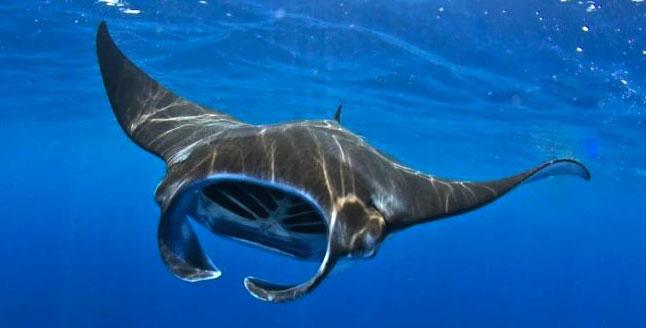
The Sri Lankan oceans are home to the oceanic manta ray, the largest ray species in the world. These endangered and vulnerable species need to be protected in our waters, as their mainly killed for their flesh (or gill plates) and exported to countries such as China.
Manta’s Matter
Manta rays, with their large triangular pectoral fins and two horn-like projections on the side of their heads, are large rays whose beauty and graceful flapping of wing-like fins, are elegantly described by Dr. Jagath Gunawardana, Attorney at Law and environmental activist, as large birds flying underwater.
Though they are very large and have a mouth that helps them feed on planktonic forms, they are harmless species, that come to the bottom of the food chain when it comes to their feeding habits, adds Dr. Gunawardana.
This places them in a unique position on the food chain; they are huge creatures and yet depend on the smallest creatures in the ocean. He mentions that the true ecological services provided by manta rays are still not fully understood.
According to Marine Biologist at Ocean Rosy Sahan Thilakaratna the manta ray was found to dive between 100 to 1000 meters and as they return to the surface, they defecate and bring back crucial nutrients. These are essential for the growth of phytoplankton, the primary producers of marine ecosystems.
“The natural life cycle of mobulid rays not only supports biodiversity but also plays a small yet meaningful role in regulating the ocean’s capacity to absorb carbon, indirectly helping mitigate global warming,” he adds.
He says even after they die due to natural cause, the carcasses of mobulid rays support entire communities of deep-sea scavengers; “A real blue circle of life to prevent global warming.”
Sri Lankan rays
Mr. Thilakaratna mentions that both manta rays and devil ray species belonging to the genus Mobula.
According to research conducted by the Ocean Rosy organization, since 2022 Sri Lankan coastal waters are home to the Oceanic manta ray and five species of Devil rays (the spinetail devil ray, sickelfin devil ray, shorthorned pygmy devil ray, bentfin devil ray, and Longhorned pygmy devil ray).
He adds that among these, the spinetail devil ray, is the most common and most frequently harvested species, and “all these species face significant threats due to their low reproductive rates, making them particularly vulnerable to overexploitation.”
He says that compared with tuna and other fish species that produce millions of eggs per spawning (And two to three spawning per year), manta rays produce one pup once every two to five years, “making them far more vulnerable to fishing pressures.” For this reason, he mentions the need for a regulatory mechanism for manta fisheries.
“The giant manta ray is the world’s largest ray with a wingspan of up to 26 feet. They are filter feeders and eat large quantities of zooplankton. Giant manta rays are slow growing, migratory animals with small, highly fragmented populations that are sparsely distributed across the world.” - National Oceanic and Atmospheric Administration .
Threats
According to activities negatively impacting mobulid populations, Sri Lanka was included in the high priority level (of which 14 countries out of 75 were identified), according to a 2024 study titled, Global Assessment of Manta and Devil Ray gill plate and meat trade: conservation implications and opportunities.
The high priority group, including Sri Lanka, exhibited the characteristics; moderate to high level of mobulid landings as targeted or retained bycatch, involvement in the gill plate trade and involvement in meat consumption and/or meat trade, according to the study.
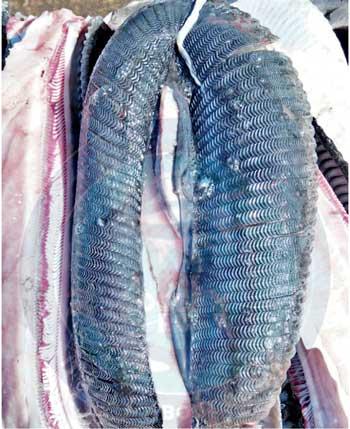
The 2024 study introduces this issue by saying “some of the largest reported mobulid fisheries in the world include Sri Lanka, Indonesia, and Bangladesh,” adding, “in recent decades, a supply chain expansion driven by demand for the dried prebranchial appendages of mobulids (commonly called gill plates or gill rakers) led to a drastic increase of international trade into key hubs in Asia.
Gill plate
“We have not given any value to these species,” said Dr. Gunawardana, explaining that there is a large export market for a specific part of the species gills.
“They are fished for both their flesh and, more importantly for their gill rakers [Or gill plates], the part of the gills used to filter plankton to feed, he adds. This “is a delicacy in the far eastern countries especially in China and Hong Kong.”
“In Sri Lankan waters, manta rays are mostly caught as bycatch in the tuna gillnet fishery operating in offshore waters and on the high seas,” Mr. Thilakaratna explained
He adds that Sri Lankan multiday boats operating in offshore and international waters primarily use tuna gillnets and tuna longlines (targeting valuable species such as yellowfin tuna), however fisheries (especially gillnet fisheries), incidentally catch mobulids (and small cetaceans, dolphins, turtles, and sharks) as bycatch. He adds, while fishers often release small cetaceans and turtles, but typically retain sharks and mobulids due to the high international demand for their gill plates.
“Manta rays are primarily killed for their valuable gill plates, which are exported to markets in China, Singapore, and Hong Kong, as some Chinese believe they have medicinal properties,” Mr. Thilakaratna said.
There are practical issues, which he explained, that according to interviews with many tuna gillnet fishers, they prefer not to harvest manta rays due to their extremely rough skin, and the inconvenience of their large size.
He says that for these reasons, only a few local fishers actively target manta rays, however there is a high bycatch rate of the devil ray species, known as the spinetail devil ray.
Sri Lankan Reputation
“Declining population trends and their life history vulnerabilities have resulted in seven mobulid species being listed as Endangered on the International Union for the Conservation of Nature’s (IUCN) Red List of Threatened Species,” mentions the 2024 study.
IUCN Red List of Threatened Species
The oceanic manta ray
The sicklefin devil ray
The spinetail devil ray
The bentfin devil ray
The longhorned pygmy devil ray
The shorthorned pygmy devil ray
The Atlantic pygmy devil ray
It adds, “Since 2017, when international trade in all mobulid species was regulated, each of the nine manta and devil ray’s species have either moved up the threat status level on the IUCN Red List of Threatened Species or remained in a threatened category (IUCN 2024).”
Dr Gunawardana also mentions that we have an obligation and duty under the Convention on Biological Diversity to protect all species of animals and plants that are threatened.
He adds that the Convention on the Conservation of Migratory Species of Wild Animals (or the CMS Convention), under which certain species that migrate between waters need international protection, means that we are bound to protect Manta rays within our waters.
“Which we have not done,” said Dr. Gunawardana.
He also points out that this is negatively impacting Sri Lanka’s reputation internationally.
Mr. Thilakaratna said, “many mobulids are highly migratory species.
Therefore, our national policy framework should be aligned with those of neighboring countries in the region. This calls for a collaborative regional effort to conserve these highly migratory stocks.”
Neglected Manta
Many people are unaware of these species, their beauty, and their unique role in the ocean’s ecosystem. This lack of awareness means that Sri Lankan marine biologists and environmental activists are tasked with not only working to protect these species, but also to convince people and even governments, why they matter.
Tied with the ecological contributions, the impact on our reputation is an imminent concern.
The conservation of endangered species, though prioritized for some more familiar animals like elephants or even turtles, are often neglected in species like the manta ray.
Why is that? Is it the lack of familiarity and awareness? Is it the lack of regulation and legal protection? Or is it the profit incentive that these species unintentionally create?
Comments - 1
Comments - Unknown and neglected - the enigmatic Manta Ray
Fricky Thursday, 18 September 2025 02:31 PM
Isn't is possible to introduce them to Beira Lake in order to consume the plankton and clear the stench??
01
222
Add comment
Comments will be edited (grammar, spelling and slang) and authorized at the discretion of Daily Mirror online. The website also has the right not to publish selected comments.