Reply To:
Name - Reply Comment
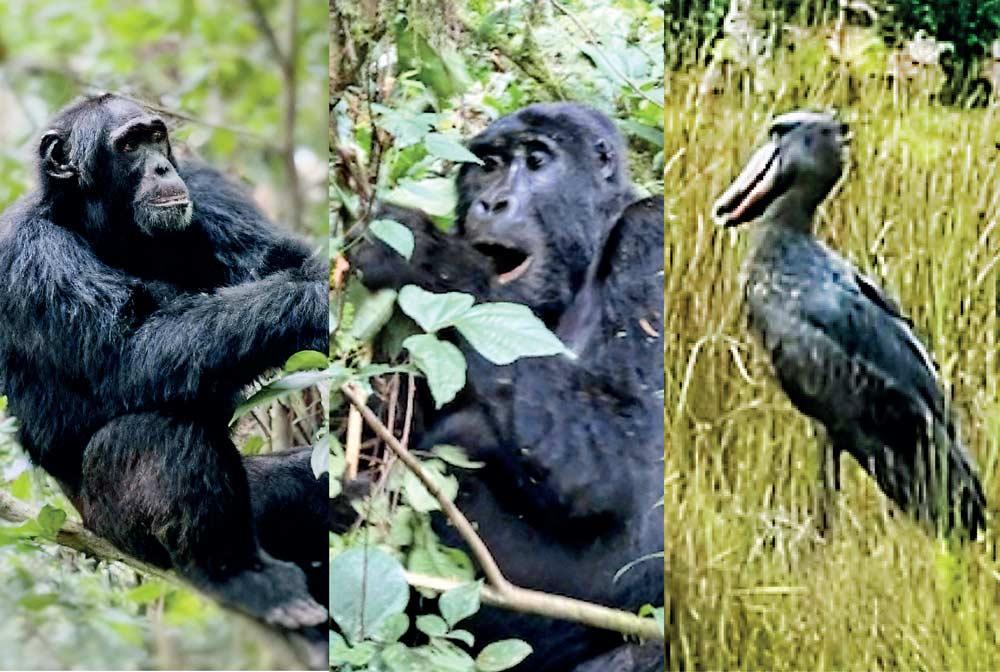
 “Tracking the silverback gorilla, I felt the humbling presence of a creature so closely related to humans, aware of our gaze yet commanding respect, reminding us of the delicate balance between observation and intrusion in the wild.”
“In Kibale, chimps swung overhead with astonishing agility, their loud hoots announcing territories, while babies clung to their mothers, demonstrating complex social hierarchies and behaviours that mirror our own in fascinating, sometimes violent ways.”
“The dense jungle of Bwindi was alive with elephants, antelopes, and snakes, each step in the thick undergrowth revealing nature’s choreography and the challenges of tracking elusive, endangered species while respecting stringent conservation rules.”
“Murchison Falls roared in magnificent power, as hippos wallowed and elephants approached the river, reminding us how water shapes life and sustains a breathtaking diversity of birds and mammals in one of Africa’s most iconic national parks.”
“The rare Shoebill Stork in Mabamba Swamp captivated us with its prehistoric appearance and hunting prowess, highlighting the vulnerability of certain species and the importance of preserving wetlands that serve as vital habitats for extraordinary wildlife.”
By Premala de Mel
A journey through Rwanda and Uganda brings wildlife enthusiasts face-to-face with some of Africa’s most remarkable creatures. From the misty jungles of Bwindi, home to the rare mountain gorillas, to Kibale’s energetic chimpanzees, and the thundering waters of Murchison Falls, this expedition blends adventure, conservation, and cultural insight. Guided by expert rangers, travelers witness intricate animal behaviour, scenic rivers, and vulnerable species, experiencing both the majesty and fragility of East Africa’s ecosystems.
A group of wild life enthusiasts and I flew into Kigali, Rwanda with an organised tour by Classic Wild. We drove in Land Rovers to the Ugandan border.
Rwanda has a population of 13 million.
The country has made great strides economically, since its earlier upheavals and every month a day is designated for the citizens to clean their area. There are no high rises or tuk tuks. English and French are the principal languages and agriculture and tourism are some of the sources of revenue.
Uganda is landlocked and has a population of 46 million with 56 tribes and 5 kingdoms. However, the President is the head. Elections are to be held next year and the incumbent has been in power for forty years.
The main languages are English, French and Swahili. Education and Health care are not free and I saw a number of children not attending school. The country’s economy is agricultural with coffee, tea, cotton and other crops. Christianity is the major religion followed by Islam and traditional tribal practices.
Bwindi Impenetrable National Park in the south west was our next stop to see the Muyambi mountain gorilla family assigned to us. We were entertained to a Masai dance by the ladies.
Our group participated in the dancing. Sam, our knowledgeable ranger said that the apes chosen for our trek are familiar with humans and limited numbers are assigned to see the gorillas daily. Prior to the foray, we were told how to behave when sighting the apes. Eye contact is avoided and kneeling suggested, if the ape moves in our direction.
A distance of 5 ft. must be maintained and masks are mandatory, since apes share 98 percent of our DNA and are susceptible to illnesses. Flash photography is disallowed. The jungle is dense with 96 wild elephants (2019 census.)
Sam, with a military escort and hired porters to carry our backpacks, led us to a point in the dense jungle. An African helicopter for a fee is available. To find the family of seven mountain gorillas that had moved took an hour and a half.
Sam briefed us that the other animals to be found in the jungle were antelopes, four types of monkeys, elephants, and snakes. A short walk is three hours. Suitable clothing is advised but not camouflage.
Carrying water, electrolytes, and a snack is advisable but nothing can be discarded in the jungle. If toilet facilities are required holes are dug and covered. We were advised to keep our voices low. Sam kept questioning our knowledge of the apes, as well as educating the porters.
The dominant male silver back matures at the age of 12 with his back turning silver and he is the leader. There are challenges from emerging males.
A female entices the male to mate after the age of six and pregnancy is 8 ½ months. Whilst feeding the baby, the mother will not mate. The life span of a gorilla is fifty years. The gorillas feed on the vegetation and get their supply of water from the plants. At night they prepare a nest of leaves to sleep.
The Batwa tribe now rehabilitated at the fringe of the forest to prevent poaching are involved in conservation.
There are 1,063 gorillas in Rwanda, Uganda and the Congo. Three hundred are familiar with humans and the rest wild. The day is spent foraging for 25 kilos of food. They have large bellies and when standing could be about 5 ft. 6”. The apes are known to mourn for the dead.
A mother may carry her dead baby around for months. There are stringent laws in place for breaking trekking rules, poaching and hunting these endangered animals with life sentences for some offences.
We observed a male aged 11 on the ground feeding. His arms have a span of 8 ft. and he grunted on seeing us. The young male made a move to walk ahead, and I bowed to indicate that I was not confrontational.
The silver back on hearing us had climbed the tree followed by his family. To thwart him we left the area and when we returned he was on the ground with the family. We watched the apes for over an hour.
We drove to Kibale to see the chimps. There are 5,000 chimps in Uganda. They live in communities and are territorial. Their enemies are other troops, who even murder for feeding grounds.
At the centre, we were greeted with the traditional dances and assigned rangers, hired porters for our three-hour walk in the dense tropical rain forest to see the family of 120 chimpanzees.
Chimps move fast and it took time to locate them. An isolated chimp hooting to find his family led us to where they were perched on the trees. The noise of loud hooting and the crashing of branches greeted us as they swung overhead and we saw a baby clinging to her mother’s back. The hierarchy feast at the top and the practice continues when hunting. A small group had killed a duiker, whilst others sat by for the spoils. Chimps are closest to humans (DNA 98.7) and we wore masks and kept a distance of 8 metres.
Two chimps walked past me. Strict rules whilst in the forest were given with no eating in their presence, no flash photography, no mimicking, speaking softly and sticking to the group. Chimps are carnivorous and meat a treat. In the forest we found the piths of the discarded fruit eaten. They hunt when they are well fed and battles are fought for territory. Bonds are established and grooming is part of the experience. One hour is the time limit.
A drive of eight hours took us to the Murchison Falls National Park in the north west. We drove in the park and boated down the Victoria Nile river. Hippos wallowed in the water.
A herd of African elephants edged towards the water. Birds flew overhead amongst the birds were the pied king fisher, great heron, African darter, Abyssinian geese, the red throated bee-eater and the malachite king fisher.
We boated near the bottom of the massive waterfall and the next day visited the source where the river thunders and sprays through a narrow 7 metre wide gorge to cascade 43 metres into a turbulent pool.
Driving in the park we saw a lioness and her cubs, herds of elephants, the Rothschild giraffe, antelope’s waterbuck, warthogs, troops of baboons, colobus and patas monkeys.
We concluded our tour with a two-hour boat ride to the Mabamba swamp, on Lake Victoria to see the vulnerable Shoe Bill Stork only a limited number remain. We were lucky to observe the stork with its strange beak before it took flight. The bird eats eels, catfish, water snakes and small crocodiles.