Reply To:
Name - Reply Comment
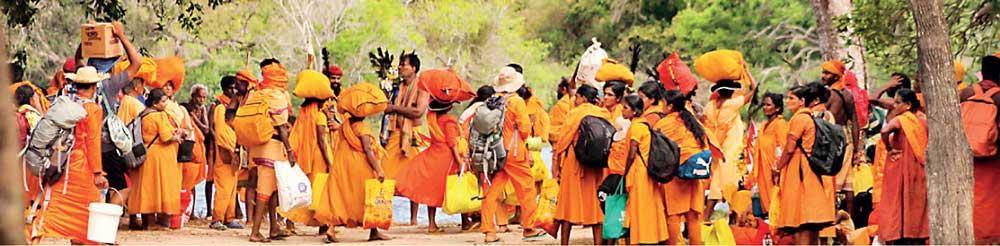
Pilgrims on foot take part in the Pada Yatra
 By Nayanajeewa Bandara
Pada Yatra pilgrimage or the journey by foot from the North and East and the hill country to attend Ruhunu Kataragama Maha Devala Esala Festival has a long history that dates back as far as the ancient times History has recorded that during the reign of Buwanekabahu IV, who ruled in Gampola, bands of pilgrims from India had ferried by sea to the North and from there proceeded by foot to Kataragama through thick jungles teeming with wild beasts. The Ola leaf manuscripts in Aluthnuwara Kataragama Devala and the legends bear evidence to it.
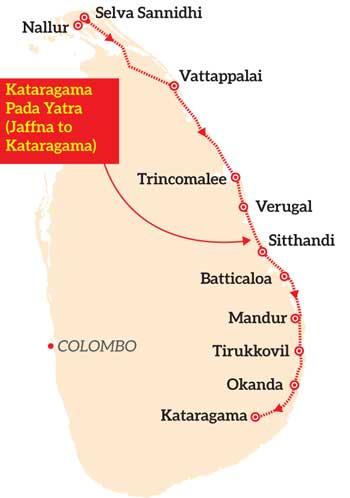
Although the journey by foot from the main entrance of Kumana National Park is considered as Pada Yatra, in fact, the pilgrims set off from far-flung areas of the North and East and the hill country, about two months prior to the opening of the Kumana National Park to facilitate the trek. The pilgrims from the North usually set off from Selva Sannidhi Kovil in Jaffna. The pilgrims from the North and East trek through Trincomalee, Batticaloa, Ampara, Potuvil and Panama and stay at Okanda Hindu Kovil and wait for the opening of Kumana National Park.
According to legend, Lord Skanda, who arrived from India to meet Valli Amma, had landed ashore near Okanda, which later turned into a sacred area with a Kovil being built. The pilgrims on the Pada Yatra journey remain at Oakanda for two days and attend prayer sessions seeking protection for the pilgrimage, which is made through thick jungle. The pilgrims journeying through Kumana and Yala National Parks take about five days to approach the sacred city of Kataragama.
S. Vivekananda Rajah (48), Zonal Director of Education in Thirukkovila area, is a scholar who has conducted a thorough study on the subject of Pada Yatra.
He said that in the past, thousands of devotees from India had visited the shrine in Kataragama to attend religious observances.
“Tamils believe that Arunagirinatha, a famous poet in India in the 14 century AD, had made a journey by foot from Jaffna along the coastal belt to arrive in Kataragama to perform religious rites. Hindus vindicate it by the existence of two Thiruppugal poems recited by him at Koneswaram Kovil in Trincomalee during his visit and his poems on Kataragama and Wedihitikanda,” Rajah said.
Although the Pada Yatra journey by foot coincides with the annual Esala festival in Ruhunu Kataragama Maha Devala, the trekking through the jungles has been a custom since the past that demonstrates the devotion of Hindus’ in paying reverence to God Skanda. Even at present, Pada Yatra remains as a colourful cultural pageant at which people of different communities and faiths participate.
However, there are occasions when certain individuals who join the Pada Yatra seek pleasures and in the process mar the serenity of the jungle and also cause extensive environmental damage.
.“About two months prior to the journey, devotees strictly adhere to a series of rituals. They survive purely on a vegetarian diet. There is a sub culture interwoven with it. The Tamil devotees call it ‘Kathirgramam Karaiyathirai’. The devotees sing devotional songs, poems, hymns and stanzas in praise of the God. It brings them solace and relief from weariness,” explained Rajah.
This journey from Kumana National Park through hard terrain- that takes five days- is subject to the wildlife regulations. Buddhika Vithana, Park Warden of Kumana National Park, said that 10444 pilgrims had set off on their trek through the park when the main entrance opened on June 20.
Wildlife officers estimated that it was the largest ever group of pilgrims that had set off on the Pada Yatra journey and entered the Kumana National Park on a single day after 2016.
The pilgrims who enter the Kumana National Park take three to five days to reach Kataragama Maha Devala (main shrine), after completing a distance of about 90 kilometres. They break the journey on the first day at Bagura Willuwa and the following day at Kuda Kebelittha, on the banks of Kumbukkanoya River. Their other resting places are Linthuna , Katupila Ara, the banks of Menikganga and Warahana. They enter the sacred city of Kataragama through Katagamuwa Exit, Bodhirajapura, and Lochchipathana.
According to Wildlife officials, Dan Salas (providing of free meals and refreshments) are organised for the benefit of the Pada Yatra pilgrims every year. There are also arrangements to provide protection and medical facilities to the pilgrims. And this is done with the help of the police and the security forces.
Pada Yatra journey through the eyes of Englishmen
John Davy, a traveler, in his book “An Account of the Interior of Ceylon and its Inhabitants” writes about journeys made during his visit to Sri Lanka. The book contains an account of the Kataragama Maha Devala Esala festival and the heavy influx of Indian pilgrims attending it.
According to him the pilgrims made a long journey by foot along a sandy path running through an arid country. The distance from Buttala to Kataragama through Thalawa was about 40 miles. He says that he took three days to reach Kataragama. A huge boulder spreading over a vast area at Galge has in it two waterholes that never run dry and the pilgrims use them to quench their thirst.
According to him, 2000 pilgrims had attended the Kataragama Esala festival in 1871, and 500 in 1972. However it stood between 6000- 8000 in 1873.
In the biography of Hendrik Englebrecht (who was a war prisoner of the British and the first Park Warden of Yala National Park) authored by Wijesena Beligalla, there are references to the Pada Yatra of the Hindus and the Esala Festival. These are memories that span about150 years ago and recalled in narration by Englebrecht.
By 1875, the Kirindioya Colonization Scheme had been inaugurated and Hambantota- Wellawaya and Weerawila – Tissamaharama roads were constructed. The construction of these roads stands to the credit of Government Agent in Hambantota, Thomas Steel. The pilgrims from the south and the upcountry had travelled along these new roads by bullock carts to attend the Kataragama Esala festival.
Englebrecht has mentioned about the heavy influx of pilgrims from the upcountry estates and South India during the Kataragama Esala festival. There is also mention of a health hazard due to the spread of fever, cholera and diarrhoea in epidemic proportions that resulted in the death of thousands of people.
According to the administration reports of Asst. Govt. Agent Thomas Steel, the government had attempted to restrict the arrival of pilgrims in 1873 due to the prolonged drought that had prevailed. However the pilgrims had arrived as usual regardless of the government’s warnings and it compelled the Government Agent in Badulla to break open the anicuts in Menikganga at Buttala and to release water to protect the pilgrims.
However, most of the pilgrims contracted Cholera and the decease reached epidemic proportions. The government opened a temporary hospital at the Hambantota Old Dutch Prisons to provide treatment to the patients. It is sad that Government Agent Thomas Steel’s wife Elena Catherine Steel, who risked her life and undertook the attending of the patients, contracted the disease and died on June 20, 1975. Hambantota Govt. Agent (1908 to 1911) Leonard Woolf in his autobiography “Growing Seven Years In Ceylon” has given a clearer perspective of the Kataragama Esala Festival.
According to him, Kataragama was within the purview of Uva Govt. Agent. But any official from Uva wasn’t able to intervene in the affairs of Kataragama for want of road access and that the Govt. Agent in Hambantota was responsible for the affairs in Kataragama area.
According to him, thousands of devotees had arrived from India to attend the festival. Many of them believed in the healing power of the God Skanda and expected their illnesses to be cured. According to the British Govt. Agent in 1910, the Kataragama shrine had been surrounded by the thick jungle and it was accessible through a jungle path from Hambantota to Kataragama.
As mentioned in his autobiography, the pilgrims from the south make their way along the jungle tracks from Ruhunu Magampattu and from Tissamaharama. Several of them died on the way due to starvation. The arrival of pilgrims from India, in large numbers, resulted in the spread of Cholera and Diarrhoea. With this in view, the government was compelled to impose restrictions on South Indian pilgrims. And the Government also decided on issuing a limited number of permits to groups of Indian pilgrims. He had been staying in Kataragama for 14 days, from July 08 to 22, in 1910. This was to attend to the duties associated with the Kataragama Esala festival. He has mentioned in his autobiography that at that time he was a Youngman of about 29 years of age. He has said that about 3000-4000 pilgrims attended the festival. The Govt. Agent has mentioned in his autobiography that he had only one doctor, to look into the health of 4000 pilgrims, and one Village headman, to maintain law and order.
Dr. R.L. Spittel had visited Bowatagala in Kumana as mentioned in “Far Off Things” authored by him in 1933.
Judging from the brick ruins, found in a cave, he believes that a jungle monastery had existed there in the past and that it had been a resting place of pilgrims; on their way to Kataragama. Another traveller and Government Official, D.J.H. Hensy, who authored Green Aisles in 1949, has mentioned about the danger faced by pilgrims in his publication. He had met Park Warden Englebrecht during his visit. Englebrecht had told him that several pilgrims who journey by foot through Kumana and Panama fell prey to the leopards every year. He had said that he saved many pilgrims from the leopards.