 Kamanthi Wickramasinghe
 Reply To:
Name - Reply Comment
Footage of a dog escaping an encounter with the famous Nelumwila Big Male, fondly known as Neluma, one of the most iconic leopards at Wilpattu National Park went viral on social media. The video, which was initially viewed as an exciting development within the animal world later became a social media sensation. Before long, many critics and conservationists started pointing out the risks associated with having a domesticated animal within a national park; the risks included the spreading of rabies. But there were many interpretations to this incident from safari drivers trying to attract leopards by sending dogs inside national parks to dogs being used as a bait to lure leopards inside national parks. While speculation is rife about the dog’s entry into the national park, the dog’s great escape too merits mention.
Villages bordering Wilpattu National Park are continuously threatened by the human-elephant conflict and it is because of guard dogs such as Tomiya that people are able to stay alert about approaching wild elephants or other animals such as wild boar who frequent cowsheds at night. The Daily Mirror learned that these dogs are used to travelling long distances and that some are used to the park environment.
How defensive actions saved Tomiya
Explaining how the dog freed itself from the grasp of Neluma, Sethil Muhandiram, Founder of Leopocon, a non-profit organization dedicated to the conservation of leopards and their ecosystems said that leopards are ambush predators. “They stalk their prey and go for their killing tactics using their ability to surprise. Leopards who live inside forests don’t have dogs as prey types or under their prey preference. They used to hunt wild buffaloes and wild boars, which retaliate and chase them if leopards miscalculate their hunting tactics. That’s why leopards are used to take down larger prey such as wild boars using all their strength and try to bring down prey as soon as possible to avoid possible confrontations. In addition to that, the success of a leopard hunt would be 25% in most cases,” Muhandiram explained.
He said that in the case of the dog that crossed his lines with the famous Nelumwila Big Male, the leopard tried to hunt the dog, as clearly seen in the videos. “But to the leopards’ surprise, the dog manages to free itself a bit and while starting to bite the leopards’ most sensitive area, the nose pad, and between the nose and the mouth which are sensitive areas of the leopard. This was indeed a surprise, which comes with sudden frustration and fear, even to a leopard and is accompanied with a lot of pain. The dog’s tactic, or the mechanism the dog used to get rid of the grips from the leopard, is called “defensive actions by prey,” which many species use to survive from predators,” he explained.
Muhandiram further said that leopards, specifically leopards within the Central Highlands, are used to hunt down stray dogs, and they are experts when it comes to that. “Now with field observations and research, it’s obvious that leopards are considering dogs as a natural prey due to a lack of natural prey, and they are getting adapted to dogs and their movements. It indicates that more than 50 percent of the average leopard’s diet consists of stray dogs within the highlands.”
He also underscored the risk of wild animals being exposed to diseases such as Canine Distemper and rabies when stray animals enter into a national park. “Stray animals are a threat to wildlife because dogs are considered an alienated species where they try to hunt down mammals unnecessarily. Such involvements may affect ecosystems and make imbalances inside forest complexes and their species. The authorities may need to address such entries to the parks and may require preventing such incidents from occurring in future,” he added.
A usual occurrence
The Flora and Fauna Protection Ordinance prohibits the entry of domestic animals inside national parks. But it is a usual sight to see many dogs at the entrance to a national park. These dogs are familiar with park officials and would often come in search of food. Visitors also have the habit of feeding and petting them. But these dogs are not allowed inside the park premises as it is home to many wild animals including leopards. Park officials have been given permission to remove any stray animals within the park. But this incident on January 29 had been a rare occurrence.
Investigations carried out by park officials and Department of Wildlife Conservation (DWC) revealed that the dog wasn’t deliberately sent into the park premises. The Daily Mirror learned that stray dogs in surrounding villages have the habit of visiting national parks in search of food. They would travel long distances and may hunt down small prey. A park official told this newspaper that the dog had been on his way out when the encounter occurred between Kumbukwila and park office and opined that the encounter was a coincidence. “If there are many people and visitors, domestic animals have the habit of frequenting the entrance to national parks. Neluma has a large territory and roams around these areas. There is no chance for safari drivers or visitors to take a dog inside a national park as mentioned in certain media reports. We check these vehicles before they are sent into the park. Once an interpretation has been developed they try to maintain it and it is very damaging. Our mandate is conservation and that is our fundamental principle. If people claim that we are violating our mandate to promote tourism that is an absolutely false claim,” the official underscored.
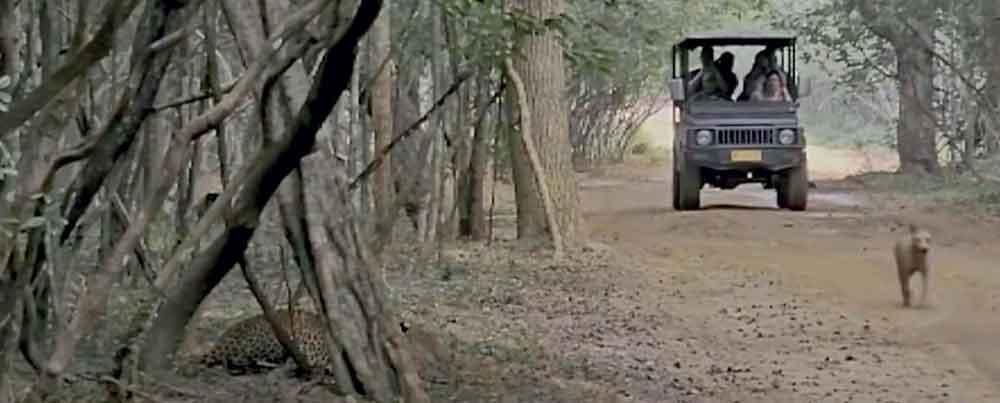
The picture shows a leopard named Neluma (on left) waiting to pounce on Tomiya (a domesticated dog) in the jungles of Wilpattu,
a place which is frequented by wildlife lovers who make their travels within the sanctuary using vehicles
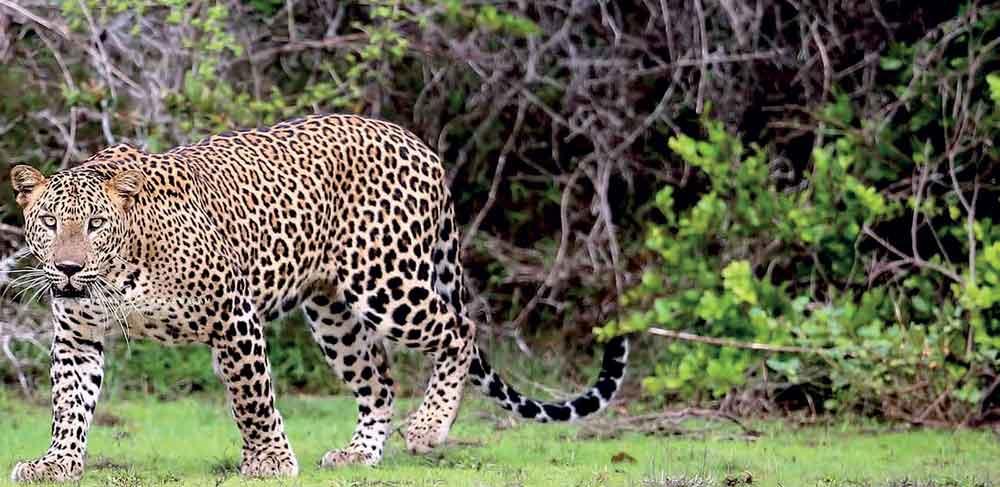
Neluma on the prowl
PIC BY Krishan Kariyawasam
“This incident is an absolute coincidence” – Tomiya’s ownerThe dog’s much spoken about owner Sampath Dissanayake is a paddy and cattle farmer from Randagama, Hunuwilagama. But for him this incident was an absolute coincidence. “My dog’s name is Tomiya and he is only 10 months old. He looks after my chena cultivation and the herd of cattle. When there’s an elephant or any other animal in the vicinity he would bark and alert us especially at night. It is usually unleashed and is set free,” said Dissanayake speaking to the Daily Mirror. When asked about the incident he said that an incident of this nature had taken place for the first time. “On the day of this incident I wasn’t at home. But that evening a friend of mine shared a video asking me to check whether it is my dog. When I saw the confrontation with Neluma I got Goosebumps because Neluma is the strongest leopard in Wilpattu National Park. I immediately inquired from a few friends who operate safari tours and they informed me that the dog is safe. I knew that there is only a faint possibility of survival given the fact that Neluma is a strong leopard. But to my surprise, Tomiya returned home on its own the following day,” he added. |
WNPS raises concerns on undue attention given to incidentIssuing a statement regarding the incident, the Wildlife and Nature Protection Society noted with serious concern and regret, the magnitude of attention, traction, media and official attention and response, that a single “Dog-Leopard” encounter generated during the past week. “In a country which reported over one elephant death each day, the murder of several tuskers and even leopards, and a human death almost every second day due to some form of animal conflict, it would seem that the focus is disproportionate on such incidents; social media frenzies often clouded with unverified facts or wrongful statements, incidents within wildlife parks, and issues which only impact a small section of our society. The WNPS urges and demands that a much stronger focus be given to addressing the fundamental root causes of these broader issues above, and that all officials, authorities, media institutions and indeed the public try and come together to bring longer term solutions to them. The vast majority of species in Sri Lanka live outside protected areas, and we need to learn to share our beautiful land with them. The roots of our nation are anchored in peaceful coexistence with nature and species, and it is time we made the difficult decision which will help bring back a better balance within our country. Future generations will indeed judge our actions of today,” the statement read. |