 Kamanthi Wickramasinghe
 Reply To:
Name - Reply Comment
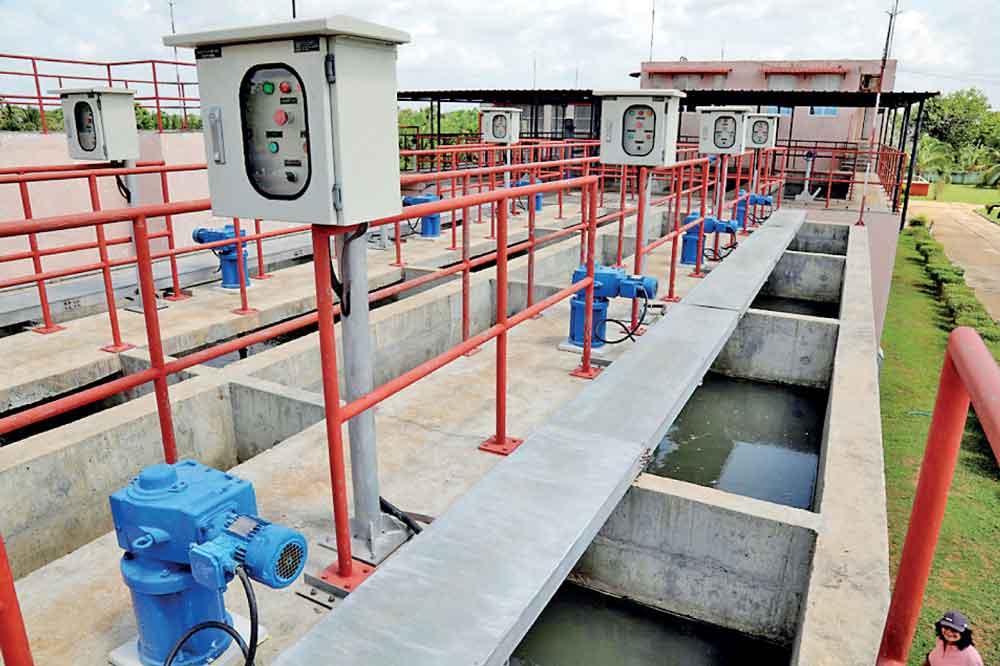
Water treatment plant
We are planning to get an ISO laboratory for this plant so that the water quality can be checked here. There’s a policy in Sri Lanka that every water supply system should have a water supply plan. Therefore, a particular risk management tool should be maintained and implemented properly”,
Vijayabalan Jeganathan, NWSDB
Many residents in Vavuniya have benefited from the Asian Development Bank’s (ADB) Vavuniya Water Supply Scheme under the Dry Zone Urban Water Supply Project, which was initiated just after the conclusion of the civil conflict in 2009. The Vavuniya Water Supply Scheme is the largest water project providing 12,000 cubic meters per day. The Scheme was completed in 2019, benefiting 80,000 people. It comprises a surface water impounding reservoir, a water treatment plant and a water distribution system.
The new reservoir constructed by building a dam across the Peru Aru River is the first large-scale reservoir constructed solely for drinking water purposes. During a recent tour organised by ADB, the Daily Mirror, along with other media, visited the Peru Aru Reservoir, the water treatment plant and also met with some beneficiaries of the project.
Facing challenges
According to Kamal Dahanayake, Principal Project Officer at ADB, it had been challenging to mobilise resources and technical people in the area simply because there had been no water facilities in Vavuniya and Mannar. “We were challenged with land mines and other security issues as well. The other challenge was that there were paddy fields in the area, and people were resettling. They had to start cultivation, and we had to acquire that land and provide them with alternative land. We have a strong resettlement process where we have to compensate them properly before taking over. People were initially not happy to provide their land to this kind of project,” he added.
The Peru Aru reservoir spans over 640 hectares, and according to officials, it has the capacity to provide water to Vavuniya for the next 30-40 years. The reservoir has been built in a way to retain water even during the peak dry season prior to the setting up of this reservoir, people had obtained water from tube wells. However, due to the presence of heavy minerals, groundwater is not suitable for drinking purposes. As of May 2025, over 14,000 service connections have been provided through this water supply scheme.
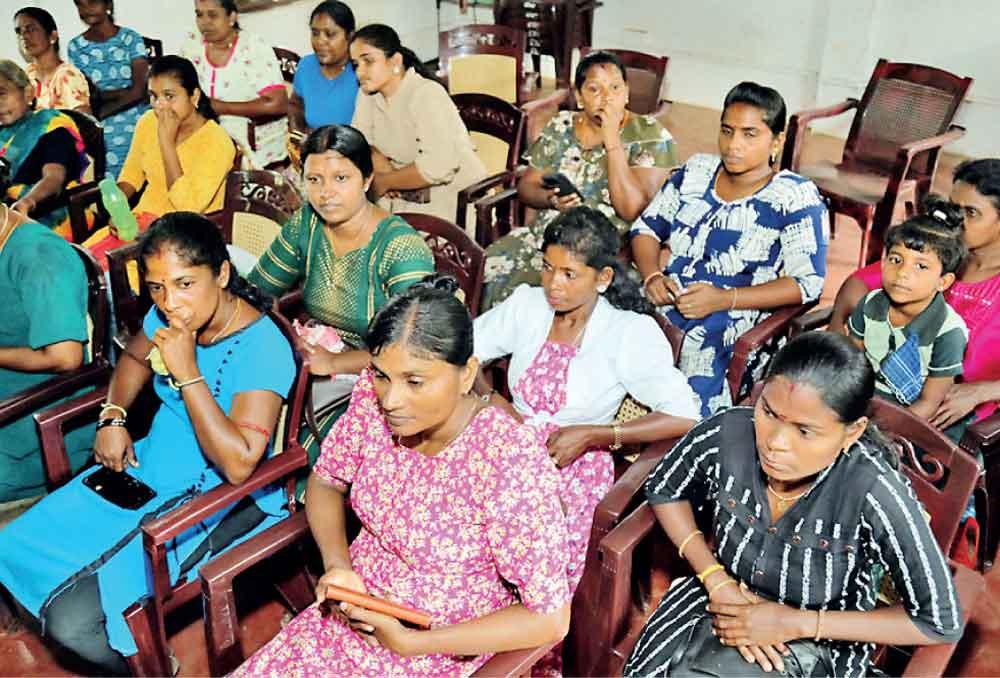
Beneficiaries of the Vavuniya water supply scheme
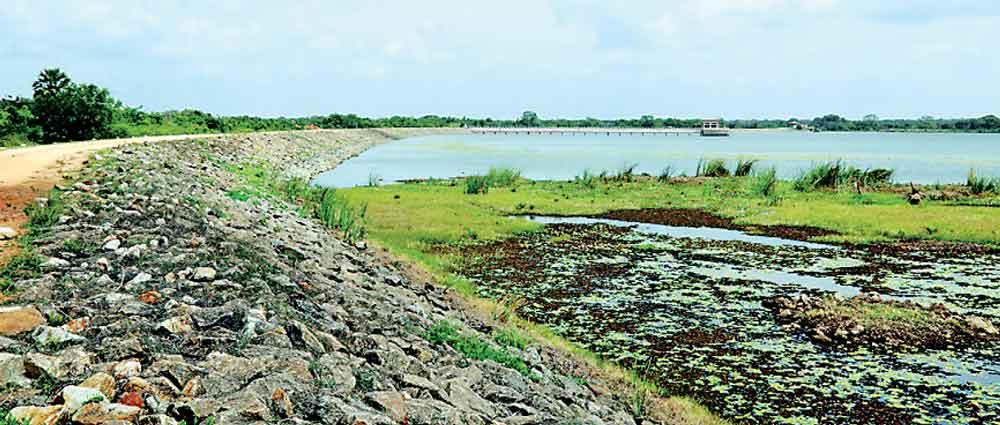
Peru Aru Reservoir
The water treatment plant has been designed to provide 100% quality water to people. The purification process includes several stages, most of which are fully automated. Water pumped from the lake first flows through the aerator and then to the chlorinator, mixed with chemicals. Next, a flocculation process takes place to separate dirt particles from the water. This process takes around half an hour, and from there, purified water is taken to the sand beds. At the sand beds, the water goes through more filtration processes before being disinfected with chlorine prior to the final distribution. The plant also includes a backwash recovery tank and a sludge holding tank, where the sludge is usually taken for paddy cultivation. The plant has a capacity of providing 12,000 cubic meters per day.
In order to ensure the smooth functioning of various processes at the plant, a Supervisory Control and Data Acquisition (SCADA) system has also been installed. In his remarks, Vijayabalan Jeganathan, Regional Manager (Operations and Maintenance for Vavuniya and Mannar) at National Water Supply and Drainage Board (NWSDB) said that water samples are tested at the in-built laboratory at the water treatment plant and samples are also taken to the ISO laboratory at the NWSDB Vavuniya office.
Fire alarm in place
“We are planning to get an ISO laboratory for this plant so that the water quality could be checked here. There’s a policy in Sri Lanka that every water supply system should have a water supply plan. Therefore, a particular risk management tool should be maintained and implemented properly. Out of 300 schemes, we got first place for water safety plan implementation. The auditing was done by a third party, and we received an outstanding score. This is proof of the quality of water that we are supplying to people. The SCADA system also includes its own chemical adjustment process and a fire alarm in case of an emergency,” he added.
We then visited Tharanikulam Grama Niladhari Division in Vavuniya District to speak to some beneficiaries of the project. They were thankful for the support extended by ADB and NWSDB to provide them with safe drinking water. Speaking to the media, Maithri, one of the beneficiaries of the project, said that they had faced numerous difficulties in obtaining water. “We had to obtain water from common wells located in specific locations. But we now get pipe-borne water and we use it for drinking, washing, cooking, gardening and all other purposes,” she added.
But one of the main requests from beneficiaries was to provide them water connections at concessionary rates. “It is difficult to pay Rs. 37,000-40,000 to get a connection because many people are daily wage earners,” said Jinodani. She said that it is difficult to pay high water bills with the pittance they earn. “It’s difficult to pay utility bills which often exceed Rs. 1000 when the daily wage itself is only Rs. 3000,” she explained further.
Many individuals from Jinodani’s father’s generation living in Tharanikulam have been diagnosed with chronic kidney disease. “At least the future generations will not face such health issues because we now get pipe-borne, safe drinking water,” she said while requesting the officials to introduce home-based entrepreneurship programmes so that they too could earn an income to settle utility bills.
Journalists were also taken on a site visit to the Iranamadu Irrigation Project, which was completed by ADB in 2018. Over the years, many farmers have benefited from this project. In addition, the media visited the Technology Faculty at the Rajarata University, upgraded with state-of-the-art facilities under the Science and Technology Human Resources Development Project.