Reply To:
Name - Reply Comment
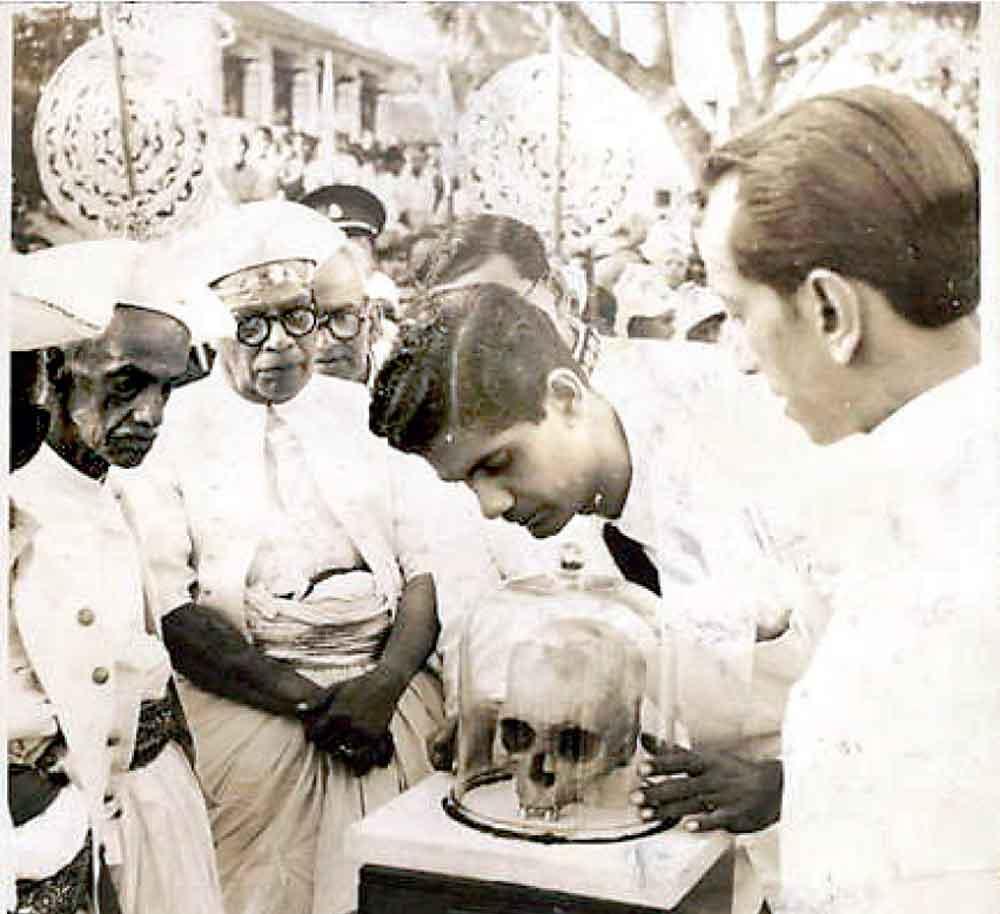
Keppetipola's skull on display before it was buried
 No one has been speaking about the son of the valiant freedom fighter Maha Adikaram Monarawila Keppetipola
who was beheaded on November 26, 1818, after a ‘Kangaroo Trial’ held at the Kandy Audience Hall. The Maha Adikaram or chief minister was not arrested but surrendered to Captain O’Neill on his own, declaring boldly: “I am Keppetipola”.
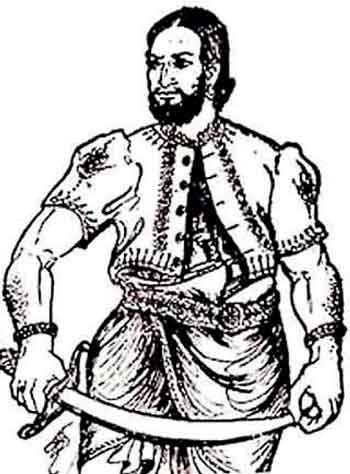 |
| Keppetipola Maha Adikaram |
It took nearly another two years for the British forces to find Keppetipola’s only son, Loku Banda Keppetipola, at a Buddhist Temple in Matale District. Loku Banda escaped after the Maha Adikaram was executed. He had donned robes fearing he would be beheaded too, after his father was executed.
When Loku Banda was found, the British army informed hurriedly their Headquarters in Colombo that Keppetipola’s son was finally found. This important news was conveyed to Governor Sir Edwards Barnes and instructions awaited as to what should be done with him. Barnes was more refined and humane than those who were with him. He directed that Loku Banda should be sent to Colombo, so that he could be taught English. In 1822, after two years of English studies in Colombo (Revenue Commissioners Diary), Loku Banda was permitted to visit his Grandmother Monarawila Kumarihamy. Loku Banda did not return to Colombo after this visit. Instead, he married a sister of Dunuville. From this marriage, he had three children, and one daughter married Molegoda Ratemahatmaya. According to Judicial Commission reports, there were land disputes involving the family. Though many claim to be related to Keppetipola, the claim of continuity comes from Molligoda or Madugalle. The history of other claimants is less certain.
The events which led On the arrival of the British, and the Proclamation on March 2 1817, there was a certain amount of peace. But with the Army taking an upper hand, the atmosphere became strained again, which resulted in tension and the appointment of a Muslim Hadjiar to Uva.
The situation became worse with the arrival of Doraiswamy, who claimed to be a relation of a the last king of Kandy Sri Wickrema Rajasinghe. He was a pretender to the throne.
As tensions rose, the Acting Government Agent Sylvester Wilson was killed due to the dispute over the Hadjiar. The British, realizing the gravity of the situation, sent Adikaram Keppetipola to quell the riots that erupted with the death of Sylvester Wilson.
But the rioters won Keppetipola over to their cause. With a very noble gesture, he allowed the British military contingent accompanying him to return to safety bearing their arms.
British re-inforcements
Thus commenced the rebellion. Half way through the rebellion, Keppetipola knew that the rebels could not succeed as as they had no food, and could not face the British army, now reinforced with troops from India, with guerilla tactics. He directed his Deputies Madugalle and Tikiri Banda to lead the rebels. Both realised that they too could not face the newly reinforced British army headed by Brigadier Shuldham. But they soon left the fighting rebels to fend for themselves and escaped.
Madugalle left to join Kepettipola, and Tikiri Banda came to Kandy, and built a small house on the present Peradeniya Road, near present Kingswood College, a jungle tract at the time.
With the arrest of Keppetipola October 26 1818, (but some say October 30), the Rebellion fizzled out and Keppetipola and Madugalle were beheaded.
The head of Keppetipola was sent to the newly formed Phrenological Society of Edinborough. The body was burnt at a location known only to Henry Marshall). However, the place is said to be an area between Getambe and Mulgampola, which is identified as a place where later ‘ beggars ‘were rounded up and held by the British Administration.
Thus ended the rebellion
Due to a request by Upali Keppetipola, a relation of Adikaram Keppetipola, the Sri Lanka government after Independence asked for and brought back the skull, and it on record that the skull was in a drawer at the National Museum. Again it was Upali Keppetipola who to urged the government to place it in a memorial.
In 1954, the Skull of Keppetipola was shown to the public in Colombo and in Kandy. It was then placed in a hermetically sealed glass box and buried under a memorial at the Maha Maluwa, Kandy.
The 207th Memorial service was held due to be held on November 26 at Mahamaluwa co-ordinated by Maha Diyawadana Nilame Pradeep Nilanga Dela.