Reply To:
Name - Reply Comment
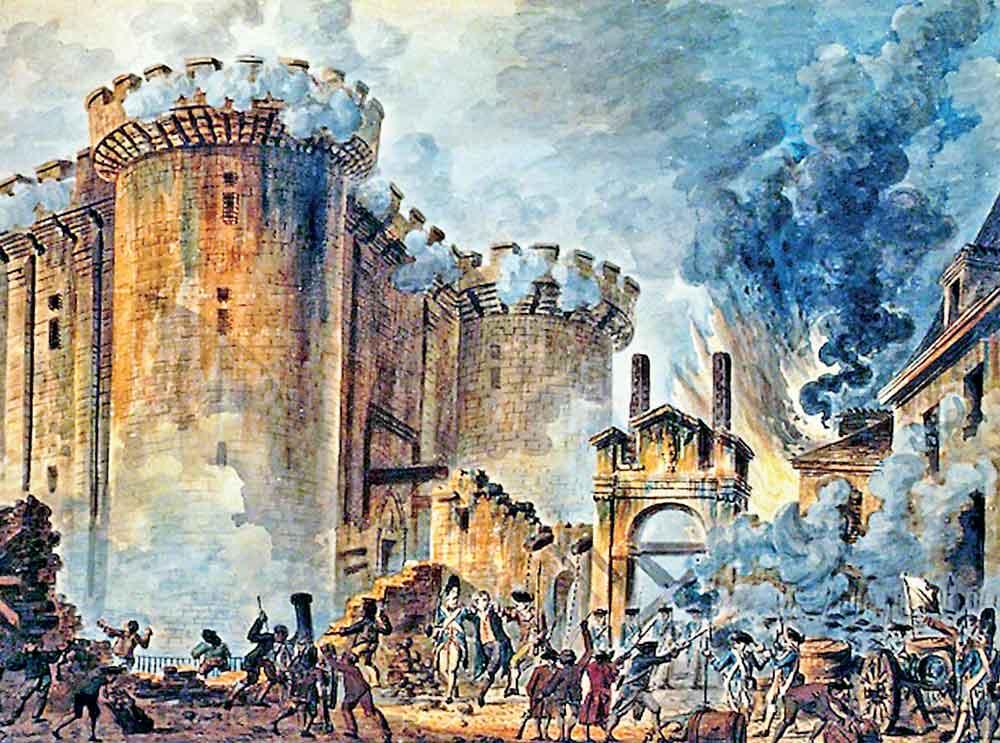
The storming of the Bastille was possible because there were armed groups in the crowd
It was on July 14, 1789, that the common people of France stormed the Bastille prison in Paris to liberate persons unjustly thrown into its dungeons by an autocratic ruler, Louis XVI. At the Bastille, prisoners were subjected to physical torture, forced labour, and isolation without trial or charges. Many were thrown into it for their opinions, writings, or associations deemed threatening to the crown.
 The prison’s notorious reputation was fuelled by the case of Étienne de Bonnart, a nobleman who spent several years in the Bastille for his alleged involvement in a plot against King Louis XVI. De Bonnart’s imprisonment sparked outrage among the nobility and commoners alike.
The storming of the Bastille is one of the iconic events of the French Revolution and its first violent manifestation. The fall of the Bastille was a turning point. It showed that people were no longer willing to tolerate absolute rule. Fittingly, the day is celebrated as the French National Day.
The ground was Ready for Revolt
At the time of the storming, France was in a deep crisis. The monarchy was struggling financially, partly due to its participation in the American War for Independence (1775-1783). The common Frenchman was suffering from high taxes and food shortages.
To address these issues, King Louis XVI (1774-1792) called a meeting of the “Estates-General” in 1789. The Estates General comprised the three Estates of pre-revolutionary France, namely the Clergy, the Nobility, and the Commons. But the Estate General broke up when the Third Estate (the Commoners) broke away from royal authority. This is generally considered the start of the French Revolution (1789-1799).
First created in 1302 as an advisory body to King Philip IV of France (1285-1314), the “Estates-General” was traditionally consulted on fiscal policy. It presented the King with petitions and grievances from the various Estates. Although it had no legislative power of its own, its authority came from its role as the voice of the people.
But the “Estates-General” was not a sitting body and was only called intermittently at the King’s will. As the French Kings began to centralise power and pursue policies of absolute monarchy, the Estates-General was convened less often. Upon the close of the 1614 meeting, it would not be called again until 1789, 175 years later!
Tennis Court Oath
The deputies of the Third Estate (Commoners), realising that in any attempt at reform they would be outvoted by the two privileged Estates (the clergy and the nobility), formed, on June 17, 1798, a “National Assembly.”
But on June 20, 1789, they found that they were locked out of their usual meeting hall at Versailles. Thinking that the King was forcing them to disband, the Third Estate moved to a nearby indoor tennis court to hold their meeting. There, they took an oath never to give up until a written constitution had been established for France. It came to be known as the “Tennis Court Oath.””
In the face of the solidarity of the Third Estate, King Louis XVI relented. On June 27, he ordered the clergy and the nobility to join with the Third Estate in the National Assembly, which took the official title of National Constituent Assembly on July 9. However, at the same time, he began gathering troops to force its dissolution, prevaricating at a time when the problem of maintaining food supplies had reached its climax. Amidst rumours of an “aristocratic conspiracy” led by the King and the privileged to overthrow the Third Estate led to the Great “Fear of July 1789”.
On July 14, 1789, the Parisian crowd stormed the Bastille, a symbol of royal tyranny. They killed its Governor and liberated the seven prisoners they wanted to set free. Above all, they destroyed the structure as it was a symbol of oppression.
Again, the king had to yield. Visiting Paris, he showed recognition of the sovereignty of the people. But the people had lost faith in him.
Organised Attack
The storming of the Bastille is often romanticised as a spontaneous and heroic act. However, historians have debunked this notion, revealing a more complex sequence of events. The reality is that the prison’s fall was the culmination of weeks of planning and organisation by radical revolutionaries. The myth of spontaneity likely originated from the fact that the crowd that stormed the Bastille on July 14 was large and seething with anger. But this crowd was not just a disorganised mob – it was made up of people who had been mobilised through weeks of propaganda and agitation. The Parisian population had been primed for rebellion by inflammatory speeches, pamphlets, and graffiti plastering the city walls.
A key factor that contributed to the fall of the Bastille was the presence of armed groups within the crowd. These groups, composed of revolutionaries and members of the National Guard, were instrumental in breaching the prison gates and overpowering the garrison inside.
The Aftermath -the Good and the Bad
The storming was celebrated across France, with people taking to the streets in joy. The fall of the Bastille led to the abolition of feudal privileges and the Declaration of the Rights of Man and of the Citizen, which established the principles of Liberty, Equality, and Fraternity.
The immediate aftermath saw the establishment of a temporary committee to govern Paris, marking a shift from absolute monarchy to representative democracy. This bold move emboldened the National Assembly, which soon declared itself the sole governing authority in France.
Camille Desmoulins, a charismatic orator, emerged as a key figure in this movement. He advocated for the rights of the people and the establishment of a constitutional monarchy. Georges Danton, another influential leader, joined forces with Desmoulins.
Politics Turned Violent
However, the storming also marked the beginning of the revolution’s violent phase. The revolutionaries, now armed and emboldened, began to take more radical actions, including the execution of King Louis XVI in 1793. Key figures emerged during this period, including Maximilien Robespierre and Georges Danton, who would later play significant roles in the “Reign of Terror.” The storming of the Bastille sent shockwaves across Europe, inspiring other revolutionary movements and influencing key figures. In Germany, the fall of the Bastille sparked widespread protests against feudalism, leading to the eventual collapse of the Holy Roman Empire. The French Revolution’s emphasis on liberty, equality, and fraternity also resonated with the Polish people, who were fighting for their own independence from Russia.
In Britain, radicals like Thomas Paine drew inspiration from the French example, advocating for democratic reforms and an end to monarchic rule. Meanwhile, in Italy, nationalists were emboldened to push for unification against Austrian dominance. These evolutionary fervours eventually led to the establishment of new governments and the redrawing of national borders in Europe. In America, Thomas Jefferson and John Adams drew parallels between their own struggle for independence and the French people’s fight against monarchy.
A key legacy is the establishment of democratic principles, such as universal suffrage, equality before the law, and government accountability. These concepts were first articulated in the Declaration of the Rights of Man and of the Citizen, adopted by France’s National Assembly in 1789.
Recognition of Human Rights
The French Revolution’s emphasis on human rights has inspired similar movements globally. For instance, the American civil rights movement and anti-apartheid activists in South Africa drew heavily from the language and ideals of the French Revolution. Today, social justice movements continue to draw upon these ideals, advocating greater economic and social equality.
(Sources: www.worldhistory.com, www.completeera.com, www.britannica.com)