Reply To:
Name - Reply Comment
 By Prageeth Sampath Karunathilaka and Sudharika Gurusinghe
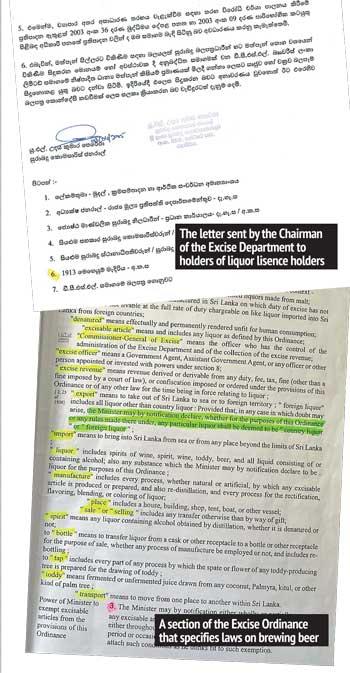
The Excise Ordinance was introduced in Sri Lanka on January 1, 1913. The title of the ordinance states: “An Ordinance to consolidate and amend the law relating to the import, export, transport, manufacture, sale, and possession of intoxicating liquor and of intoxicating drugs.” This ordinance is referred to as the Excise Ordinance. Section 2 of Chapter I states: “In this Ordinance, unless there be something repugnant in the subject or context—’beer’ includes ale, stout, porter, and all other fermented liquors made from malt.”
Despite this specification existing regarding liquor and alcoholic products, the quality of beer currently produced in Sri Lanka is in a deplorable state. Reports indicate that beer is being manufactured using sugar and rice, in violation of the Excise Ordinance. The Ordinance specifies the types of grains permitted in beer production and accordingly beer can be made from any approved grains. While the Ordinance allows for beer to be produced from various grains, it also restricts the use of grains not listed therein. Rice is not included among the approved grains. Furthermore, the Ordinance explicitly states that malt should be used in beer production. However, it has been revealed that local beer producers are substituting malt with caramelised sugar.
When the Excise Ordinance was introduced in 1913, the British were aware that the country was self-sufficient in rice. However, they were not prepared to produce beer from rice. As a result, the Ordinance does not include rice among the ingredients allowed for beer production. Although the Excise Ordinance clearly specifies which ingredients may be used in brewing beer, it is concerning that brewing companies are using rice and sugar instead. Critics point out that this practice is a blatant violation of the law.
Granting permission for
unlawful brewing
It raises questions as to how the approval of the Excise Department and the Sri Lanka Standards Institution (SLS) was obtained for such unlawful production. SLS 234:1985 section 5:1 states that “other fermentable carbohydrate preparations may also be added”, which beer manufacturing companies have interpreted as permission to use sugar and yeast in beer production. It appears that the Sri Lanka Standards Institution has acted in violation of the Excise Ordinance. Furthermore, it is alarming that the Excise Department of Sri Lanka has granted permission for these violations and remained inactive in the face of such misconduct.
Civil Intelligence Front Convener Sanjaya Mahawatta recently visited the Sri Lanka Standards Institution to file a complaint regarding this issue. He claims to possess evidence to prove that beer is being produced using sugar and rice. He has expressed his willingness to take legal action regarding this issue in the future. “Beer manufacturing companies recently informed the President that 80,000 kilos of rice are required daily for beer production. They argued that, given that the annual rice consumption in Sri Lanka is 24 metric tons, the amount used for beer production is relatively small,” said Mahawatta. He said, “The manufacturers have claimed that the rice associated with beer brewing represents only 6 percent of the country’s total annual rice consumption. However, he insists that the information presented to the President by these companies is unlawful and constitutes a violation of Acts of Parliament”.
Another claim made by beer manufacturers is that beer produced in Sri Lanka is exported to 18 countries. This beer is exempt from customs duties and they argue that their operations generate significant foreign exchange for the country. However, Mahawatta pointed out that there is no guarantee that those dollars are brought into the country without being used in Undiyal transfers. He added that there is no data available to confirm that the country would receive a substantial inflow of foreign currency from beer exports, and no one can verify what ultimately happens to this money.
Information has also emerged that beer manufacturing companies are not exporting the full quantity of beer as claimed in their orders. Mahawatta alleged that certain individuals in Sri Lanka are engaged in fraudulent operations in collaboration with the foreign buyers. While documentation may show that 100,000 cans of beer have been exported to a particular country, in reality, only half of those cans contain beer. The remaining cans are empty. Despite this, the buyer in the foreign country, fully aware that the correct quantity of beer has not been sent, still pays the exporting company. The beer that was supposedly exported remains in Sri Lanka and is sold locally. However, it is recorded as an export, allowing the company to claim tax concessions. Mahawatta stated that some companies profit not only from the sale of these beers in the local market, but also from the fraudulent export of empty cans. He added that this is a serious scam, carried out under the guise of exports to obtain tax concessions illegally.
At present, what is sold as ‘beer’ in Sri Lanka is actually moonshine. This moonshine, marketed as beer, is made from sugar and rice in violation of legal standards and poses a threat to human health. At present, many people drink a highly toxic substance thinking it is beer. Furthermore, beer manufacturing companies allegedly use toxic chemicals to stop rice weevils from infesting the rice used in beer production. Mahawatta pointed out that if the rice contains harmful substances like arsenic, these toxins can end up in the final product.
Any government in power contributes significantly to rice production by offering fertilizer subsidies, providing free irrigation water, establishing storage facilities for purchasing paddy, and deploying agricultural officers for guidance. A substantial portion of the people’s tax money is allocated for these purposes. Sri Lanka’s irrigation sector is entirely sustained by public funds. The water managed under this sector is primarily used for agriculture and hydropower, with agriculture being the top priority. Despite such significant investment in uplifting agriculture, the ultimate beneficiaries appear to be beer manufacturers. In the past, while ordinary citizens faced rice shortages, beer manufacturers reportedly had sufficient supplies. It is hard to believe that rice mill owners were unaware of this situation.
Dudley Sirisena, at a media conference held in Colombo on November 4, 2024, stated: “We need 1.8 million metric tons of rice per year. The paddy production is 4.6 million metric tons. To produce 1.8 million metric tons of rice, we need 2.8 million metric tons of paddy. Then, we should have 1.85 million metric tons of paddy left over. From this amount, we need to set aside some for seed paddy. After setting it aside, we will have 1.5 million metric tons of paddy remaining. This amount is not produced within our country, but it is not absent either. Beer is made from rice, and chicken feed is also produced from rice, although Keeri samba is not used for these purposes. Instead, Nadu rice is used for these purposes. Therefore, criticizing the businessmen is not fair, as they are fulfilling the country’s needs. Whether people drink beer, raise chickens, or eat eggs, Dudley is the one to blame for this situation.”
Based on Dudley’s remarks, it is evident that large stocks of rice are going to beer manufacturers. Critics point out that it is the duty of the authorities to investigate these claims thoroughly.
Beer manufacturing companies purchase paddy at prices 10–20 rupees above the market rate to produce beer. Major rice mill owners remain silent about this practice; even when they do speak, it often appears to be a show in front of the media. Mahawatta claims to have information confirming that beer companies are buying large quantities of rice from mill owners. It is disappointing that the Ministry of Consumer Affairs Authority remains silent despite seemingly being aware. The Excise Department of Sri Lanka has also remained quiet.
Barley and malt—the standard ingredients required for brewing beer—can be imported. According to the Excise Ordinance the use of rice and sugar isn’t permitted. However, the Sri Lanka Standards Institution has issued a SLS certification. The Government Analyst’s Department addressed a letter to the Commissioner General of Excise under No 12/2013/Legal, stating: “According to the Excise Ordinance, beer is a product made by fermenting malt. Therefore, it is not lawful to allow the use of sugar in beer production. However, clause 5:1 of the Sri Lanka Standards Institution’s standard for beer (SLS 234:1985) allows ‘other fermentable carbohydrate preparations’ to be added—sugar being one of them. As this clause contradicts the provisions of the Excise Ordinance, I conclude that this clause of the SLS standard should be amended.” Thus, the Government Analyst’s Department does not support the use of sugar in beer production either.
No clear standard for
alcohol and beer
Commenting on this, Ajith Udugama, Chairman of the Sri Lanka Liquor Licensees’ Association, said that according to the Excise Act, beer cannot be made from rice. “The Act stipulates that malt should be used instead of sugar. However, any grain can be used to make beer, including rice, as beer is essentially a drink made from grains. Despite this, the Excise Act in Sri Lanka prohibits the production of beer from rice, meaning that beer cannot legally be made from rice.
If beer is being produced using rice, then the relevant Act should be amended, and a separate tax should be imposed on such products. It is possible to prevent beer from being made using rice, but the Excise Department lacks proper regulations. There is no clear standard for alcohol and beer. Beer manufacturing companies produce beer within 2–3 days, adding sugar to increase alcohol content. As a result, the side effects of consuming such beer cannot be avoided. Drinking this beer poses a serious health risk. This constitutes an offense under the Bribery Act. Therefore, the Excise Department must be held accountable. We have also filed a case—CA writ/4/2019—demanding that beer and liquor be manufactured according to proper standards,” Udugama.
Meanwhile, most of the 75,000 metric tons of rice recently imported from India was reportedly purchased directly on board by a beer manufacturing company. Another portion of the stock was sold to a rice milling company, reportedly at a price of three rupees per kilo which is higher than the regulated rate. When this newspaper contacted the owner of the company that bought the rice for beer production, he said: “Are you out of your mind brother? People are spreading rumors. We have all the information about this transaction, and we plan to reveal it to the public in due course.”
When beer is produced using rice, the production cost for a 500-millilitre can is less than 80 rupees. Producing a bottle of beer costs around 100 rupees. With taxes added, the total retail price rises to approximately 300–400 rupees. This indicates that companies producing beer with rice and sugar are making substantial profits. Therefore, this newspaper intends to disclose detailed information about the actual cost of beer production in the near future.
This writer attempted to contact the Ministry of Consumer Affairs Authority several times via their general number, but there was no response. The Authority remains obligated to provide a response to the queries this newspaper has on this issue.
This newspaper then contacted the Sri Lanka Standards Institution regarding this matter, and a person named Anjana stated that the SLS certification is not granted for beer production. When this scribe inquired about Clause 5:1 of SLS 234:1985—which allows the use of “other fermentable carbohydrate preparations”—and about the report from the Government Analyst’s Department, he transferred the call to a person named Jayawickrama. However, Jayawickrama was also unaware of the clause or the use of rice and sugar in beer production. He then redirected the call to Management Assistant Sujeewa Kumari, who admitted that she was not familiar with the issue and referred this journalist to another department..
This scribe was then connected to a trainee at the Sri Lanka Standards Institution, who also lacked knowledge regarding the beer brewing process. He said that another officer would speak to this scribe and left the phone unattended. Eventually, Senior Deputy Director of the Sri Lanka Standards Institution Keerthini Suraweera responded. She, too, was unaware of the issue and stated that she could provide information only if we visited the institution in person, refusing to share any details over the phone. The manner in which these officials at Sri Lanka Standards Institution handled queries from this journalist should be brought to the attention of the relevant authorities.
Later, Director of the Sri Lanka Standards Institution, Eng. Sunanda Fernando, stated that discussions had taken place at the ministerial level, involving the Excise Department and manufacturers. The discussion was on whether to amend the Excise Ordinance or the provisions of the Sri Lanka Standards Institution. He noted that no final decision had been made yet and that further discussions are pending before a conclusion is reached
When asked about the matter, Commissioner General of the Excise Department of Sri Lanka, Udaya Kumara, stated: “We are currently looking into this matter. Discussions have been held at the Ministry level and with the Food Committee. Further steps will be taken following an announcement from the Food Committee.”