Reply To:
Name - Reply Comment
 Journalist Sugath Moragahakumbura is a man for all seasons. From writing stories to the tabloid newspaper ‘‘Nawaliya’’ (Still in publication) he went on to try his hand at like drama, photography and even authoring books with considerable success. This attempt is to write about his contributions to society as an author. He has over 80 books to his credit.
He talks fondly of his maiden novel ‘Kanduluthotupola’(love knows only tears) which was published in 2003 as a booklet because the content didn’t go beyond 100 pages; the requirement for a publication to be classified as a book is for its content to be over 100 pages. This book sold 12,000 copies, which is a great achievement. He has fond memories of accomplished artist Lalith Senanayake doing the cover design for his maiden book free of charge.
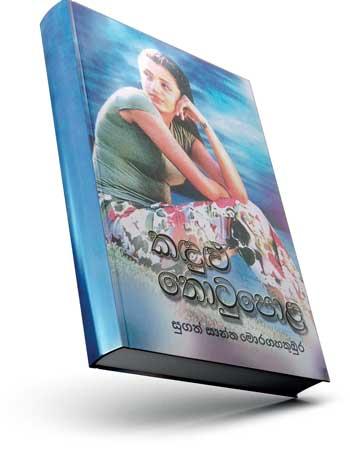 |
| The author fondly talks about his maiden novel ‘Kanduluthotupola’ |
Most of his books came as a result of doing his rounds as a tabloid newspaper journalist. “When I travelled to collect information for newspaper work, I would also come across hot and timely topics which gave me the idea that they could be used as contents in books as well. I didn’t need any motivation to write books. I had a disciplined routine in the day to get my work done, first for the newspaper and then for any book which was a work-in-progress” Sugath said, starting our conversation at his boarding room in Malabe.
Sugath has penned a lot of books, often working on multiple books at the same time. He averaged on producing four books per year. And critics never told him or warned him that he was working too much and that quality would drop. One time editor of Divaina, the late Merrill Perera had once paid him a lovely compliment by saying: “Sugath is a writing machine”.
Rural origins
He talks fondly of his maiden novel ‘Kanduluthotupola’-- the novel contains matter from a weekly column he ran in Nawaliya. “I was also the publisher of my book. I took a bank loan to facilitate the printing of my book. My printer was S&S in Maradana. I was determined to establish myself as a person who came from the village to make it in Colombo. But I didn’t shed my identity as a villager,” said Sugath as he spoke to me on a rainy day at his boarding premises during a pleasant conversation over tea, bananas and biscuits. A somewhat steady drizzle outside completed our lovely conversation. One aspect that nurtured him was the encouragement given to him by his editor Chamindi Ranatunga who gave him a free hand when penning his columns to the newspaper. “My writing that went into books and columns was mostly think pieces” he underscored. He put in over 30 years as a journalist, and he always chose to remain as a tabloid newspaper journalist. In a world where the broadsheet newspapers rule the roost, he was able to put Nawaliya in the limelight. There was once a press conference at the foreign ministry where journalists were getting ready to be fed with information regarding women who were experiencing untold hardships abroad at their work places. The convener of the press conference had told the gathering that the event would commence as soon as the Nawaliya representative would arrive. He said that what he had achieved as recognition could be shared by all who worked for tabloid newspapers.
Nocturnal writing
Working on books while at the same time committing to full time newspaper work is not easy. On a typical writing day, Sugath would return to his boarding room around six in the evening after his rounds in the newspaper, have a dosai and then sleep for about three hours. Then he would get up and write from 9 pm till 10 am the next day. He was blessed with a body that needed less sleep and less food. He took alcohol occasionally and had few friends, so he had all the time for himself and for writing.
As a newspaper journalist, his editors’ would insist that he travel out of Colombo like other journalists to get stories. These were the fun times in his life and what more, the company he worked for would pay the bills for his travelling. But more than anything else, he has a wife, Dhammika Hapugoda, who has given him much freedom to pursue his career as a journalist and stay away from home for lengthy periods at a time. His home sweet home is in Pussellawa, in Kothmale and he has two daughters, Ravihari and Pabasara; both are academics. He dedicated one of his books titled ‘Lehkirisuwanda’ (The fragrance of parent’s love) to his daughters. In this book he writes about soldiers and workers (labourers) who were forced to stay away from home and find employment to keep the family fires burning at home.
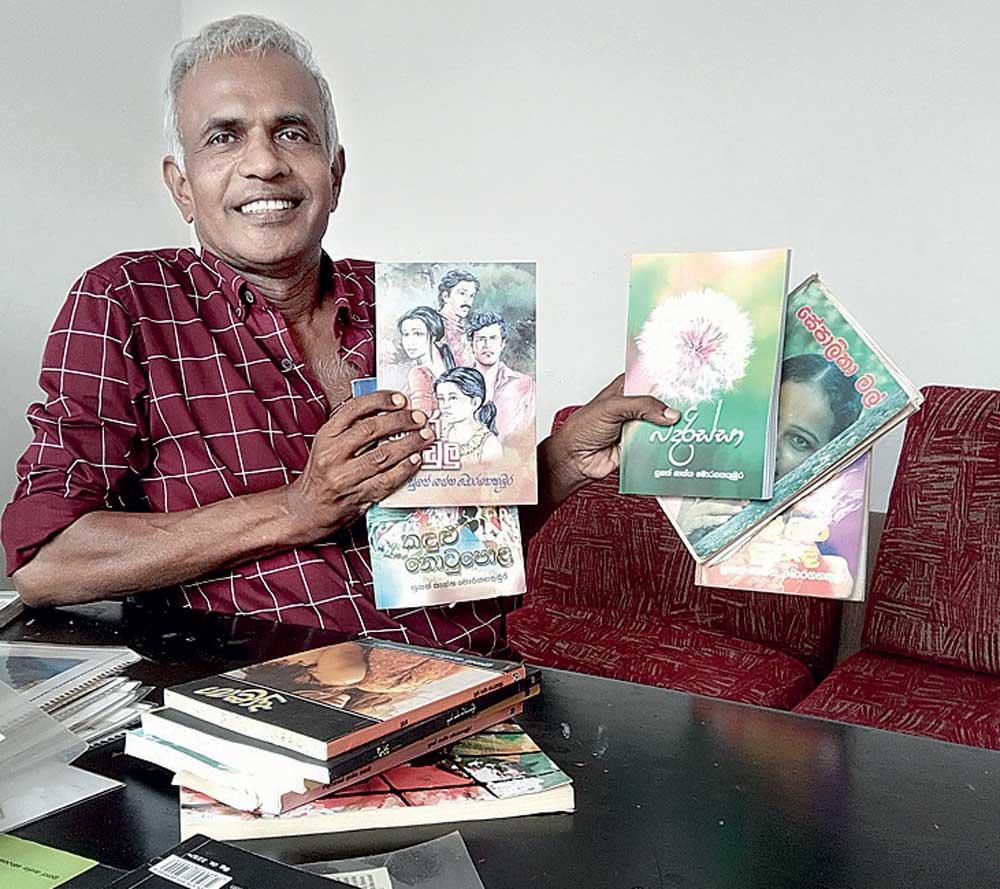
Journalist Sugath Moragahakumbura displays some of the books he has penned
As writers, we all have our favourite periods in the island’s history. Sugath spoke fondly of the period during the early 1990s. “That was a time when people in the society I lived in were very sensitive by nature. Slowly people moved away from being sensitive, and I think after the year 2000 we saw more of the gruesome side of people who living in this island. Having a sensitive nature is a very important aspect in a society which wishes to develop and grow” he affirmed. Now retired from newspaper work, he still resides in a boarding room and writes extensively. He is at present writing content for a collection of short stories.
He cherishes going home for the vacation and seeing his wife and children, but those trips are limited due to work engagements with his drama crew. “When we were kids, we waited for our parents to arrive home from work. Now as ageing parents we love to see our children who are employed return home from work. But I don’t have that opportunity because I remain a boarder who resides several hundred miles away from home,” said a thoughtful Sugath.
Writers pay a huge price to find resources and develop the mindset and environment that aids their writing. As for Sugath, he sacrificed because of his writing immensely valuable time that would otherwise have been spent with his family.