Reply To:
Name - Reply Comment
 There is no hard and fast rule that a child must achieve A9 results at the Ordinary Level Examination
When one targeted student is pressured to perform the negative atmosphere affects other students as well
Currently, more than 20 children who studied at Mahinda Rajapaksa National School, Homagama, have left and enrolled in other schools
If the allegations presented by representatives of the deceased girl are proven, the perpetrators may face mandatory imprisonment
By Prageeth Sampath Karunathilaka and Sudharika Gurusinghe
Parents entrust their children to schools with a great deal of faith in the principal and teachers. A school, therefore, should never be a place where a child feels unsafe. Whether a child experiences physical abuse, sexual abuse, neglect, or mental distress within the school environment, such issues should never be hidden or ignored. When such incidents arise, the principal, as the chief authority of the school, must take immediate action. He carries great responsibility and is fully accountable. Ignoring such matters can contribute to the overall failure of the entire school system.
One of the key milestones in a child’s life is successfully passing the GCE Ordinary Level examination. It is the responsibility of both teachers and the principal to provide proper guidance for this. However, there is no hard and fast rule that a child must achieve A9 results at the Ordinary Level Examination. This depends on the child’s own competence. Although the nine A’s goal was once a milestone for a child, it has now become a tool used to pressure education officials in a school, district, or province. As a result, children face severe mental distress, and in some cases, may even be driven to thoughts of suicide.
 “On August 22 2025, we were asked to provide a response regarding an investigation into the pressure exerted by the school in connection with the student’s death. It was said to be in response to a request made by the Director of National Schools to the zonal office”
-A. A. Sumanasiri Amarasinghe (Ruchika Induma’s father)
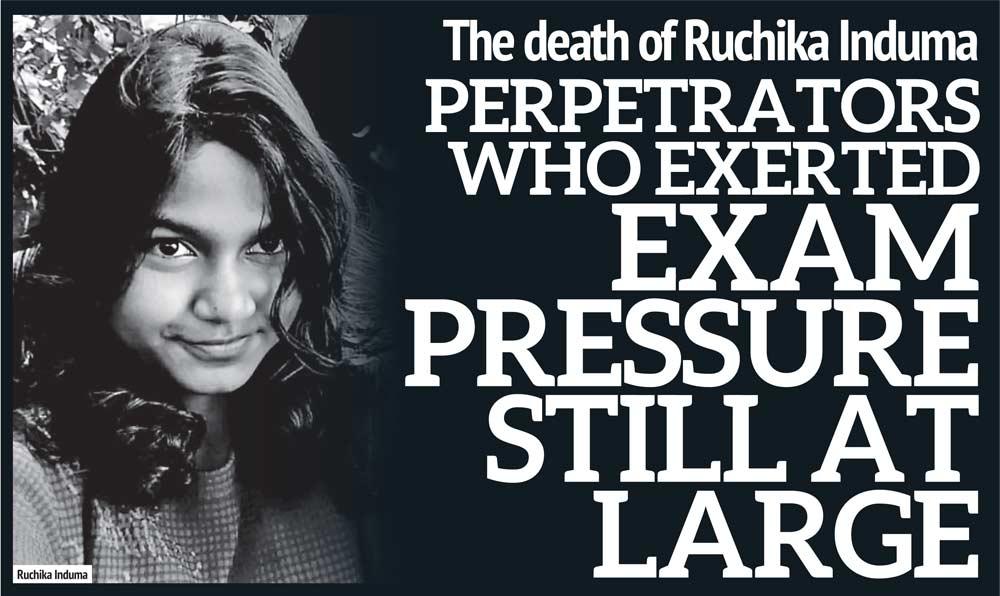
Ruchika Induma entered Mahinda Rajapaksa National School, Homagama, in 2022. She joined Grade 8 with countless hopes in her heart. Her main goal was to prepare well for the G.C.E. Ordinary Level Examination, a challenge she knew to be in the near future. Since she was good in her subjects, she did not attend tutoring classes, nor did she feel the need for that kind of service. Ruchika, who engaged in her education as a regular school student, faced a turning point in her life when she entered Grade 11 in 2025. As she began preparing for the Ordinary Level Examination, she worked diligently and remained committed to her studies.
 “This has been reported to the Ministry and an investigation is being conducted”
– Sarath Bandu, Principal of Mahinda Rajapaksa National School
However, her class teacher in Grade 11, who was also her mathematics teacher, constantly blamed her, saying that she was weak in mathematics. Ruchika confided in her mother that the teacher constantly scolded her and subjected her to mental pressure. She has suffered greatly due to humiliation and insults as a result of this teacher’s behavior in the classroom. According to her mother, Ruchika had scored high marks in all her subjects except for mathematics.
When questioned, Ruchika often explained that she simply could not follow the lessons taught by her mathematics teacher. Her mother further stated that since Ruchika had not attended tuition classes at first, her struggles in mathematics were directly linked to the teacher’s negligence. She believed that the teacher had placed undue mental pressure on her daughter in an attempt to cover up her own shortcomings.
This is what Rushika’s mother revealed to this newspaper. The mathematics teacher had also started an extra class for students who were weak in the subject. These sessions were held before school hours. Ruchika and several other students were asked to attend these sessions, though no specific time was given for them. According to Ruchika’s mother, her daughter was unable to attend school on eight out of forty-eight days due to illness.
Caned by the head of the section
Even though medical certificates had been obtained for those days, Ruchika could not submit them. Instead, she was referred to Ven. Dodampe Saddhawimala, the sectional head of the Grade 11, because of her absences from school. It is reported that she was caned by the head of the section. Following this incident, Ruchika experienced heightened mental distress and became extremely reluctant to attend school, resulting in her staying away from school for several days.
The Grade 11 section at this school consists of 18 classes; each having more than 40 students. Among them is a class named 11T, specifically reserved for students considered weak in their studies, according to Ruchika’s mother. Ruchika’s mathematics teacher had repeatedly told her that she would be moved to this class. The mother states that this proposed change caused Ruchika severe mental distress.
 “Under Article IV of the 1978 Constitution, every state officer has a constitutional duty to uphold and promote fundamental human rights. They must protect these rights. In particular, a school principal is responsible for the entire process that ensures the well-being of children”
-- Dr. Prathibha Mahanamahewa, FormerHuman Rights Commissioner and lawyer
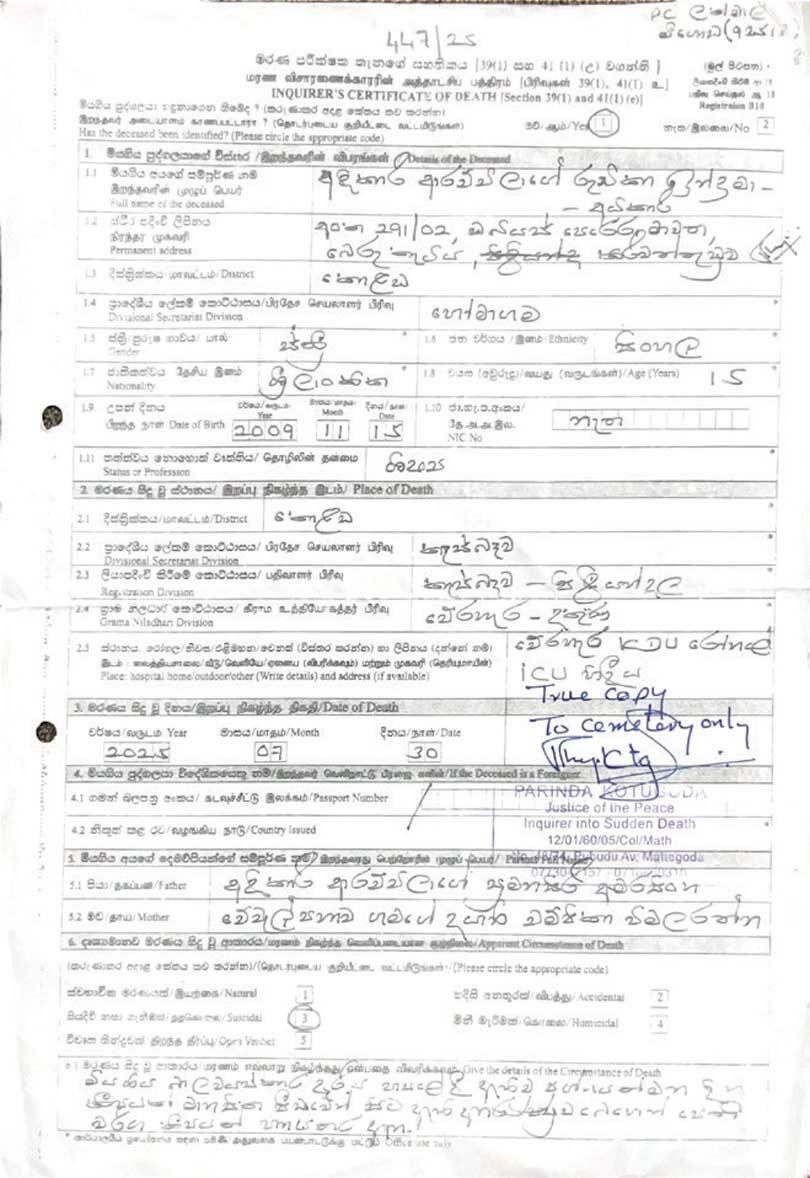
Ruchika Induma Adhikari, the above-mentioned student studying in Grade 11 at Mahinda Rajapaksa Vidyalaya, Homagama, was 15 years old at the time of her death. While preparing to sit for this year’s G.C.E. Ordinary Level examination, she had allegedly taken her life on 30 July 2025. The pressure exerted on her was not limited to her and affected other students as well. Currently, more than 20 children who studied at this school have left and enrolled in other schools.
Serious injustice
Ruchika Induma’s parents emphasised that although their daughter had been suffering from mental trauma for a long time, she received no help from Mahinda Rajapaksa National School. Unable to bear the constant mental pressure, she ultimately took her own life. It has now been 50 days (calculated as at September 18) since her death, yet no one who directly or indirectly contributed to her suffering has been held accountable.
A separate investigation into her death was recently conducted by the Homagama Provincial Education Office. “On 22 August 2025, we were asked to provide a response regarding an investigation into the pressure exerted by the school in connection with the student’s death. It was said to be in response to a request made by the Director of National Schools to the zonal office. However, the letter from the Director of National Schools instructing the investigation was actually dated 31 July 2025,” said the student’s father, A. A. Sumanasiri Amarasinghe.
Amarasinghe further stated that the investigation was conducted in a biased manner. According to him, Homagama Zonal Education Director summoned the Principal of Mahinda Rajapaksa National School and, in front of the Divisional Education Director, asked his wife to leave the meeting. “They attempted to manipulate the matter, but because we insisted on a fair inquiry, the investigation was held after 22 days. We were never informed who was conducting the investigation or under whose authority it was being done. We also did not receive any written notice. When I asked to see the letter sent by the National Director of Schools, they refused to show it,” he said.
“During this investigation, Homagama Divisional Director of Education acted primarily to protect the teacher and the principal of the school. We understood this as an attempt to safeguard the school’s reputation. We need a formal investigation to be carried out under the Ministry of Public Administration and not a biased inquiry,” he further said.
Sections 195 and 196 of Gazette No. 1589/30, dated 20.02.2009 state how an investigation must be conducted when a complaint is received against a teacher. In such cases, the teacher or the group of teachers should first be transferred, and the investigation should then proceed. However, in this instance, the inquiry was carried out without transferring the teachers concerned. Amarasinghe raised the concern that justice cannot be expected when an investigation is conducted while the accused teachers remain in the same school.
Requesting a fair investigation
For this reason, Amarasinghe requested a fair investigation under an independent team consisting of the Minister of Education, the Secretary of the Ministry, and officers from the Department of Public Administration. He has no confidence in how the investigation is currently being carried out. This distrust stems from the pressures his family members experienced during the investigation held at the Homagama Zonal Education Office.
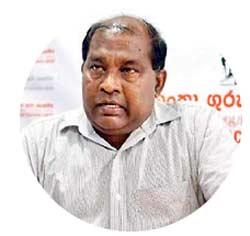 The principal of Mahinda Rajapaksa School holds a higher grade in paper qualifications compared to the Zonal Director, which makes it difficult to ensure justice in such a situation.”
- Joseph Stalin General Secretary of the Ceylon Teachers’ Union, stated
There remains a problem as to who gave the authority to request evidence for a preliminary investigation and conduct this inquiry, as stated in section 13 of Chapter XLVIII of the Establishment Code. Furthermore, according to Section 13:9 of the same chapter it is not essential that the officer conducting the preliminary investigation is senior to the suspect officer. However, Amarasinghe pointed out that in these investigations, it is appropriate to include officers senior to those under suspicion in every possible instance. Amarasinghe also pointed out that both the Divisional and Zonal Education Directors are junior in rank to the principal of Mahinda Rajapaksa National School, who holds the Grade I rank in the Education Administrative Service.
According to Amarasinghe, the investigation is being directed in a different direction. He also added that a parents’ meeting was convened on July 7, 2025, during which the deceased child was blamed for faults she did not commit. He pointed out that the school accused their child without regard for the fact that a 15-year-old girl could not endure such mental distress and as a result died.
If the allegations presented by the representatives of the deceased girl are proven, the perpetrators may face mandatory imprisonment ranging from 2 to 10 years under Section 308(a)(1) of the Penal Code for their cruel actions. If the act results in death, the imprisonment may be increased. In addition, the court may order the payment of compensation. This is explicitly stated in the Penal Code (Amendment) Act, No. 16 of 2006. The circular 12/2016 issued by the Ministry of Education is not being implemented in schools, and in future, those holding authority who fail to enforce it during educational reforms must be held legally accountable.
When this newspaper inquired about the matter from Saddhawimala Thera, section head of Grade 11 at Mahinda Rajapaksa National School, he said the following: ‘I don’t know about that. I didn’t hit that student. Those stories are just what people say’.
The Daily Mirror also inquired about this matter from Jayantha Kumari Gamage, the mathematics teacher against whom allegations have been made in connection with the girl’s death, but she did not respond.
Investigation is being conducted
When this newpaper inquired from the Principal of Mahinda Rajapaksa National School Sarath Bandu, he said: “This has been reported to the Ministry and an investigation is being conducted,” and then disconnected the call. When we called the principal again, he said, “Why are you asking me about that?” and hung up. After fresh efforts made to contact him succeeded he said that both the Ministry and the Zonal office are conducting investigations regarding this matter. He added that a police investigation is continuing, and he cannot take any decisions or impose punishments until the investigations are complete.
“A committee has been appointed, teachers have been informed, and for details about the Zonal investigation, one should contact the Zonal office. About 150 students, not just 20, have left the school, but this has no connection to the nine A’s incident,” the principal of the school said.
This writer then called the principal to inquire about the matter again. However, for the third time, he spoke to us using offensive language. When asked about the messages sent by the monk, the principal said: “Don’t be asking me about this. Just hang up the phone.” But before he hung up he used. He spoke in foul language to this writer.
Safeguarding the dignity of students
Former Human Rights Commissioner and lawyer, Dr. Prathibha Mahanamahewa, commenting on this matter, stated the following:
“Under Article IV of the 1978 Constitution, every state officer has a constitutional duty to uphold and promote fundamental human rights. They must protect these rights. In particular, a school principal is responsible for the entire process that ensures the well-being of children. A principal must safeguard the dignity of students as well as every other citizen.
“If a principal instead responds with anger and verbal abuse, that constitutes of misconduct. Such behaviour can cause psychological harm to both children and their parents. There are institutions to which complaints can be made if someone’s dignity is harmed through such improper verbal conduct.”
Furthermore, a fundamental principle recognised by the United Nations is that children must not be subjected to punishment which is not limited to physical harm, but also includes psychological harm. For instance, forcing children to obtain nine As constitutes a violation of their fundamental rights. In such cases, complaints can be made to the Child Protection Authority, the Police Children and Women’s Bureau, or the Human Rights Commission,” Dr. Mahanamahewa explained.
Pushing children to extreme limits
Commenting on this matter, Joseph Stalin, General Secretary of the Ceylon Teachers’ Union, stated the following:
“Attempts are being made to implement educational reforms to stop competitions at exams. However, the principal and teachers are pushing children to extreme limits to achieve the best results. Each province, district, zone, and school seems focused on securing the best outcomes for themselves. There is little cooperation among students in this country. The Ministry of Education’s handling of the incident at Mahinda Rajapaksa School is questionable. The matter has now been assigned to the Homagama Zonal Office for investigation. The principal of Mahinda Rajapaksa School holds a higher grade in paper qualifications compared to the Zonal Director, which makes it difficult to ensure justice in such a situation.”
When asked about the matter, Homagama Zonal Education Director Hemantha Gamage responded:
“The investigation into the incident at Mahinda Rajapaksa School was conducted by the Ministry of Education and the Zonal Office. During the investigation, it did not matter whether anyone was senior or junior; that can be confirmed with the Education Director. No pressure was applied during this investigation, nor could it have been. I cannot comment on the monk at the school.”
The Zonal Director instructed that such matters should not be publicised or reported as incidents.”
It has also been learned that the Ministry of Education has appointed a committee to carry out an independent investigation into Ruchika’s case. Additionally, the Child Protection Authority has requested the Meegoda Police to follow up on this investigation.