Reply To:
Name - Reply Comment
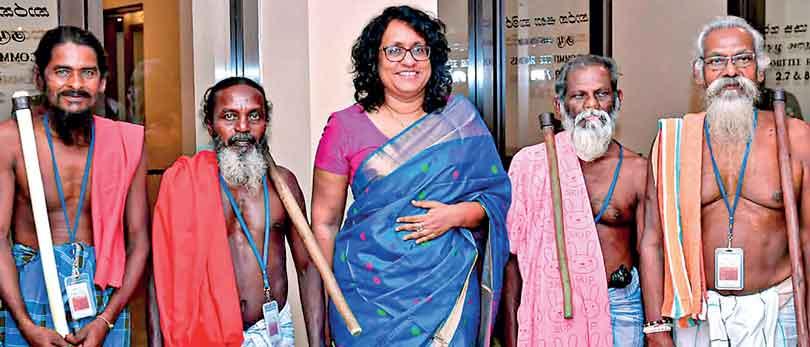
Adiwasi leaders posing for a photo with PM Harini Amarasuriya after discussions on the parliamentary bill prepared to secure the rights of indigenous people and the rights they have demanded.
Image courtesy - Prime Minister Media
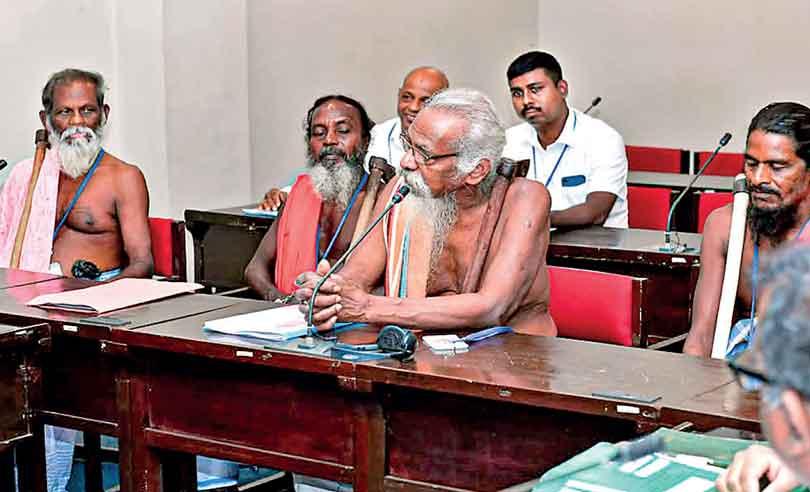
The Adivasi people of Sri Lanka are primarily dispersed across the Uva, Eastern, and North Central Provinces.
A significant number of these Adivasi populations reside in the Uva, Eastern, and North Central Provinces.
The maritime Adivasi populations in the Eastern region remain largely neglected, facing unique challenges that are often overlooked.
The Adivasi community of Sri Lanka constitutes a group of esteemed citizens, possessing a distinct cultural and social identity, and should be granted full access to the rights and privileges afforded to all citizens. Nevertheless, the Adivasi populations residing across the island currently face a range of systemic challenges.
These communities find themselves in this undeserved situation due to the prolonged failure of successive ruling governments to transform political promises into substantive actions. While many pledges have been made regarding the socio-economic, cultural, and political rights of these communities, these promises have largely remained unfulfilled, lacking both the formal policy framework and legal enforcement necessary to address their needs.
The Adivasi people of Sri Lanka are primarily dispersed across the Uva, Eastern, and North Central Provinces. Notably, the maritime Adivasi populations in the Eastern region remain largely neglected, facing unique challenges that are often overlooked. More generally, the Adivasi communities continue to struggle with a variety of issues such as discrimination and challenges in sustaining their daily livelihoods, the use of forests and engaging with the administrative processes of the state.
A significant number of these Adivasi populations reside in areas such as Dambana, Rathugala, Pollebedda, Dalukana, Dimbulagala, Vaharai, and Muthur in the Uva, Eastern, and North Central Provinces. These communities have witnessed the erosion of their traditional rights to use forests and have increasingly been assimilated into the broader society. However, in doing so, they have encountered considerable economic, social, and cultural hardships. The current situation, exacerbated by an overwhelming debt burden, has further entrenched their vulnerability and worsened their quality of life.
The Centre for Policy Alternatives (CPA) has been closely monitoring and researching the challenges faced by Adivasi communities for an extended period. In response to these issues, and at the request of Adivasi leader Uruwarige Vannila Attho, CPA initiated a process to draft a comprehensive bill to safeguard Adivasi’s rights. As a result of this process, approval was granted for the introduction of a new legislative framework regarding the rights of Adivasi people at the Cabinet meeting held on August 26, 2024.
The procedural steps taken towards the drafting of the bill in brief are as follows:
1. The CPA engaged with Adivasi communities across Sri Lanka to understand the myriad issues they encounter in their daily lives. Based on these consultations, a comprehensive document was compiled, which was subsequently presented to the Speaker of Parliament and various key parliamentary representatives in 2023 with the active participation of provincial Adivasi leaders, including the leader of the Adivasi community Uruwarige Vannila Attho.
2. Although the matter was discussed in Parliament on a single occasion, it was regrettably not pursued further. However, in this context, multiple discussions aimed at revisiting the bill were conducted with the intervention of the former Minister of Justice. Representatives from key ministries, including the Ministries of Wildlife and Forest Conservation, the Mahaweli Development Authority, the Department of Wildlife, the Department of Irrigation, Sri Lanka Police, the Department of Culture, and the Attorney General’s Department, participated in these deliberations.
3. Based on the outcomes of these discussions, the CPA, in alignment with international frameworks such as the United Nations Declaration on the Rights of Indigenous Peoples (UNDRIP), developed a document titled “Grievances Faced by Adivasi Communities in Sri Lanka and Recommended Remedies / Draft Concept Paper on the Rights of Adivasi Peoples in Sri Lanka.” This document was submitted to the relevant authorities for further consideration.
4. Taking into account the input from all stakeholders, the Attorney General’s Department prepared a draft bill, which was subsequently presented for Cabinet approval. However, during this process, the Prime Minister’s Office and the Ministry of Finance raised objections to sections 14 and 15 of the bill. Following discussions at the Prime Minister’s Office on August 5, 2024, it was agreed that these sections should be revised before being resubmitted for Cabinet approval.
Sections 14 and 15 were removed from the draft bill during the previous government’s tenure; however, it is our strong conviction that these provisions should be reinstated in alignment with the principles outlined in the United Nations Declaration on the Rights of Indigenous Peoples (UNDRIP), which was adopted by the United Nations on September 13, 2007. These sections are crucial for safeguarding Adivasi rights and must not be excluded from the proposed legislation.