Reply To:
Name - Reply Comment
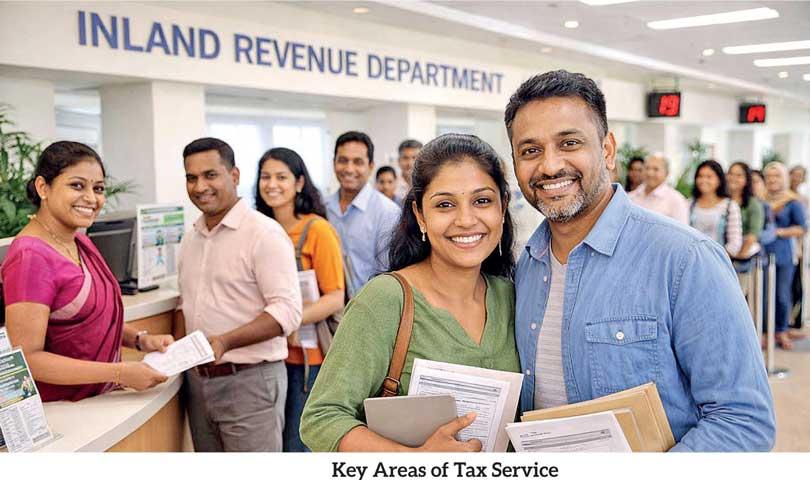
 As the Inland Revenue Department celebrates 94 years of service, taxation remains the bedrock of Sri Lanka’s fiscal stability and social progress. In an era of rapid globalisation, the department is pivoting toward a digital-first, taxpayer-friendly culture to foster public trust and voluntary compliance. By integrating virtual assistants and AI-driven solutions, we are streamlining the tax experience, ensuring quality standards that meet modern expectations. This anniversary reinforces our commitment to balancing robust revenue mobilisation with the legitimate rights and aspirations of every citizen for a better society.
Tax plays a vital role not only in developing fiscal stability and Revenue mobilization but also upgrading living standards of the people. Many countries in the world except a few depend on tax money which is contributed by the civilised citizens. Today in the context of the globalisation, we are focusing to develop digitalization process for the tax system, and also need to build up taxpayer friendly culture. Understanding taxpayers’ issues and fulfilling their aspiration for a better society, facilitating quality-oriented services with high standards for them are important things in present Tax Administrations. Having understood these factors, many revenue authorities have deeply analysed the present scenario with stakeholders’ analysis. Taxpayers, Tax agents, social service providers, media, intermediate groups, banks are some who are actively cooperated with tax administration.
Taxpayers’ service is about tax administration in delivering services and adopting measures according to tax laws and rules during registration, enquiries, legal relief delivery, return and payment compliance, supporting services relating to tax matters, problem handling, consulting remedies, etc. The uttermost aims of these services are to promote compliance, protect taxpayers’ right and improve tax administration.
Collecting high tax revenue through tax policies and administrative mechanism of a country needs public trust, confidence and taxpayers’ morality. Sri Lanka tax revenue which once recorded as the lowest ratio to GDP in the world, has been improved in a steady way. International donor agencies also emphasise the need of maintaining 2.3% primary balances in government budget. For these purposes, increasing revenue at a rate of 15% or more is a mandatory requirement in revenue administration. To achieve these objectives, community confidence especially on tax administration, attitudes towards voluntary compliance and strong long-lasting relationship with policy makers and administration of a country are essential.
Basic Tax Service Functions
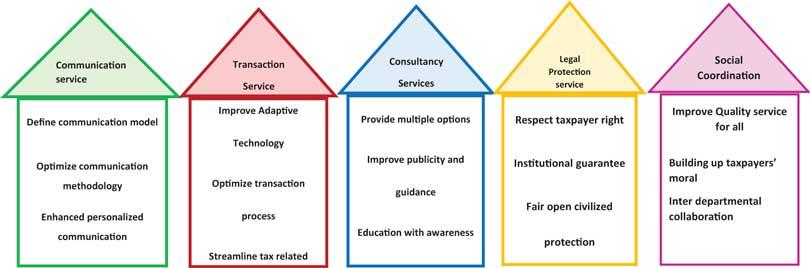
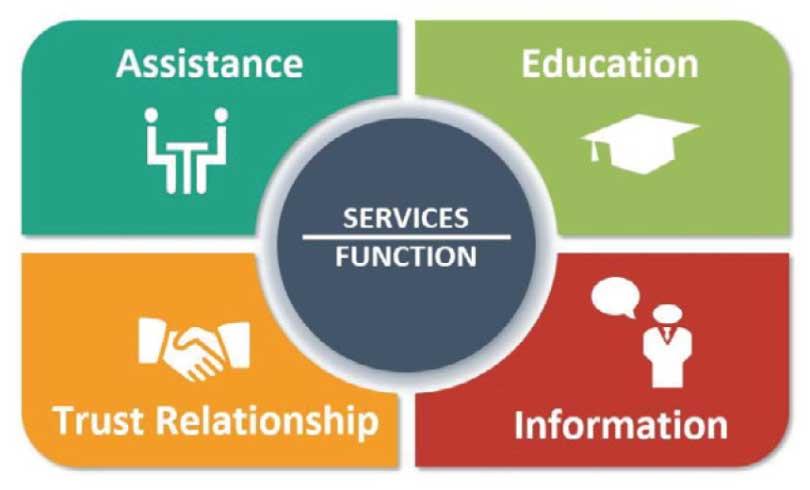
Today, majority of world economic activities and tax-related matters are depending on the services that provided by relevant institutions. No organisation can survive today without identification of customer needs, expectation, future plans organizational culture and their perceptions. Therefore, as Tax Administrators we must take care of Taxpayer Services that already provided and to be provided with quality standard for organisational development. Chart No. 01 indicates the modern activities of tax services.
How can Tax Authorities provide better services
Today Tax Authorities in the world provide various types of services for their customers.
As illustrated in chart No.02. The services can be catergorised under following ways. These are the basic areas of Tax Services.
Tax services in the world
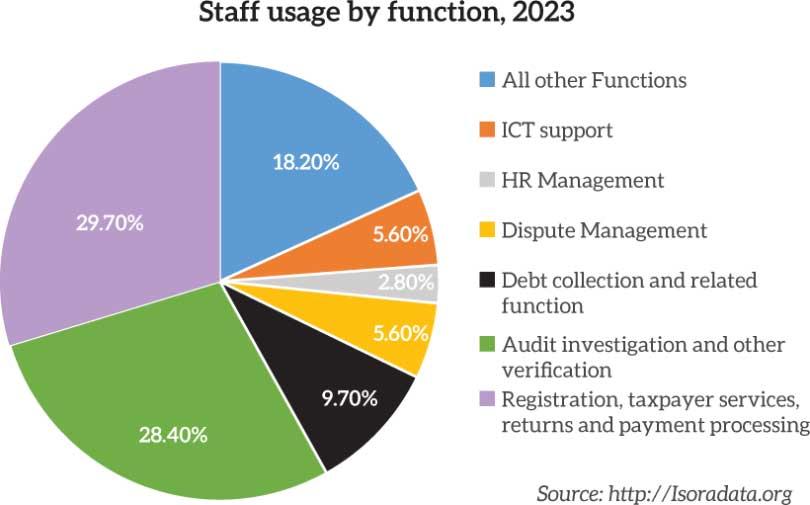
Human Resources engaging for Tax Payers Services
Although, many revenue administrations have attempted to develop online process and virtual system, the needs of human activities for Taxpayer services also show a tremendous progress. Audit examination and other verification functions and the registration and payment processing could be equally seen in the present world. Today, world trend in customer service is more important than audit and other programmes. The following chart shows the new Trends in the world.
Source: http://Isoradata.org
Many tax administrations in the world identifying human needs with new technology, have increased their services in order to increase efficiency and reduce administrative costs of Tax system.
With the expansion of technology and time saving matters. Today Tax services have been rapidly developed all over the world. Taxpayers and non-Taxpayers are willing to get maximum benefits from tax services for their day-to-day activities. Therefore, today Tax services play key role not only in providing services but also collecting revenue, enhancing compliance and building up taxpayer rights.
Digitalization of Tax Services
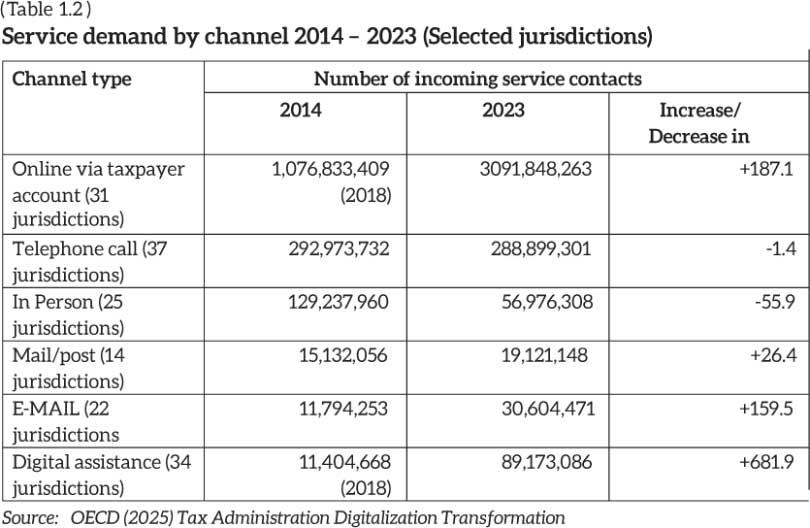
Today, many countries are providing their assistances and services for taxpayers through online or virtual methods. It helps tax officials also to perform their activities in proper manner. Virtual assistants or digital assistants in the world tax administration has rapidly grow for the past periods. It helps taxpayers to handle enquires, support self service and support to quick service by saving their valuable time. When we analyse the table 1.1, we can get idea about service demand by channel and growth for the period between 2018 and 2023. Therefore, as a country we must improve and develop methods of virtual assistance to increase taxpayer compliance.
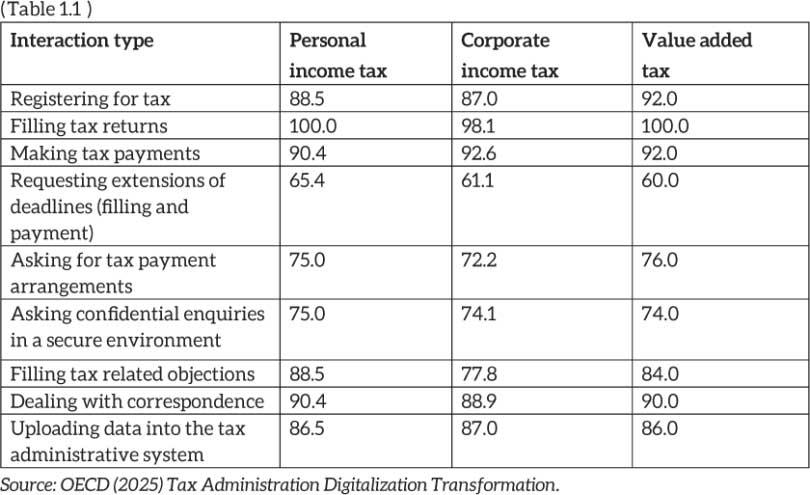
The overview of some online services that handling tax matters and providing services for the main three tax types in the world. The following table illustrate the world data in 2024.
Online Services offered by tax administrations in respect of tax type in 2024 Percentage of administrations that have the respective process in place
Source: OECD (2025) Tax Administration Digitalisation Transformation. (Table 1.1)
The following table 1.2 shows its present scenario.
It shows the increasing of digital assistance, Email facilities and online Taxpayer accounts are important than in-person.
Service demand by channel 2014 – 2023 (Selected jurisdictions)
Source: OECD (2025) Tax Administration Digitalisation Transformation
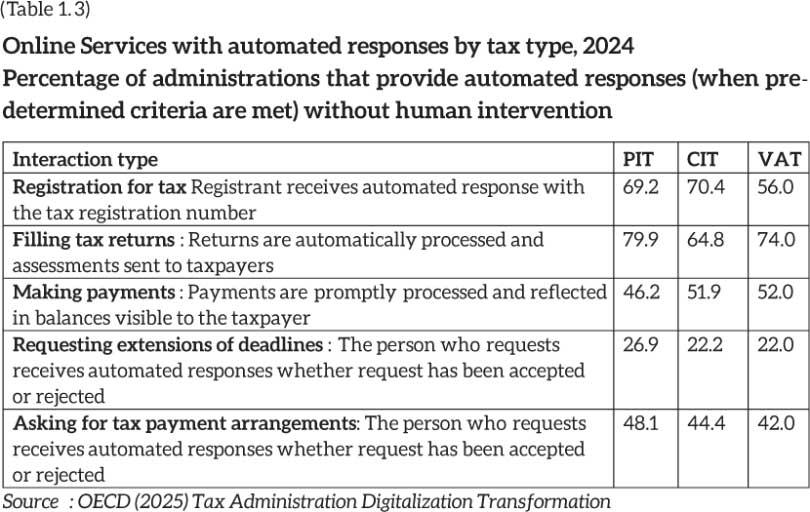
Online Services with automated responses by tax type, 2024
Percentage of administrations that provide automated responses (when pre- determined criteria are met) without human intervention
Source: OECD (2025) Tax Administration Digitalisation Transformation
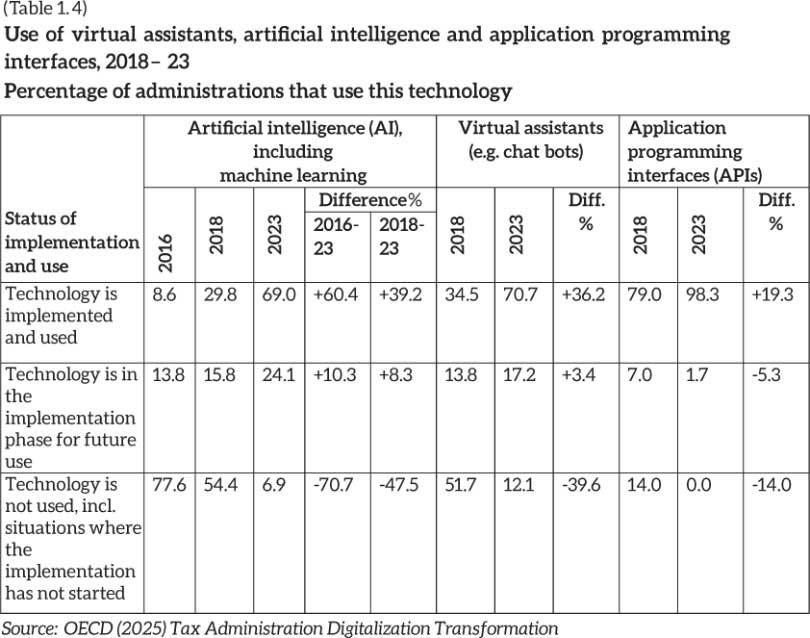
Use of virtual assistants, artificial intelligence and application programming interfaces, 2018 – 23
Percentage of administrations that use this technology
Source: OECD (2025) Tax Administration Digitalisation Transformation
Developing Areas in Tax services in the world Service Centre
Tax Service Centre can operate like a one-stop service, whole process service, appointment service, alert service and first asking responsibility service.
One Stop Service – accepts and handles all kinds of tax issues.
Whole – process service – Provide acceptance undertaking reply service through internal operation mechanism after reading issues.
Appointment service – Assist taxpayers to have tax issues handled timely before occurrence of tax liabilities or fulfilment of legal responsibilities.
First asking responsibilities – Tax officials who are the first to handle tax issues are responsible for answering questions or giving guidance without giving excuse to refuse.
Collaborative Services
Government Revenue agencies can reduce burdens for taxpayers by providing service for every sector they visit. “Collect once use many times” approach helps to develop collaborative services and strength the tax administration. Today’s registering and tax payments are part of government whole digitalisation process for these purposes. Many governments have introduced various mechanisms as taxpayer’s services. Electronic payroll system, single source of income for self-employee scheme are some classic examples.
Tax payer facilitation Centre
Taxpayer facilitation Centre is a place where Tax Administration handles and solve various tax types problems of taxpayers. The major responsibilities of tax facilitation Centre are,- To handle filling of tax returns, tax collection etc.
Mobile Transaction Service
Mobile transaction service vehicle is a well-developed concept for providing services specially for the people of remote areas. It is ICT backed and equipped with computers, printers, copiers, scanners and Wi-Fi facilities. It provides services for return filling process, registration matters, advisory services, and appointment and application services for taxpayers. It also provides service for taxpayers to communicate their problems, grievances through SMS, WhatsApp, MMS etc. This helps to minimize taxpayer’s burdens.
Importance of taxpayers’ service in Sri Lanka
Taxpayer services fill the gaps of taxpayers and administration. It also helps to narrow the level of noncompliance and improve to build taxpayers and tax administration image. The main aim that maintains tax payers’ source are as follows.
Today, the Inland Revenue Department, while playing a key role in revenue collection, also providing Taxpayer services on a grand scale manner. There are six service branches mainly functions as tax services in the head office and all regional offices located in various parts of the country providing taxpayer services too. Issuing TIN certificates, issuing tax type registration, issuing temporary and permanent VAT and all other tax type registration, updating of a profile of taxpayers, issuing clearances, Remittance certificates, providing consultancy services, providing educational services are some of them.
Conclusions
Taxpayer services in Tax Administration is an important practical oriented concept in the world. It develops taxpayer moral and also minimize burden of tax Administration. Everyday modern Tax Administration develops new concept to the world. Setting taxpayer service conducting Taxpayer satisfaction survey, getting feedback from Tax payer’s evaluation for services. Handling taxpayer’s grievances providing quick service with modern technologies. Providing taxpayers services with increasing satisfaction is our prime duty as we are depending on their contribution. Source: Tax Administration 2025, Comparative Information on OECD and other Advanced Economy