Reply To:
Name - Reply Comment

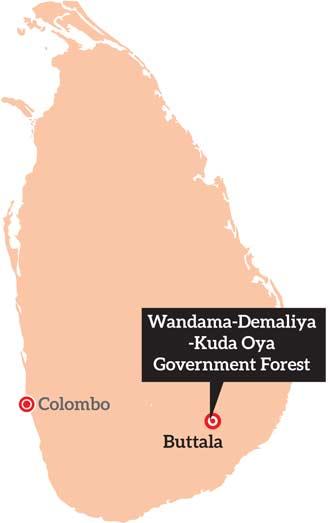
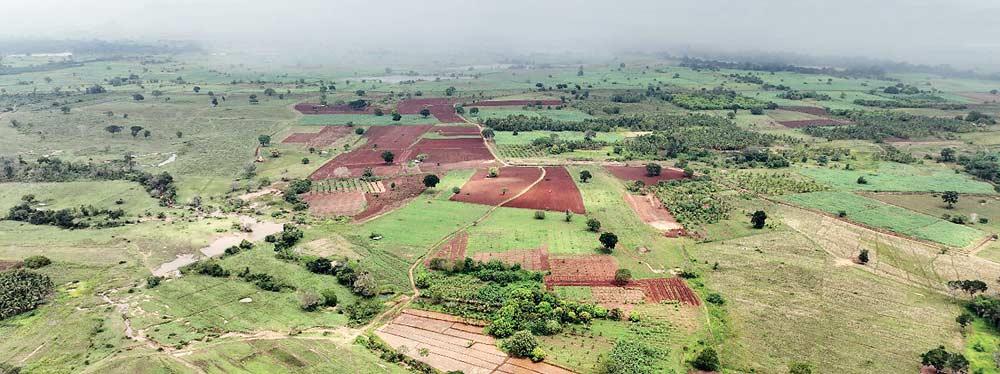
Plots of land inside a forest located in Rahathangama Grama Niladhari Division, which part of the Wandama-Demaliya-Kuda Oya Government Forest, have been sold to individuals and companies
 The Wandama-Demaliya forest area serves as a corridor for elephant migration between Lunugamvehera National Park and Handapanagala Wewa
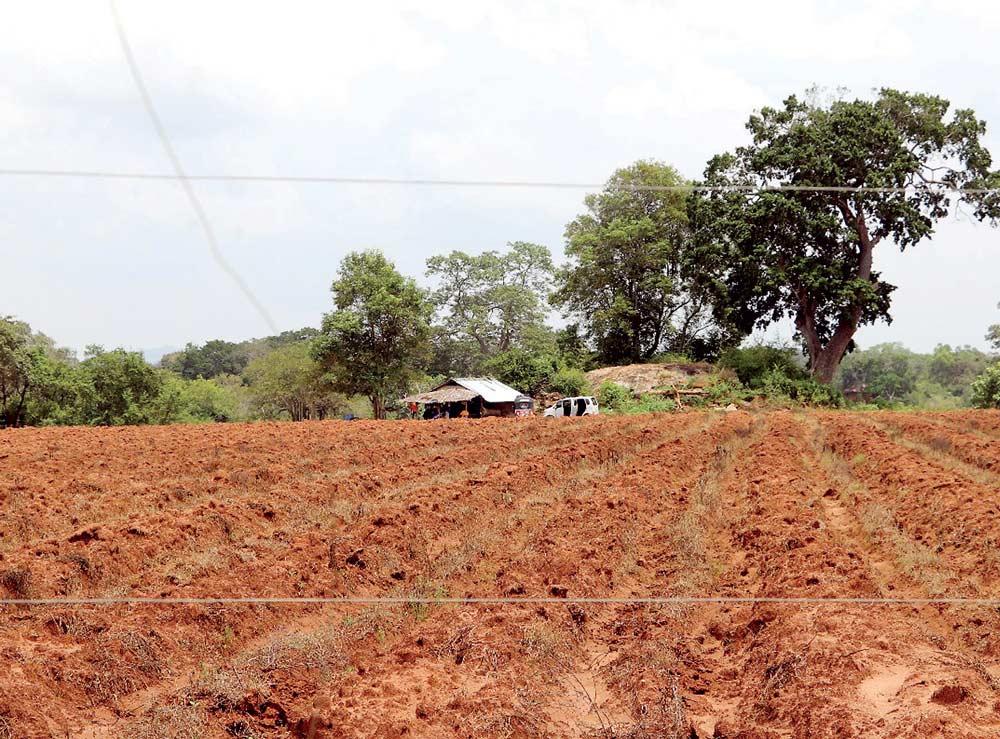
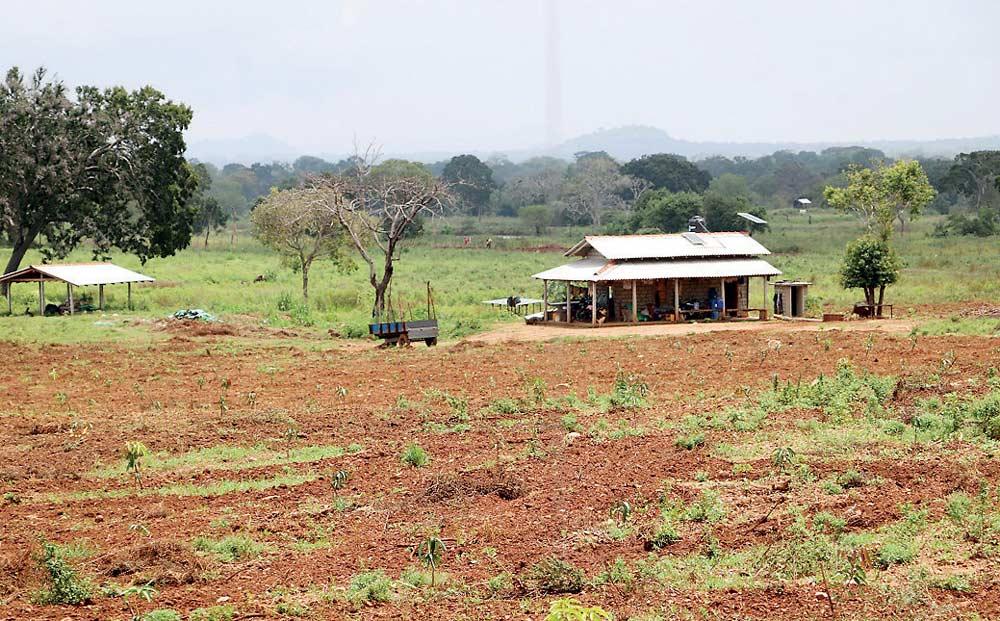
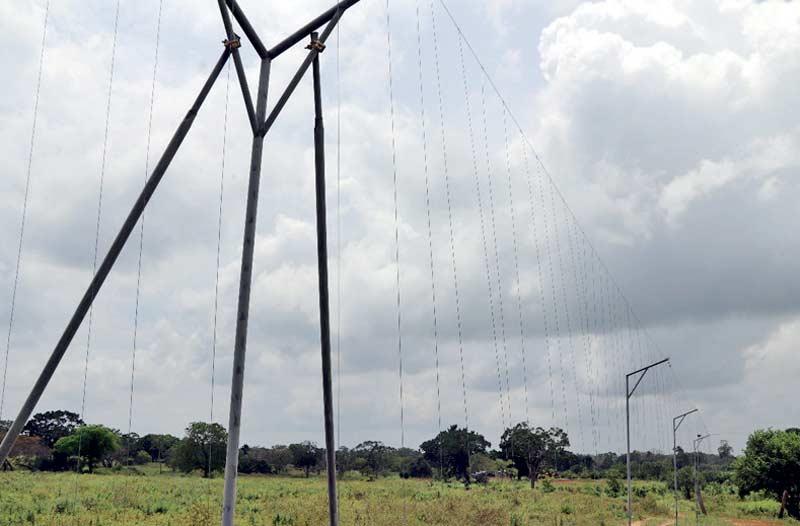
Currently, around 3000 acres of forest have been cleared, suspended electric fences have been installed and large-scale commercial plantations have expanded
This land acquisition started with 1,200 acres of government forest being unlawfully allocated to a leading agriculture company and another 500 acres to a company associated with farms
 The forests located in Rahathangama Grama Niladhari Division, which is part of the Wandama-Demaliya-Kuda Oya Government Forest— a crucial habitat for elephants roaming across Buttala and Wellawaya Divisional Secretariats in Monaragala district — have been leased to several companies and businessmen by an official attached to the Buttala Divisional Secretary. Additionally, a former Buttala Beat Forest Officer, who was responsible for overseeing these areas under the Forest Conservation Department, has facilitated the release of these lands to companies and businessmen by allegedly accepting bribes. This large-scale land scam has been orchestrated by a former Member of Parliament, who was also a Deputy Minister and a former Chairman of Monaragala District Coordination Committee.
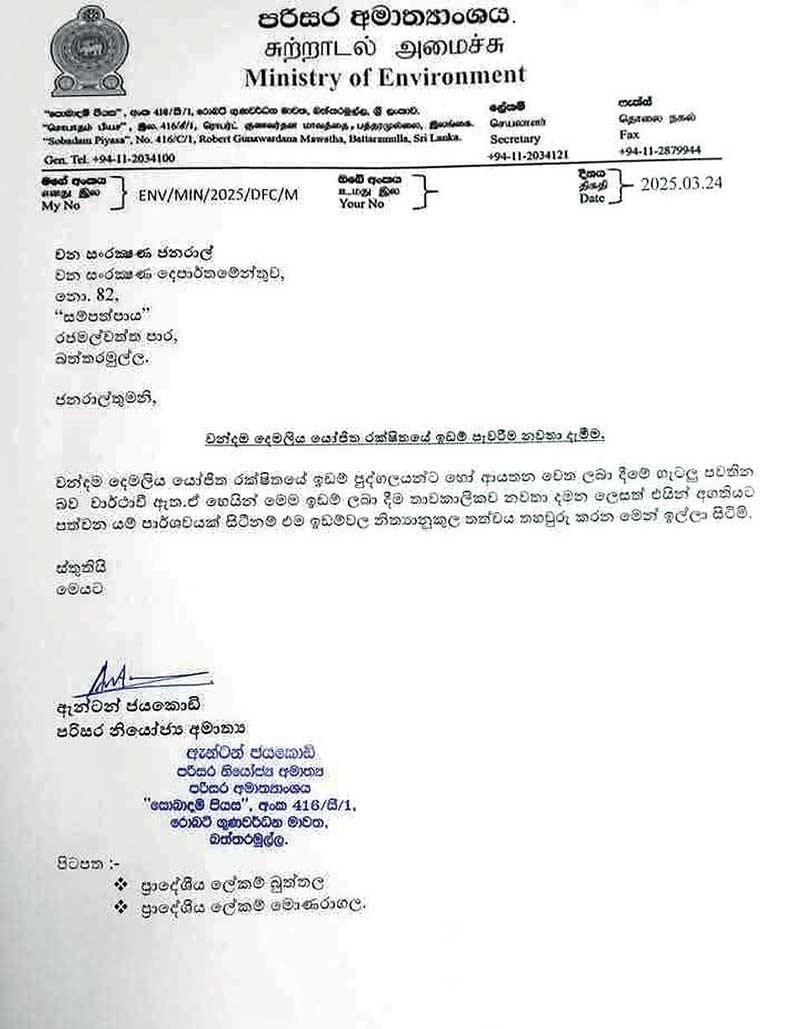
 Now there is bad news for individuals who have obtained lands inside Wandama-Demaliya-Kuda Oya Government Forest reserve in a questionable manner. A circular dated 24-3-2025 and issued by Deputy Minister of Environment Anton Jayakody to Forest Conservation General of the Forest Conservation Department states that there are issues related to how lands have been distributed to individuals and companies inside the Wandama-Demaliya-Kuda Oya Government Forest reserve. The circular stops plots of land from being further distributed inside this reserve to individuals. It adds that individuals who have lands inside the reserve and are grieved by this circular to prove legal ownership of their lands.
The Wandama-Demaliya forest area serves as a corridor for elephant migration between Lunugamvehera National Park and Handapanagala Wewa. Approximately 120 elephants and tuskers inhabit this region. Currently, around 3,000 acres of forest have been cleared, suspended electric fences have been installed, and large-scale commercial plantations have expanded. As a result, elephant movement routes have been entirely blocked, forcing elephants into nearby villages and plantations in Blocks 16 and 14 — including Thelulla, Ethilwewa, Kithulkote, Ulkanda, Handapanagala, and Pelwatte colonies — leading to a severe escalation in human-elephant conflict.
 Furthermore, Section 48(1) of the Ordinance allows for the arrest without a warrant of any person who conceals information related to forest offences. Section 53A states that anyone who unlawfully clears, acquires, or occupies a government forest without permission is guilty of an offence and is subject to ejectment, in addition to the penalties
Additionally according to Project Procedural Orders No. 1 of 2001 published in Gazette No. 1152/14 dated 04 October 2000 as per Sections 23A and 47 of the Antiquities Ordinance No. 09 of 1940 (amended), an archaeological impact assessment is required and approval must be obtained before clearing any area larger than 2 hectares
Kadawara Wewa, Paralu Wewa, Demaliya Wewa, Hurathgamuwa Wewa, and Guneris Wewa are located within and along the borders of the 2,694-hectare Demaliya-Wandama-Kuda Oya Government Forest. This forest area serves as the catchment for these reservoirs, as well as Kirindi Oya. It was also proposed to be designated as the Wandama-Demaliya Wild Elephant Management Reserve under the Uma Oya Multipurpose Project. However, before this could happen, a team led by an official of the Divisional Secretariat Buttala leased the entire forest area to companies and businessmen.
Illegal occupying of Govt. forests
|
The circular dated 24-3-2025 and issued by Deputy Minister of Environment Anton Jayakody to Forest Conservation General of the Forest Conservation Department states that there are issues related to lands that have been distributed inside the Wandama-Demaliya-Kuda Oya Government Forest reserve- The Wandama-Demaliya forest area serves as a corridor for elephant migration between Lunugamvehera National Park and Handapanagala Wewa |
The illegal acquisition of this forest land began during the tenure of a former Monaragala District Forest Officer. This land acquisition started with 1,200 acres of government forest being unlawfully allocated to a leading agriculture company and another 500 acres to a company associated with farms. Since then, this land racket expanded throughout the entire Wandama- Demaliya -Kuda Oya Government forest system. A former Buttala Divisional Secretary and a former Wellawaya Divisional Secretary were also involved in unlawfully releasing these lands to some companies. As a result, elephants that inhabit this forest (the figure roughly estimated at 120) along with those that migrate between Lunugamvehera National Park and Handapanagala Wewa— now face severe consequences. Many elephant deaths have been reported in this region, with company employees and businessmen allegedly shooting elephants.
Additionally, 202 acres of the largest forest area in the region, bordering Lunugamvehera National Park (currently home to elephants) are now being prepared for release for commercial cultivation. These lands, which fall under the Wellawaya Divisional Secretariat Division, are being set up for release by a Divisional Secretary, who is alleged to be under the influence of several land smugglers.
The lands within the Wandama- Demaliya Kuda Oya Government Forest are being acquired on a large scale by a network of politicians and businessmen. A former Member of Parliament has acquired 300 acres, while the son of a former Member of Parliament has obtained 100 acres. A Buttala businessman, known for owning several massage parlours, has secured 150 acres. Another company associated with farms now occupies 100 acres while another company having interests in the farm industry has 50 acres. A monk residing in Australia has acquired 100 acres, and several other businessmen have obtained 50 acres each. All these forest lands have been cleared and cultivated in direct violation of numerous environmental laws.
Violation of forest laws
The Wandama-Demaliya-Kuda Oya government forest is designated as Demaliya-Kudaoya Proposed Reserve and is maintained as a government forest according to Section 20(1) of the Forest Conservation Ordinance, last amended by Act No. 65 of 2009. According to this section, it is an offence to fell trees, cultivate land, erect temporary or permanent structures, reside, or build and use roads within such a forest. Anyone convicted of these offences by a court of law may face imprisonment for up to 2 years, a fine ranging from 5,000 to 50,000 rupees, or both. Additionally, the court may impose further fines to cover the damage caused to the forest. Under Section 20(2) of the Ordinance, aiding or abetting illegal activities in a government forest is also an offence, and those involved may face the same penalties.
Furthermore, Section 48(1) of the Ordinance allows for the arrest without a warrant of any person who conceals information related to forest offences. Section 53A states that anyone who unlawfully clears, acquires, or occupies a government forest without permission is guilty of an offence and is subject to ejectment, in addition to the penalties. These ejectments are carried out under the State Lands (Recovery Of Possession) Act (No. 7 of 197) and are enforced by Divisional Forest Officers in the relevant area.
The key question remains: on what legal basis have officials of the Buttala Divisional Secretariat, Department of Forest Conservation and a former Deputy Minister lease the Wamdama- Demaliya-Kuda Oya Forest? How can the authorities ensure the legal protection of the forest from companies and businessmen? The law must be enforced against everybody; regardless of whether the wrong doers are officials or politicians.
An important legal precedent on this matter is the Patapilikanda judgment. According to writ petition CA/Writ/No. 2047/2003, heard in the Court of Appeal, which challenged the granting of an annual licence by a Divisional Secretary for government forest land in Patapilikande governed by the Forest Conservation Ordinance, the writ directed the Secretary to the Ministry of Environment and Natural Resources and the Conservator General of the Forest Conservation Department to take measures to safeguard the relevant government forest land.
Case S.C. No. 78/2006 heard in the Supreme Court against that order, upheld the Court of Appeal’s decision, holding that issuing an annual licence for government forest land without the consent of the Department of Forest Conservation constituted an act of excess of power. Despite these legal precedents, an official of the Buttala Divisional Secretariat has unlawfully leased government forest lands in Wandama and Demaliya areas to companies and businessmen, violating the law.
Violation of Environmental and Antiquities Acts
The development of these controversial lands, illegally leased to companies and businessmen, has also been carried out in violation of the law. Under Gazette No. 772/22, dated 24 June 1993, issued pursuant to Section 23B of the National Environmental Act No. 47 of 1980, as amended, prior written environmental approval, subject to an Environmental Impact Assessment (EIA) process, is mandatory before utilising more than 1 (one) hectare of forest for non-forest uses or clearing more than 50 hectares of land. Anyone found violating this provision, upon conviction in a Magistrate’s Court under Section 31 of the Act, may face a fine of up to Rs. 15,000, imprisonment for up to 2 years, or both. Despite this, questions are raised whether the Central Environmental Authority, responsible for enforcing the Act under these provisions, has failed to act against the illegal activities of these companies and businessmen?
Additionally according to Project Procedural Orders No. 1 of 2001 published in Gazette No. 1152/14 dated 04 October 2000 as per Sections 23A and 47 of the Antiquities Ordinance No. 09 of 1940 (amended), an archaeological impact assessment is required and approval must be obtained before clearing any area larger than 2 hectares. However, the Department of Archaeology, tasked with implementing the Antiquities Ordinance, has taken no action against companies illegally maintain large-scale plantations by clearing forests in breach of these regulations.
Violation of the Constitution and the Penal Code
The actions of Buttala Divisional Secretary and Forest Conservation Department officials leasing out government forest lands in violation of established ordinances amount to abuse of power. Additionally, the officials of the Central Environmental Authority and Department of Archaeology are earning the wrath of critics for failing to enforce these ordinances. This constitutes a violation of the Constitution, which stands as the supreme law of the country. Article 27(14) of the Constitution, under Chapter Six: Directive Principles of State Policy and Fundamental duties, clearly states that the government shall protect, preserve, and improve the environment for the benefit of the community. The failure to uphold this responsibility directly contradicts this constitutional obligation.
Further, when studying the Penal Code, questions are raised whether an official of the Buttala Divisional Secretariat and Forest Conservation Officers have engaged in illegal conduct? Section 289 of the Penal Code specifies that whoever willfully neglects or omits to perform any duty imposed upon him any enactment or statute shall be punished. The penalty mirrors that of aiding and abetting a crime under Section 20 of the Forest Conservation Ordinance. Moreover, Section 158 of Chapter Nine of the Penal Code deems accepting a bribe to forebear to do an official duty an offence, punishable by imprisonment for up to 3 years, a fine, or both.
All these laws are designed to ensure the protection and long-term survival of both the people and the entire biological community of the country. Additionally, they aim to secure water resources for small-scale farmers engaged in agriculture and to safeguard food sovereignty for the nation. Achieving these goals depends on the protection of forested catchments and wildlife habitats. To make this a reality, the rule of law and a democratic governance structure must be firmly established. If the current government is genuinely committed to creating such a system, it must reclaim all illegally leased government forest lands, dismantle the electric fences that fragment elephant habitats, and return these lands to the Department of Forest Conservation for restoration.
The Movement for Land and Agriculture Reform opines that all government forests should be immediately declared as reserves. They also maintain that audits must be conducted to expose past illegal activities. Legal action should follow against any officials found responsible for these violations. The government must act swiftly to enforce these measures. However, the government’s focus on censuses of animals that damage crops reveals a lack of understanding of the root causes of these issues. Therefore, the current government must recognise that the destruction and fragmentation of wildlife habitats are the primary causes of increasing elephant-human conflict and crop damage by wild animals. The Movement for Land and Agriculture Reform also stresses the need for urgent action to address these issues.
(The writer represents the Movement for Land and Agriculture Reform)