Reply To:
Name - Reply Comment
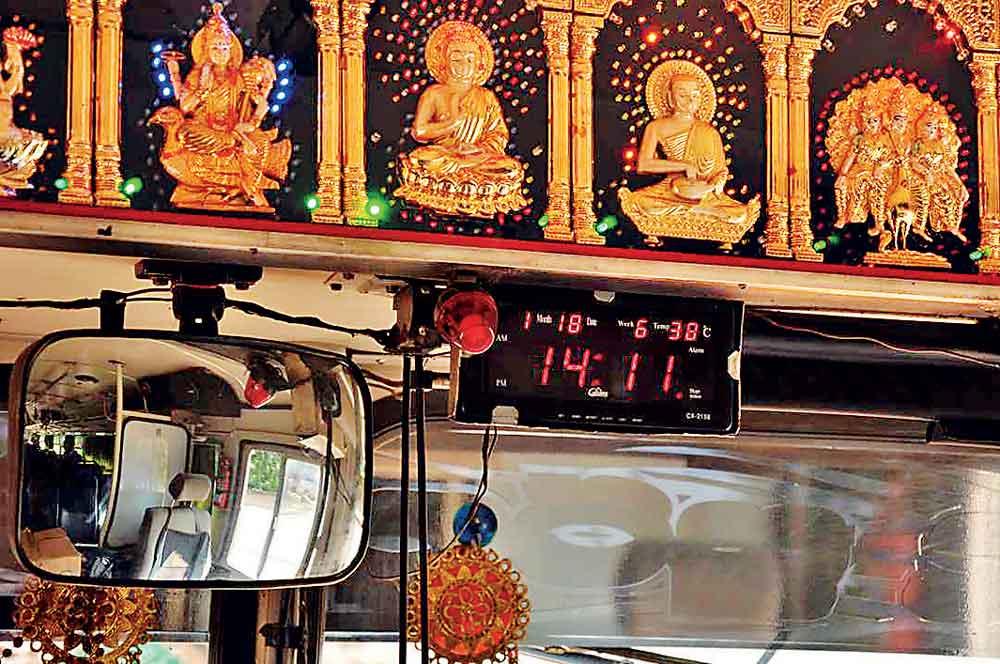
To Negombo - Bus interior
- There is, deep down, an irrational and totally unjustifiable faith about state-run services. It’s a tussle between a lost, romanticised past, and an unknown, uncertain and unromanticised future
- The choice of music in buses is often more of an insult to one’s sensibilities than the noise
- n the 1980s, fights between passengers and crews were common, but nobody raises a voice any more. They have become part of a self-consuming system of wasted energy, delays, horrific accidents and stress
 On Christmas day, I headed to Negombo for a much needed break. A friend who lives by the lagoon invited me for dinner and a quiet night of discussion and reminiscences.
I wanted to travel by train. But his home is closer to the Negombo bus station than the railway station, and I decide to go by bus. It’s three in the afternoon, and I got into a parked Fort-bound Route No. 103 at Borella. It took half an hour to get to Pettah, four kilometers away, stopping and waiting to pick up passengers.
There is a lingering sentimentality and nostalgia about Sri Lanka Transport Board (SLTB) buses. It’s hard to explain, and is certainly not shared by many of my contemporaries. But there is, deep down, an irrational and totally unjustifiable faith about state-run services. It’s a tussle between a lost, romanticised past, and an unknown, uncertain and unromanticised future.
Gone are the days when I used to linger at bus halts, waiting for an SLTB bus, and finally boarding a private bus after a fruitless wait. My loathing of the private bus ‘system’ is complete and immutable, though the days when I used to quarrel with private bus crews is now a distant memory. In the 1980s, fights between passengers and crews were common, but nobody raises a voice any more. They have become part of a self-consuming system of wasted energy, delays, horrific accidents and stress.
That’s why I made my peace with the system and switched to my own transport thirty years back. Your self-respect is less at risk. But this Christmas Day, I decided to travel by bus, a rash decision which revived bad memories of our unsalvageable public transport.
After getting down at Pettah, it took another ten minutes walking in the afternoon heat to reach the SLTB bus stand, moved further down to Gunasinghepura as the old station remains closed for repairs. There was a Route 240 Negombo-bound SLTB bus parked as I walked in. There were only a few passengers, but a loud stereo was blaring music inside.
Playing loud music in public transport was banned several years back. But there seems to be a collective amnesia about the ban. I braced myself for the ordeal as Negombo was at least one hour away.
The young driver was at his seat and using his phone’s playlist for entertainment. His choice wasn’t bad. It was a song by Senanayaka Veraliyadda. The choice of music in buses is often more of an insult to one’s sensibilities than the noise. But, when the songs are at least of some quality, there seems to be no point in protesting. You have to be thankful for the small mercies in life.
The music was actually mono, because there was only one speaker, fixed to the luggage rack at the front. This bus showed a sense of ownership, with some fresh paint daubed here and there. Unlike private bus owners, the SLTB doesn’t add cosmetics to its buses, but some drivers claim the buses they drive as their own, and add stereos and decor if they have the means to do so. I’ll always remember that Route 120 red double decker school bus which had a pair of green plastic parrots that lit up every time the driver braked.
In this bus, there were framed images of the Buddha and several deities, the god of Kataragama prominent among them. A few incense sticks burned harmoniously in a container near the driver’s seat. There were only ten passengers as we started. The ambiance was congenial, and I hoped to reach Negombo with both my inner peace and outer flesh and blood coverings intact.
The conductor’s behaviour attracted my attention. The SLTB crews no longer wear uniforms. The bearded, young conductor wore blue denims, black t-shirt and a chain prominent around his neck. His tone was hard and he gave me a hard look, seeing that I was the odd man out. He looked more like a member of the private bus mafia. It took me a moment to realise that there is actually no difference now between the SLTB, once upon a time a stickler for regulations, and the private buses, which don’t recognise any rules at all.
As we passed the New Kelani bridge and turned to Route A3 taking us to Negombo, I noticed that the driver ignored two frantic people running to catch the bus. Any private bus driver would have carried out horizontal gymnastics on the road to pick up anyone waving. The bus was mostly empty, but he wasn’t bothered.
And he was driving fast, probably a little above the speed limit. This being Christmas day, traffic was less than usual, and I didn’t see any police on the road as we passed Wattala. I looked at the small rectangular piece of metal lock on the sliding window. Contact with it during braking or a collision would cause a nasty injury.
Passing Ja Ela, however, the driver slowed down to a crawl. The reason – he was answering a phone call. The music (from the phone’s playlist) was switched off, and he drove with one hand, holding the phone with the other, till we passed Katunayake.
The bus was only half full and the conductor now began to call out for passengers each time the bus stopped at a halt. It didn’t, however, wait to pick up passengers as a private bus would have done. This is why we need to maintain the SLTB even at a loss. Sri Lanka was recently ranked among the least healthy 40 nations of the world, and the stress of bus travel has to be a prime reason for health breakdowns. You still have a greater chance for the small mercies of life from the ailing SLTB mammoth.
The sun was mellowing when we reached Negombo, a distance of 35 km. But I’m glad I got there safely. After a restful time with my friend and his family that night, I set out for the return journey the next morning. At the Negombo bus stand, SLTB and private buses take turns, and I got into a waiting private bus.
It’s the same Indian-made bus, no difference in chassis or body, but this one was covered full length with stickers and blinking lights. The sound system was more elaborate, with six speakers on luggage racks covering the whole bus.
Apart from the Buddha image, there was a small statuette of Jesus Christ on the dashboard, and a large picture of a benevolent goddess Saraswathi staring at us, gold coins pouring out of her lap.
The conductor was a big-made man, but he was polite. Mercifully, the choice of music was OK – it was mostly Namal Udugama. The bus was crowded, with barely standing room as we reached Ja-Ela, roughly half way. I noticed that, despite all the cosmetics (someone’s interpretation of heaven?) that tiny window lock looked dangerous, and the window rattled. It’s poor cousin on the SLTB bus made less of a racket.
But we managed to reach Pettah safely. Happy to report that my stress levels were under control.