 KELUM BANDARA
 Reply To:
Name - Reply Comment
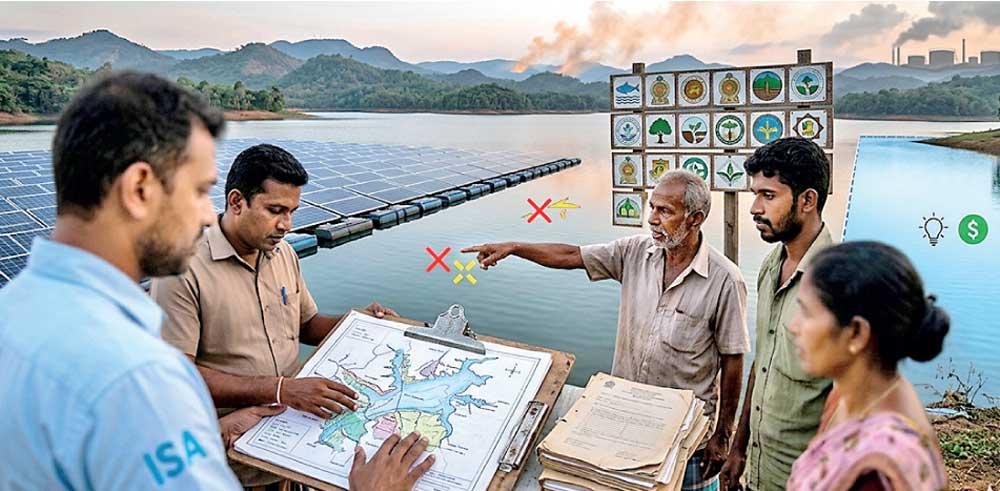
Director General of the International Solar Alliance (ISA), Ashish Khanna, who was in Sri Lanka recently, spoke to the Daily Mirror on the future of solar energy utilisation in the country and the plans put in place for it. Excerpts of the interview:
Q Given the current situation, what is the programme this time around and since you discussed certain matters during your last visit, what improvements have been made and what is the way forward now?
A lot has happened since I came the last time. There is an unfortunate war happening in West Asia. That has increased the price of oil and gas tremendously and also made availability very difficult.
 What I am hearing from across the world, including Sri Lanka, is that solar and storage made a lot of sense, first from a climate change perspective and secondly it made more sense because it is much cheaper.
For example, Sri Lanka just completed a bid for battery storage for 150 megawatt-hours, for which the price is only Rs.17, which is very good for the evening peak hours compared to, say, Rs.90 for diesel-based generation today. That is just one-fifth of the original cost.
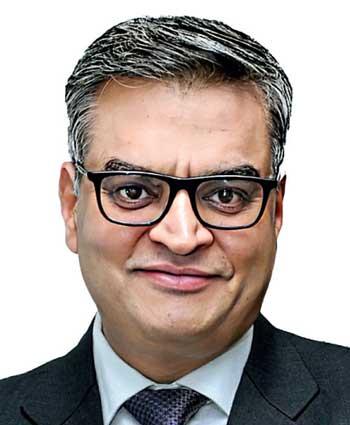 |
| Director General of the International Solar Alliance (ISA), Ashish Khanna |
Economics makes sense for solar. The war in West Asia is showing that it not only makes sense in terms of climate economics, but it also protects from shock impacts. If Sri Lanka had a lot more solar and EVs, the impact of diesel and gas shortages would have been much less. The fact that the country already has around 800 megawatts of rooftop solar and EVs is helping in this endeavour.
Imagine if this was accelerated—it could be even better.
We have also agreed to come up with a detailed country partnership strategy between the International Solar Alliance (ISA) and Sri Lanka. We are endorsing this country’s partnership strategy.
I met the Prime Minister, the Minister of Energy, the Deputy Minister of Finance, the Minister of Agriculture and the Minister of Plantation. Sri Lanka can benefit from policy work, particularly in policy and regulations.
Now, anyone who lives in Sri Lanka with rooftop solar knows how important batteries are. I think Sri Lanka needs to do much more on storage, including lithium-ion batteries and new battery technologies.
QWhat should be the pricing?
I also think everything should be done through competitive tenders only. That is a good thing because now competitive tenders are being used. The price discovered at Rs.17 is a good price for batteries.
That is the first part—we will help develop a storage policy so that everything related to batteries and others is clearly defined, given the target of 650 megawatt-hours of battery storage.
Now, the second policy issue is that it takes a long time to get approvals for solar projects. There are 17 agencies in Sri Lanka involved in the approval of any solar project.
We have started working with the Sustainable Energy Authority to streamline the approval process through a digital navigator. This means all processes will be integrated into a single tool. Not all these agencies need to be involved in solar approvals because the environmental impact of solar projects is very minimal compared to, for example, a hydro project.
Therefore, the environmental impact assessment process should be much lighter, similar to what Sri Lanka does for small hydro projects.
This is the second piece—streamlining approvals through a faster process, almost like a single-window clearance system or a single focal point. Otherwise, there are too many agencies involved.
The third policy issue is the use of digitisation and AI.
Sri Lanka already has 800 megawatts of rooftop solar. There are many complaints about curtailment on Sundays and on other occasions.
With digitisation of the grid—through smart meters, a distribution energy management system (DEMS), and an AI tool—the utility’s ability to effectively harness distributed energy resources will be significantly enhanced.
We will deploy the latest AI tools to support distribution companies in improving customer service and enhancing the integration of renewable energy into the grid. Finally, the fourth policy priority is the development of a comprehensive national solar energy roadmap. This will recognise the multiple applications of solar—grid-connected utility-scale projects, floating solar on reservoirs, rooftop installations, agri-solar initiatives and integration with battery storage systems. The solar energy roadmap will bring all of these together.
These are four important policy areas.
QHow will they help?
It will help attract significant private sector investment into Sri Lanka at much lower tariffs.
This would help bring in much more investment because there is a need to attract faster investment to reduce dependence on diesel.
QDiesel has been the fallback. But what is the position on environmental clearance? Many renewable energy projects—particularly solar and wind—face significant delays in Sri Lanka due to environmental concerns and objections raised by various stakeholder groups.
Correct. Our view is that the environmental clearance process should be simplified. Today, Sri Lanka requires environmental impact assessments for solar projects just like for hydro projects. This is not appropriate.
In India, solar projects do not require EIA at all.
Sri Lanka may decide not to remove EIAs completely. In mini-hydro projects, a smaller version of EIA, such as pre-environmental clearance, is used. Something similar can be done for solar, because solar does not have the same environmental impact as hydro projects, which affect fisheries, land and other ecosystems.
This is definitely something Sri Lanka should consider.
Why is it critical? To save scarce fiscal resources currently being spent on diesel. Diesel prices have doubled. If a farmer is operating a diesel pump or if a diesel plant is running in the middle of Colombo, it becomes very expensive.
Therefore, Sri Lanka must increase electrification of transport, industry and households. And where will that energy come from? From solar, wind and hydro, which are under your control. You are not dependent on anyone outside.
QDo you believe the current situation will accelerate a shift towards diversified energy sources and renewables, in light of the vulnerabilities exposed by dependence on the Middle East?
At present, only around 20% of total energy demand comes from electricity. Nearly 40% comes from transport—primarily petrol and diesel—while another 40% is used in cooking, industry and other sectors.
The key lesson from the West Asia conflict is that electricity’s share in the energy mix must increase significantly—from 20% to around 60% over the next five to 10 years. This shift would reduce dependence on imported fuels by electrifying transport and industry, including through the large-scale adoption of electric vehicles.
As electricity demand rises with this shift, a clear generation plan becomes essential. That demand will need to be met through a diversified mix of solar, wind and hydropower. Sri Lanka has significant potential for solar and wind energy. Harnessing these resources, alongside hydropower, strengthens energy security because they are domestically available and not subject to external supply disruptions. No global crisis can interrupt sunlight, wind or water flow. In addition, these sources are cost-effective and environmentally sustainable.
QHow big is Sri Lanka’s solar energy potential in real terms—and can it meaningfully meet future electricity demand?
Sri Lanka has already installed around 1,000 megawatts—or 1 gigawatt—of solar power capacity, the bulk of which, nearly 700 megawatts, comes from rooftop systems. The national plan is to expand this by a further 4 gigawatts, or 4,000 megawatts, by 2030, along with around 650 megawatt-hours of battery storage.
For this to materialise, the policy framework I mentioned earlier is critical. Most of these investments do not need to come from the government budget, which is already constrained. Instead, they must be driven by the private sector. Investors require clear policy and regulatory frameworks to make long-term commitments.
Globally, of the roughly US$2 trillion invested in clean energy annually, about 95% comes from the private sector, while only a small share is financed by institutions such as the ADB, World Bank, or Governments. Sri Lanka must therefore position itself to attract significant private investment into its energy sector.
QDuring your visit, did you have the opportunity to meet Sri Lankan policymakers and energy sector stakeholders and what did you learn from those discussions about the country’s energy direction?
All of them want to move faster on electrification and renewable energy in order to mitigate the impact of West Asia.
Sri Lanka has many reservoirs where floating solar panels can be installed. These reduce water evaporation while generating electricity. We will work with Sri Lanka to develop the first two projects through competitive bidding for about 100 MW.
The ISA will support both the bidding framework and the policy framework for floating solar.
The second area is agrivoltaics. In agriculture, particularly in tree plantations and spice crops, solar panels can be installed above crops in a way that generates electricity without affecting the agricultural yield. This is an emerging technology and we would like Sri Lanka to pilot and test it.
Within agriculture, there are around 27,000 diesel pumps today. There is no place for diesel pumps for farmers in today’s world. A solar pump costs about one-third of a diesel pump.
We would also like to support projects aimed at reducing dependence on diesel. Our approach is built on three pillars: policy and regulatory support, project implementation and development of human capability and green jobs in Sri Lanka.
As part of this, we have established the Solar Technology Application Resource Centre (STAR-C) at the University of Moratuwa, which was formally signed.
QIs there any plan for you to return for follow-up work?
Yes. All of this will require sustained engagement. We are working on setting up a national support unit at the Ministry of Energy for implementation.
There must be continuous follow-up. We will establish a project office here to monitor progress regularly.
I will visit every six months to jointly review progress. We have also established a steering committee co-chaired by the Secretary of the Ministry of Energy and myself. It includes all key stakeholders from Sri Lanka, along with one or two representatives from our side, to regularly meet and monitor progress.