 Kamanthi Wickramasinghe
Reply To:
Name - Reply Comment
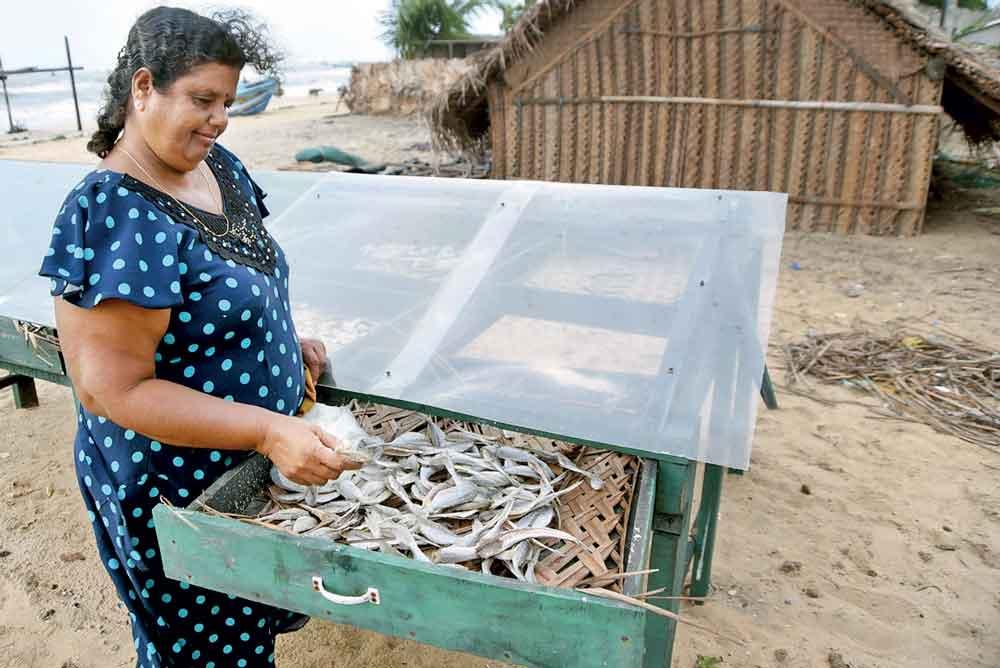
Dry fish is a main source of income for fisher women in Mannar Island. But they are challenged due to mega development projects
(Pics by Kushan Pathiraja)
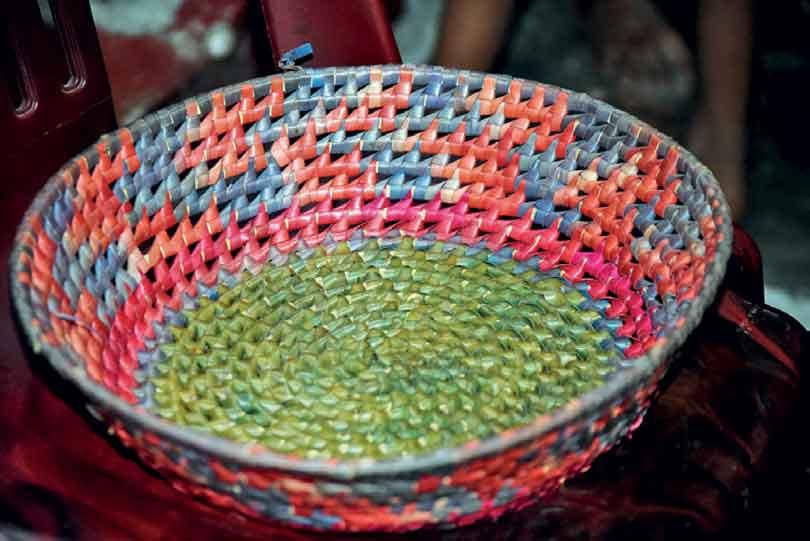
Palmyrah products made by women in Konnayan Kudiyirippu
- Today, women bear the hidden costs of climate change and mega development projects
- Over the years, Mannar has become vulnerable to rising sea levels and coastal inundation
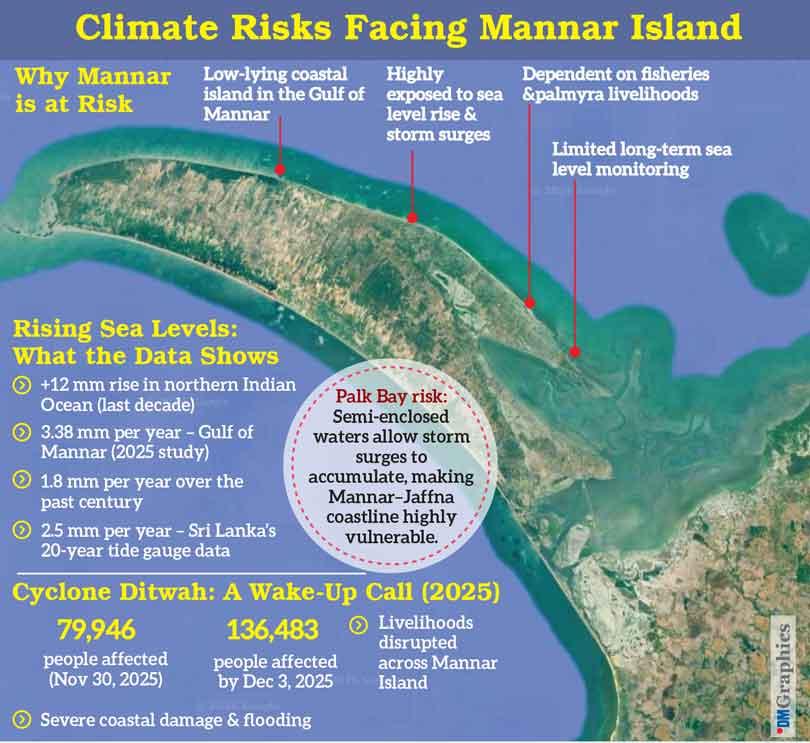
- During the peak cyclone period as many as 79,946 people from Mannar district were affected
Rita Wasanthi (54) from Jim Brown Nagar, a small hamlet in Mannar Island located in the Northern Province of Sri Lanka recalls how the shoreline along this coastal town has changed over the years. A greater part of the land on which she spent her childhood has now been dominated by the sea. Today, women bear the hidden costs of climate change and mega development projects in terms of loss of property, livelihoods and income and displacement. This story explores the woes of women in Mannar Island.
Sea level rise
A 2024 study on ‘Climate Change Risks to the Marine and Coastal Environment in Sri Lanka’ conducted by UK International Development indicates that average sea level rise has risen over 12 millimetres along the northern Indian Ocean coastal margins in the past decade. The report indicates that in Sri Lanka, the sea level is rising rapidly due to thermal expansion of the Indo-Pacific warm pool.
But the numbers have always varied. A 2025 study on 'assessing potential effects of climate change on morphodynamics of tropical coral reef islands in Gulf of Mannar' indicate that the sea level is rising at an annual rate of 3.38 millimeters per year. Over the past century, sea level rise has happened at a rate of 1.8 milimeters per year. According to a 2012 IUCN report on the Gulf of Mannar and its surroundings, much of the coastline of the Mannar region is subject to climate change. The hazard profile compiled by Sri Lanka's Disaster Management Centre indicates that Mannar lies in a vulnerable position and would be exposed to sea level rise and coastal inundation over the next few years.
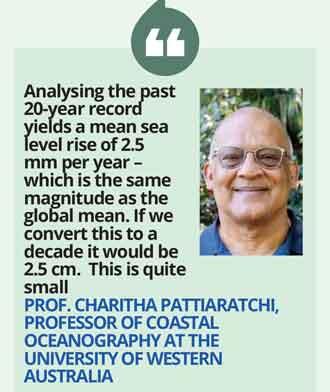
However according to Charitha Pattiaratchi, Professor of Coastal Oceanography at the University of Western Australia, Sri Lanka doesn’t have a long-term sea level monitoring system. He said that the continuous record of sea level is only since August 2004 when he managed to get a tide gage established in Colombo operated by NARA. “Analysing the past 20-year record yields a mean sea level rise of 2.5 mm per year – which is the same magnitude as the global mean. If we convert this to a decade it would be 2.5 cm. This is quite small. Consider the seasonal change in the mean sea level mainly due to freshwater input to the Bay of Bengal (density change) is 20-25 cm. Hence it is unlikely to have a major impact in the coming decades,” he added.
But, Prof. Pattiaratchi said that the Palk Bay is a critical area. “Sri Lanka doesn’t experience large storm surges in general due to the ocean topography (narrow continental shelf) except in Palk Bay. The big cyclone in 1964 (Rameswaran cyclone) created a storm surge of 7.6 metres in Danushkodi (Indian side of Adam’s bridge) – and basically washed out the train station there which used to connect to Talaimannar by ferry. India did not re-build so the Danushkodi Railway Station is a ghost town. Palk Bay is semi-enclosed – water can come in and out only between Jaffna and India – so water can accumulate in the Bay. So not only Mannar Island the island communities along the coast from Mannar to Jaffna are vulnerable as it is also a very low topographic area,” he explained.
Challenges faced by female breadwinners
 Hence, for local people and especially women, extreme weather events have now become a major concern.
“The sea is rapidly advancing towards the land,” Wasanthi told Daily Mirror. “There was a well which we used to go and have a bath. But now this well is in the middle of the sea. Similarly, the coastal area is diminishing due to rough tides and it is a risk to live along the shoreline,” she added.
Wasanthi has been working with the National Fisheries Solidarity Movement since 2014. She is a widow and also a differently-abled person, but she advocates for change, voicing issues faced by women engaged in the fisheries industry. “Fishing is a seasonal activity and once the season ends, we engage in sewing, poultry farming and other means of income,” Wasanthi said.
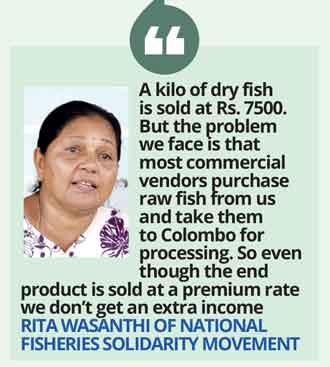
According to Wasanthi, many women are now engaged in exporting dry fish. “A kilo of dry fish is sold at Rs. 7500. But the problem we face is that most commercial vendors purchase raw fish from us and take them to Colombo for processing. So even though the end product is sold at a premium rate we don’t get an extra income,” she explained.
But living below the poverty line is a challenge in itself.
According to Wasanthi, most women have become victims of the microfinance crisis, obtaining loan after loan and getting trapped in a vicious cycle of debt. “Some people are entitled to government welfare schemes such as Aswesuma, but if there’s a husband addicted to alcohol at home, he would pressure the spouse to give him some money. Some women purchase cosmetic products and other unwanted items from the Aswesuma allowance. In fact their financial literacy is very poor and they end up in trouble,” Wasanthi added.
Gendered realities absent from national policy
Explaining the vulnerabilities faced by women in a post-war setting, Amali Wedagedara, Political Economist and Researcher specialising in agrarian debt and development said that destruction of marine ecosystems pose an existential threat for women in fisheries and related sectors who are forced to bear the burden of caring for their family single-handedly without  much external support.
The Sri Lankan government’s commitment to increasing women’s labour force participation is a stipulated condition of the 17th IMF programme. However, according to Wedagedara, the gendered realities of unpaid care and precarious work remain absent from national policy. “The misplaced faith that free-market forces would smooth the path to secure livelihoods has instead pushed women deeper into debt and dispossession, displacing many into exploitative sectors such as Free Trade Zones and the Middle East. As the proposed Microfinance and Credit Regulatory Authority Bill illustrates, even women’s own efforts to safeguard their livelihoods are now under threat in the name of regulation,” she added.
She further said that the 2024 International Labor Organization's analysis of Sri Lanka's gender pay gap hasn't informed strategies to boost female labor force participation, create public care solutions or mandate private sector equity. "By comparison, India has implemented a policy that directly acknowledges the economic value of care; an unconditional monthly cash transfer to women. The political motivations behind this transfer and it's problematic role within a landscape of shrinking social security, such as MNREGA are legitimate concerns. However, the foundational policy principle - that women's unpaid care work constitutes a public issue requiring redress - represents a significant improvement for socioeconomic rights in a context of pervasive exploitation," she observed.
Women’s unpaid care labour
Speaking at the 2026 World Economic Forum, Prime Minister Dr. Harini Amarasuriya said that economies would struggle to function without unpaid care work. According to Melani Gunathilaka, an Environmental Activist who has been vocal about injustices faced by women in Mannar Island, the government should take measures to recognise unpaid care labour that women already do. She said that women in Asia Pacific do over four times more unpaid care and domestic work than men. “Though care labour is not recognised as an economic activity, without care labour the economy cannot function. Growth driven economics ignore environmental costs just like unpaid care labour which is a fundamental issue of the economic system itself,” she underscored.
Lack of public consultation
The main livelihoods of people in Konnayan Kudiyirippu is fisheries and the palmyra industry. Many women like Jesudas Jeniprita (59) are involved in the palmyra industry. Apart from 30 wind turbines that were installed during Phase I of the Thambapavani wind power project, 10 more turbines are proposed to be installed in her village. But if more wind turbines are installed in her village, these villagers are likely to face more trouble. Apart from cutting down adult palmyra trees to make space for wind turbines, residents observe prolonged flooding as a result of newly constructed roads and wind turbines along the coastal stretch.
“Around November we start preparing ourselves to brave the floods, which is a new phenomenon to this village,” Jeniprita told the Daily Mirror. “But apart from floods we now have to purchase water because water from our wells is brown in colour and is not fit for consumption. So we purchase 10 litres of water at Rs. 120 (USD 0.39) and the bowser comes once every week, so we need to store water and use sparingly,” she added. But one of their main concerns is with regards to giving consent to the project. Jeniprita recalls how representatives of the project introduced a course on the palmyra industry and Batiks for women in this village. “The course on the palmyra industry and Batiks spread for three-months and they obtained our identification numbers and signatures. Following the course they gave us orders for products. But we raised our concerns regarding the wind power projects and in response they provided us with dry ration packs,” she added.
Speaking about the problems that occurred when obtaining consent for the EIA, Rebecca Miranda, member of Mannar Citizens Committee described it as a complete eyewash.
“The EIA was on the website, but nobody was made aware of it,” Miranda claimed. “So we made the community aware of the deadline for comments. Maybe they would have informed the Divisional Secretary, Grama Niladhari and other officials but nobody was interested to study the EIA, see what was met and what was not met, what are the mitigation measures and so on,” she added. According to Miranda, another mistake committed by the project proponent was that there was no grievance mechanism in place. “So people weren’t aware of where to complain. But on several occasions they made complaints to district secretary, divisional secretary and CEB but they weren’t addressed. These factors led people to take to the streets,” she added.
Legal provisions for public consultation
Large scale development projects earmarked in environmentally sensitive areas cause major environmental impacts. Therefore, conducting an EIA is essential to mitigate and prevent environmental degradation. Speaking to the Daily Mirror, Dr. Ravindranath Dabare, attorney-at-law and Chairman at Centre for Environmental Justice said that prescribed projects have been declared under Gazette Extraordinary No. 722/22 dated June 24, 1993. “According to that there’s a procedure of finalising and publishing the EIA. Public consultation is an essential component of an EIA. People need to be notified, it has to be published in a newspaper and be made available for comments. People have the right to file legal action such as a Fundamental Rights case or writ application if the EIA is not published in a newspaper. Usually, an EIA is open for public comment for a period of 30 days,” he added.
However, he said that a mere EIA is not sufficient for a project of this nature. “A Strategic Environmental Assessment is required but that is still not part of the law of this country. But amendments are being made to the National Environment Act to incorporate these provisions,” he further said.
|
Anton Jayakody |
When contacted, Deputy Environment Minister Anton Jayakody said that Sri Lanka needs 150 megawatts by 2028. He said that it is only after the remaining 14 turbines are installed that the country would be able to reach total capacity and meet the demand. “But as mentioned by President, we will not approve anymore wind power projects on Mannar Island, taking people’s voices into account. In addition, we will ensure that none of these projects would hinder the day-to-day lives of people,” Jayakody assured.
|
Dr. Terney Pradeep Kumara |
In order to reduce the impact of coastal inundation, the Department of Coast Conservation and Coastal Resource Management (CCD) is now looking at protecting the entire coastline using offshore breakwaters. “Offshore breakwaters would absorb wave energy and protect coastal areas from erosion. Revetments would be used as a last option but we are also putting up sandbags and trying to protect the coastline as well,” said CCD Director General Dr. Terney Pradeep Kumara.
Tamil to Sinhala/English translations courtesy of Edison Marynathan, K. Sanjeewani and T. K Mansoor.
(This story is produced with the support of InterNews Earth Journalism Network)