Reply To:
Name - Reply Comment
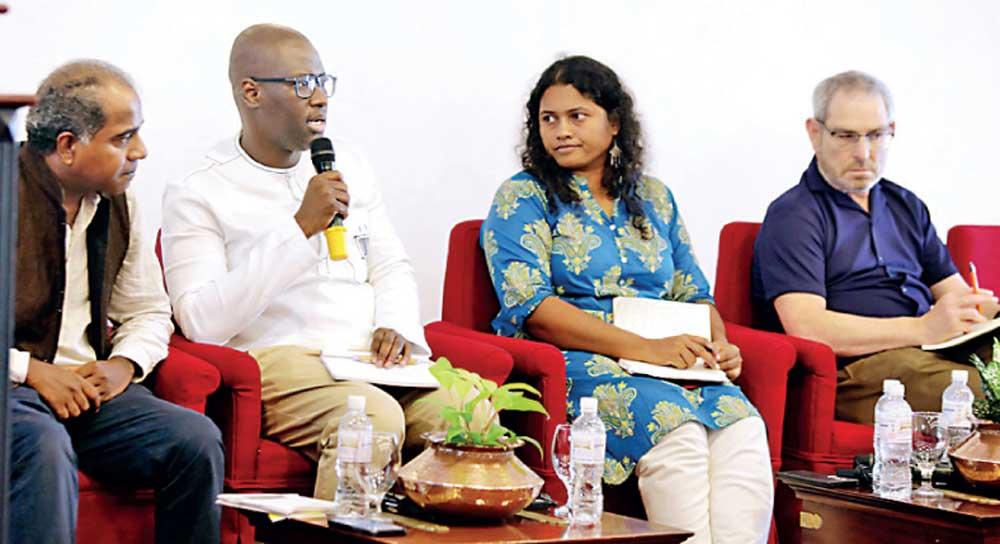
Panel 1 (left to right) Chair: Dr. Ahilan Kadirgamar, Speakers: Dr. N’dongo Samba Sylla, Dr. Amali Wedagedera, and Dr. Nimrod Zalk
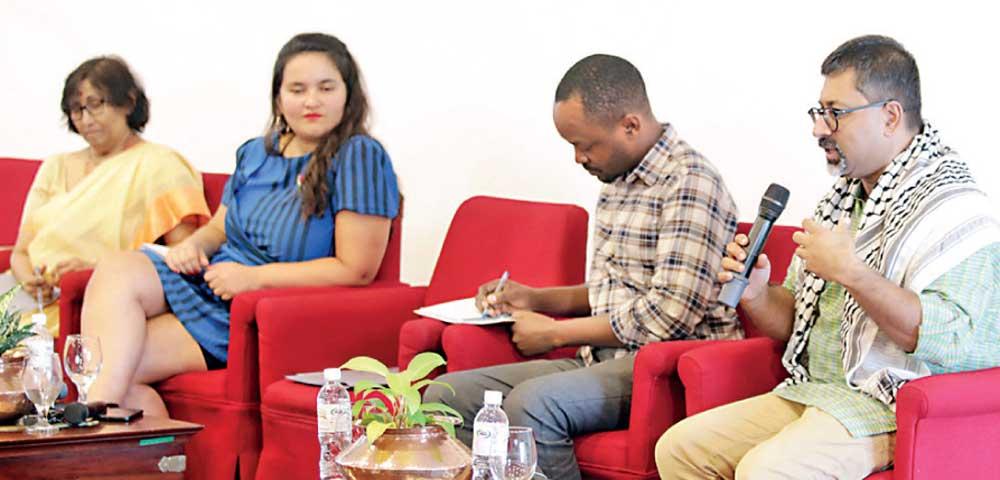
Panel 2 (left to right) Chair: Dr. Sakuntala Kadirgamar, Speakers: Dr. Javiera Maria Manzi Araneda, Dr. Sabatho Nyamsenda, and Mr. Balasingham Skanthakumar
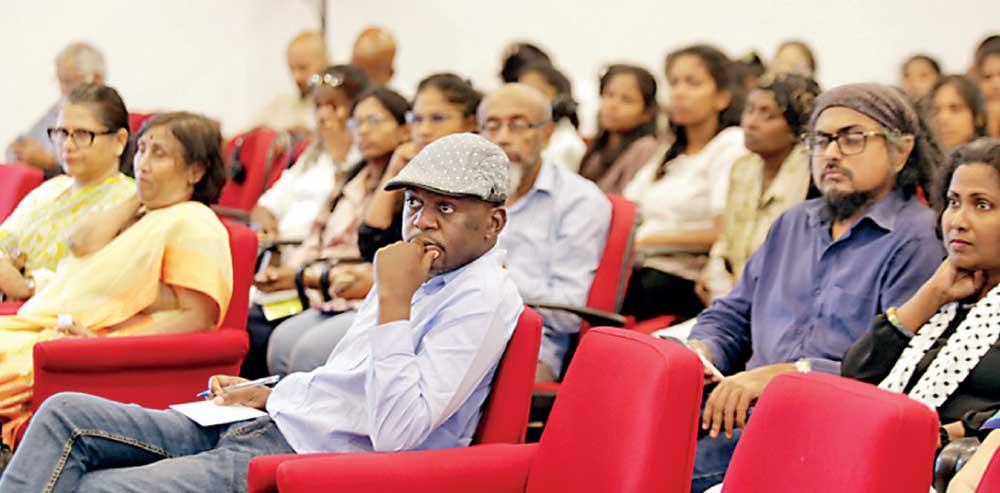
The audience at the second day of the conference held on June 3, at the Olympus Hall, BCIS
Pix by Pradeep Dilrukshana
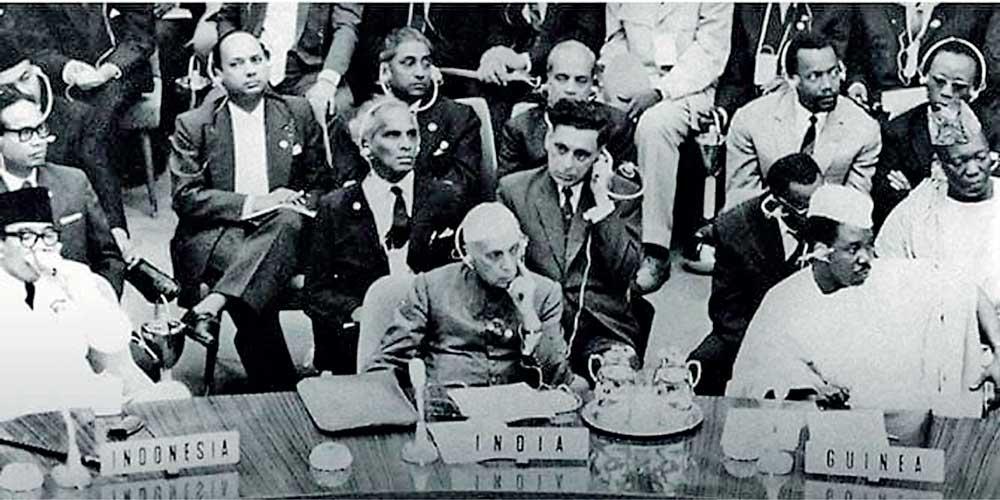
World leaders at the Bandung conference in 1955
By Zainab Hussein and Kamanthi Wickramasinghe
Bandung 1955 was a historical marker that broke the ground for third-world internationalism to develop against the logic of cold-war geopolitical monopoly. It preceded the non-aligned movement that expanded Asian-African solidarity to Latin America.In view of its 70th anniversary, a two-day conference was recently held under the title ‘70 Years after Bandung: Challenges and Struggles on the Road to Self-Determination and South-South Solidarity’.
The event hosted by International Development Economics Associates (IDEAs), Bandaranaike Centre for International Studies (BCIS), and Yukthi Debt Justice Collective brought together economists and activists from Global South, particularly countries from Latin America, Africa and Asia including from Sri Lanka.
Looking beyond the spirit of Bandung
In her opening remarks, Priyanthi Fernando, Executive Director at BCIS recalled the Bandung Conference and the events that followed when Sri Lanka co-hosted the Non-Aligned Summit. She said that in her opinion, the spirit of Bandung goes beyond non-alignment. “It was a movement that depicted the solidarity of the Third World during the late 50s, 60s, and 70s. In addition to our leadership in the non-aligned movement, there was also our leadership in UNCTAD, Law of the seas conferences and our principal stance on disarmament to name some of the global issues. Even though we are a small island state we made our presence felt,” she added.
Speaking about lessons that could be drawn from the Bandung experience, she said that solidarity and South-South cooperation are concepts that need to be pulled from the Bandung lexicon. “Then there’s the idea of colonialism, decolonisation and anti-imperialism. We could also perhaps work on reclaiming the idea of world peace, formulating a new international economic order. The 29 countries that came together in Bandung had different political and social configurations.
“It is the same diversity that today is suggested as the constraint to global South solidarity. But despite the diversity in Bandung, the countries had a unified, rallied call against colonisers and imperialism, and they demanded independence and self-determination. While we speak about the spirit of Bandung, we should also be thinking about what our unified rallying call could be,” she underscored.
Lessons to learn
Delivering the keynote speech, C. P Chandrasekhar, emeritus professor at the Centre for Economic Studies and Planning, Jawaharlal Nehru University (JNU), New Delhi, said that the Bandung conference is considered a milestone in global history. “It was a conference that reflected the spirit and aspirations of people who had just won themselves independence through freedom movements, through national resistance struggles against colonial rule,” he added.
He said that there are two aspects to consider when revisiting the Bandung Conference. “One is that we need to ask ourselves what is the nature of the Bandung movement; the other is what exactly did it reflect. “It was a point of time in the history of capitalism where there was a hegemony which had complete control over global capitalism. Japan and Germany had been defeated very badly during the war.
“You had a country which had come out of the war and escaped the Great Depression partly because of the war, and had decided to adapt changing policies; therefore we entered what’s called the Golden Age in American capitalism. You had a capitalism that had lower unemployment, low rates of inflation and high growth which was unprecedented in the history of what is known to be and is still a crisis-prone system.”
Prof. Chandrasekhar recalled how at that point of time there was renewed confidence in weakening previous imperial powers. “There was a set of countries that were willing to stand up and say that colonialism is evil and that it should be done away with.If we look at the Bandung spirit there was in some sense a recognition that it’s important to fight for the equality of nations, for sovereignty, territorial integrity, recognise each other’s’ right to self-determination.”
However at the current conjuncture, Prof. Chandrasekhar observes a decline in imperialism, ‘a decline in a kind of a crude aggression’ in his own words.
“It’s a moment in which it appears that once again after a long period of time there seems to be a softening of inter-imperialist rivalry where imperialist nations were virtually aligned together. Neoliberalism has lost its legitimacy after the 2008 financial crisis which shows that it was a system which was fundamentally flawed leading up to a crisis which could have generated another great depression,” he said, adding that this movement, compared to the Bandung movement would have a greater degree of possibility and solidarity in the effort to take down imperialism in what seems to be a weak movement.
Summary of panel discussions
The second day of the conference, held on June 3, had experts from various countries of Asia, Africa and Latin America, who focused on aspects such as decolonisation, the new international economic order, South-South solidarity, and the revival of the Bandung spirit.
The first panel discussion revolved around Crisis, Planning and Industrial Policy, and was chaired by Dr. Ahilan Kadirgamar. Dr. N’dongo Samba Sylla from Senegal explained a few key areas where we need South-South and regional cooperation. “The removal of foreign military bases and mutual defence pacts is an important aspect. Let us remember the wise (though usually demonised) Niccolo Machiavelli, who said: “There are no good laws without good weapons.”
Furthermore, the current international monetary system which primarily benefits selective currencies, lead to debt crises, especially in developing nations, and hinders smooth regional transitions. Thus, establishing a Debtors’ Club (a united front against the ‘debt system’) and alternative payment systems are crucial. We also need regional cooperation to facilitate technological upgrading while reducing technological dependency.”
He further emphasised on the importance of promoting multilingual platforms that will provide accurate information and analyses on the struggles of global south countries, away from Western-centric accounts. “When countries unite, it helps to lower their economic cost, create better military resilience and enhance collaboration on global challenges such as climate change,” Dr. N’dongo remarked.
Representing Sri Lanka, Dr. Amali Wedagedera spoke about the economic crisis faced by the country and put forward proposals for financial reforms to facilitate the process of ‘delinking’. This term refers to a strategy, where countries or regions, especially those in the global south, strategically reduce their dependence on dominant global systems, and prioritise their internal development needs. She stated: “60 years of engagement with the IMF and 75 years with the World Bank has structurally transformed Sri Lanka as a low value, low skilled and vulnerable peripheral economy in the global division of labour. The paper shortage we experienced in 2022 and imposition of US tariffs are stark reminders of our status as a country dependent on the global economy.”
Dr. Amali said that Sri Lanka remains trapped in a vicious interdependent cycle of low value production and debt, and that the new government, elected to bring about change shows signs of a peripheral state which preserves the conditions of dependence.
“In this context, delinking refers to disrupting core periphery relations that impose international division of labour in countries that are destinations of cheap labour and raw materials. Rather than blindly following these relations or deepening them as the IMF or World Bank demand, delinking is vital as a pre-condition to industrialise an economy. It is rather clear that in order to gain monetary and fiscal autonomy, Sri Lanka has to exit from the IMF programme, reverse the independence of the Central Bank Act and abolish the Economic Transformation Act which preserves Sri Lanka’s status as a peripheral state,” she explained.
The second panel discussion focused on Decolonisation, Bandung Spirit and the New International Economic Order (1974), chaired by Dr. Sakuntala Kadirgamar. She noted that 70 years after the historic gathering between Asian and African states to discuss issues of decolonisation, the ‘Bandung spirit’ has potential of being resurrected in the global south and can challenge the contemporary global order.
Dr. Javiera Maria Manzi Araneda from Chile spoke about the crucial role played by feminism and anti-imperialism in this context, and explained the three D’s of peace: Disarmament, decolonisation and development.
Furthermore, Mr. Balasingham Skanthakumar from Sri Lanka said that occasions such as this anniversary are not only held to revive memories but also to remake them, as there is a need to form a united front irrespective of geographical and social backgrounds. He explained that the aim of the new international economic order was to restructure foreign relations and redistribute economic benefits in favour of under-developed countries. “It further enhances a state’s sovereignty over their domestic natural resources, enables technology transfers from industrialised countries and grants non-reciprocal trade preferences to developing countries,” Mr. Balasingham remarked.
Overall, the conference highlighted new challenges faced by the Global South, which represents 80 percent of the world’s population. Experts discussed the possibility of re-thinking the global structure and potential South-South solidarity, while emphasising the revival of the Bandung spirit and its necessity for countries like Sri Lanka.