Reply To:
Name - Reply Comment
By Dr Upul Wijayawardhana
|
Prof C.C. was a pragmatic researcher who made big changes with small things
|
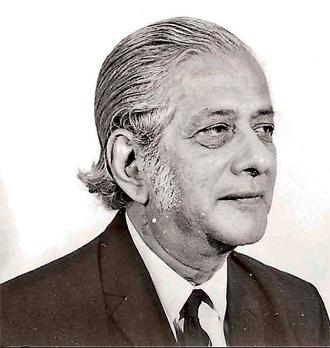
My mind went back to Monday, 20th April 1964, on reading the two tributes to Professor C. C. De Silva by Prof Thushara Kudagammana (The solicitous and virtuous life of Professor C. C. de Silva: Daily Mirror, 25 February) and Dr B J C Perera (Professor C. C. De Silva: A man like no other: Daily Mirror, 28 February). It is a day indelible in my memory as it was the day I started my very long medical career, spanning 47 years equally divided between my Motherland and my adopted ‘Fatherland’, and I had the great fortune of starting it with a ‘Man like no other’, Professor C. C. De Siva, a gentle giant.
Dressed in a white shirt, trousers, and overcoat, sporting a light green tie embossed with the face of a little child made by my late wife Primrose who was my girl-friend then, I arrived well before the great man to ward one in Lady Ridgeway Hospital, to be greeted by the outgoing intern medical officer. What astounded me was her greeting:
“Good morning Upul! Why the hell did you decide to work for this nasty man?”
Though I was dumbfounded to reply, the reason I wished to work with ‘Prof C.C’ was that even as a humble medical student I realised the greatness of the man. Shortly before my final examination, I was billed to do my second paediatric appointment with Prof C.C. The ‘Professorial paediatric appointment’ was the appointment medical students feared most, as it was the norm for Prof C.C to have a viva voce at the end of the two weeks and anyone who failed had to repeat the appointment. In our case, a batch of around 7 doing the appointment, would result in anyone failing the viva having to postpone the final examination with disastrous consequences. Fortunately for us, Prof C.C gave us a choice;
“What do you fellows want to do? Face my viva or go to the IDH with me to see smallpox cases?”
All hands went up as we shouted in unison “We will go to IDH with you, sir” Before any reader develops an admiration for our academic curiosity, let me be frank and state that the decision was based solely on the fact that we feared the smallpox virus less than Prof C.C’s viva!
Getting back to my first day as a doctor, after five gruelling years as a medical student, I waited for the arrival of the grey-haired imposing figure of Prof C.C. He arrived sharp on time and on seeing me he asked;
“You are the new intern, Wijayawardhana” When I said “Yes, sir” he fired the next question:
“Why did you choose to work under me”
“Sir, I want to start my career with a great person” The typical ‘huff’ Prof C.C was well known for, that followed meant that my start could not have been better!
Despite having several middle-grade doctors like registrars, lecturers and senior lecturers, the workload was heavy and the two interns were on call every other day; daily when the other was off for any reason. We craved undisturbed sleep on the off day but it was often disturbed as Prof C.C had the habit of ringing at all times to find details of patients relevant to his research, which was profuse. He overcame the ban on telephone calls to the house officers’ quarters after 11 pm by ringing the ward and requesting nursing staff to send the ‘call-boy’ with a message to ring him. We had no choice but to oblige.
A few weeks after I started work, a child was admitted with fits and I had to do many things to find the cause of fits and treat. By the time I finished, it was around 3 am. I knew very well that Prof C.C would be fast asleep and decided to ring him. I appraised him of the problem and answered a series of questions he posed me. Finally, he asked me:
“You have done everything. So, why are you ringing me”
“Sir, how do you feel to be woken from a deep sleep” I could hear him banging the phone.
I waited the next morning, shivering in my boots, for him to tear into me for a reprimand but nothing happened. Perhaps, he realised that it was the arrogance of youth that made me commit such a brazen act which did not deserve any reprimand and may well be that he got the point I made. I am pretty sure I could not have got away with any other superior and my respect for him grew exponentially. Not only he did not hold a grudge but also saw to it that I was not disturbed at night. This incident typifies his greatness. In that imposing big frame with a tough exterior was the kindest of hearts beating. Prof C.C indeed was a gentle giant!
I kept in touch with him after finishing the appointment and received invitations to join him for lunch at his country residence in Thalagolla. I attended with my wife, later with children as well, and remember well the wonderful hospitality of his wife Irene as well as his daughter Ilika. One morning in 1983, when I was Assistant Cardiologist to Dr N J Wallooppillai, he burst into my office and handed over a form saying;
“Fill that out and send it quickly” It was the nomination form for the Fellowship of the Royal College of Physicians, London which he had signed. I told him “Sir, I am too young. I have time” to which he retorted “You do but I do not. I want to see you rewarded for your work before I am gone” I obliged and was elected a fellow. He spotted talent and did whatever he could to reward. Dr B J C Perera mentions that he tried to do the same to him but, unfortunately, Prof C.C died on 20th May 1987 before the nomination could be forwarded.
A few years later he barged into my office again and told me that he had heart failure and I should treat him. That probably was the highest honour he could bestow on me. He had a leaky valve and I suggested valve replacement. As cardiac surgery was in its infancy, I suggested going to the UK and offered to accompany him. He told me “Upul, I am too old to do heroics. Treat me the best you can” I could not persuade him to have surgery and did my best but, unfortunately, it was not enough. He lived a full life and was not afraid of death.
Prof C.C was a pragmatic researcher who made big changes with small things. During the period when even saline was in short supply, he demonstrated that children, who were dehydrated due to diarrhoea could be treated with an infusion directly from a king coconut. He did so after establishing in his laboratory that the water from a six-month-old king coconut had the same electrolyte content as saline. He also showed that over-ripe Anamalu could control diarrhoea and help malnourished children with Kwashiorkor. Of course, this was on top of his internationally recognised research referred to in the two previous articles.
It is not often we see the likes of him. May Prof C.C continue to inspire generations to come!