 Kamanthi Wickramasinghe
 Reply To:
Name - Reply Comment
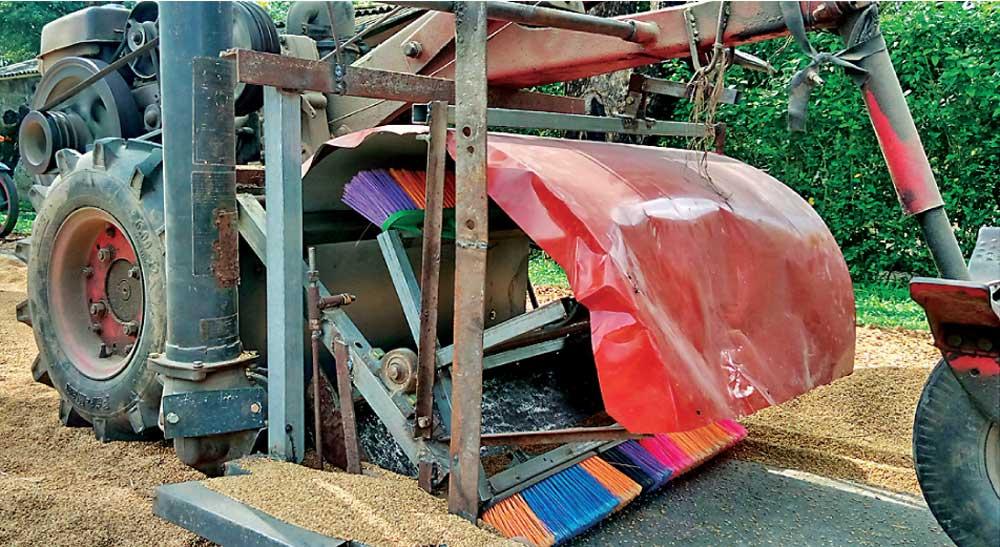
The machine has been constructed using scrap metal, brooms and other materials to collect paddy within an hour
 Paddy drying is a common sight in rural areas of the country, especially during the post-harvest season. But it is a tedious task for farmers to collect their paddy stocks as it is not only time consuming but also requires additional equipment, labour and money. To address this challenge, Indika Bandara, a farmer from Ridee Pokuna, Welikanda, Polonnaruwa has developed a paddy collecting machine that allows farmers to collect dried or moist paddy within a span of an hour.
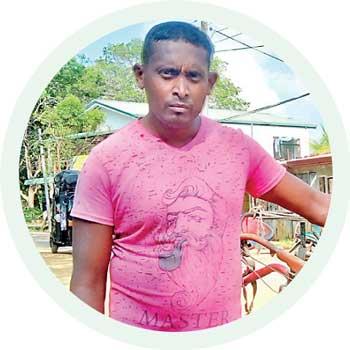 |
| Indika Bandara |
Having completed a motor mechanic course back in 2000, Bandara had already developed several other machines mainly for his own convenience. “I developed a machine to sort out rows of grass that grow in paddy cultivations and another machine to crush compost when the country experienced a shortage of fertilizer,” Bandara said in an interview with the Daily Mirror.
He said that the main reason to develop the latest machine is to meet the demand of heavy industrialization within the agriculture sector. From depending on manual labour for decades, paddy farmers are now inclined to use machines to even harvest paddy. “One of the most difficult tasks for a farmer is to dry their paddy stocks. Once the paddy has been evened out for drying purposes, at least five people are required to collect the dried stock of paddy and fill into gunny bags. So I was thinking of an alternative and eventually developed this machine,” Bandara added.
Bandara believes that his latest invention is a success but regrets not being able to fully complete it on time. Due to heavy rains experienced during the paddy sowing period, Bandara had to spend extra time in the field. “So I didn’t have time to develop the machine for this harvesting season. There are certain issues to fix such as the accumulation of dust when collecting dried paddy off the road. So I have to look at diverting the accumulated dust through a separate vent,” he explained.
The machine had been built using coils in paddy harvesting machines, pipes, certain parts in motorbikes, brooms and the rubber from tyres to push the paddy into the machine. Due to the absence of lathes, Bandara had to hunt for required materials on his own. It had taken around 45-50 days to complete the initial phase of the machine. Briefly explaining the mechanics, Bandara said that the machine has been connected to a tractor and the power is supplied through the rotary tiller. The paddy is collected within a span of one hour and consumes less time, money and labor. It had only costed him around Rs. 50,000 to develop the machine as it was built using scrap metal. “But if I used brand new materials it would have cost over Rs. 150000,” he added.
Positive feedback
Bandara hasn’t released any of his inventions to the market, but he had provided the latest machine to his friends engaged in paddy farming. He said that the feedback from them had been positive.
Speaking about challenges to the agriculture sector in Polonnaruwa, Bandara said that apart from the human-elephant conflict, farmers have been affected by extreme climate change events such as unprecedented rains. “The slightest rain would inundate some of our cultivations and this is a new phenomenon. Farmers didn’t experience such disasters some 10-15 years ago. The main cause for these flooding events is believed to be the filling up of small tanks in the area,” he said.
In his next attempt, Bandara aspires to develop a paddy planting machine. Drawing inspiration from a previous experience where had the opportunity to experiment paddy planting using a Japanese technology, Bandara believes that it would reduce the burden of planting paddy in future. “The Japanese technology takes up more space to plant the seeds. With this technology, you get 8-inch gaps between plants and 4-inch gaps between each row of paddy. Our paddy varieties don’t grow as bushes and these kinds of gaps are a waste of space. Therefore I want to develop a machine that plant paddy by taking up less space between plants and rows,” he added.
Bandara is willing to develop his inventions further and perhaps introduce them to the market if there are investors interested in providing him with finances to obtain patents and follow the due process. He believes that paddy farmers would depend on more technology in future. Bandara said that with the help of technology, farmers could reduce utilising pesticides and weedicides and develop a crop that is much healthier for consumption.
(Additional reporting and pix by Nimal Jayaratne – Manampitiya )