 Kamanthi Wickramasinghe
 Reply To:
Name - Reply Comment
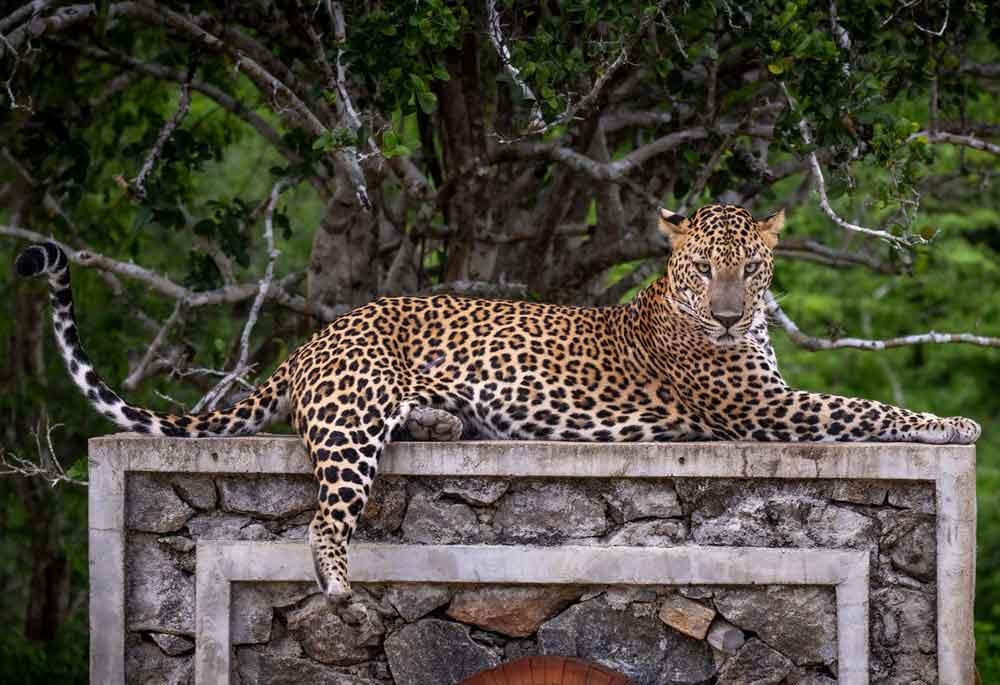
Kumana’s star
leopard Ritta. Image courtesy – Insights Kumana
Sudantha Chandrasena
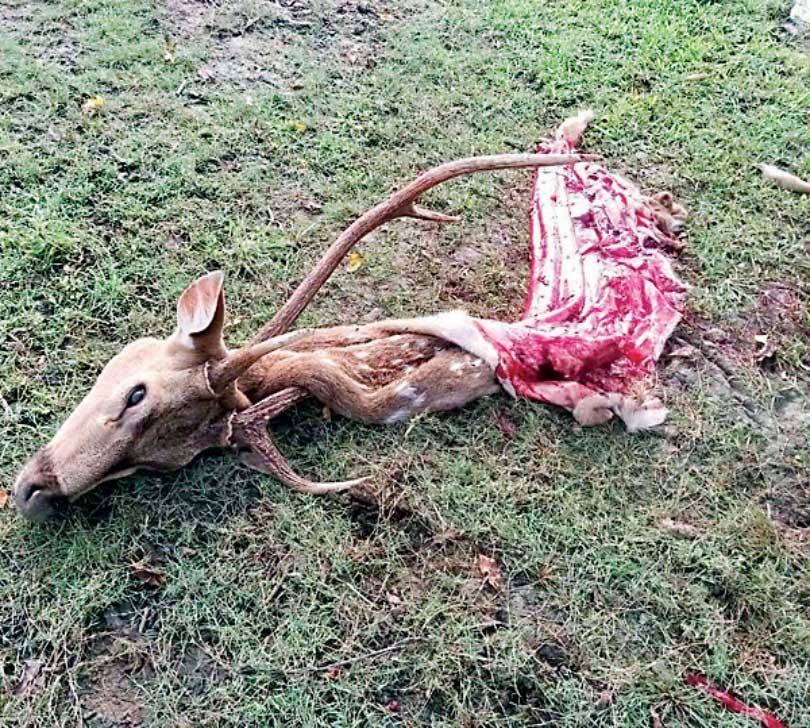
A butchered deer carcass discovered on February 8, 2026.
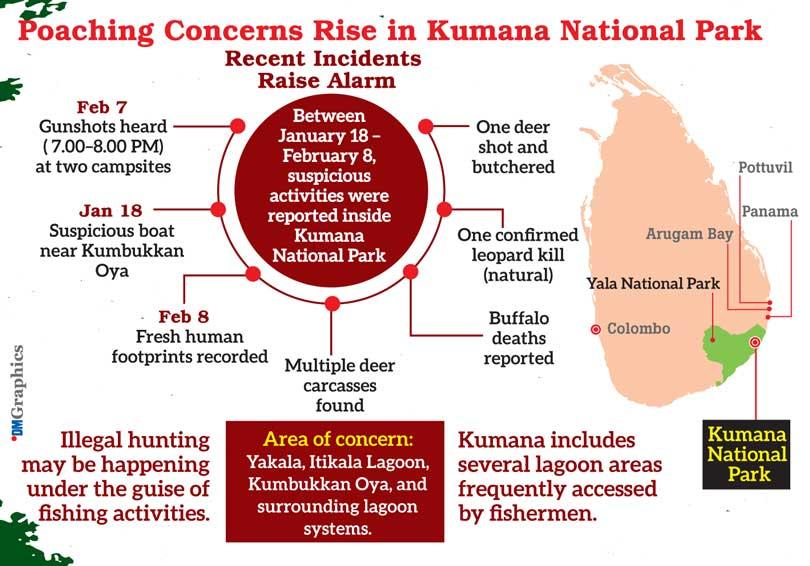
- Illegal hunting between January and February has raised speculation whether poachers are aiming at a different target
- Though there are docking areas for registered boats, most illegal activities happen under the guise of fishing
- Questions have also been raised about manpower at the Park with no dedicated unit to conduct anti-poaching patrols
 The recent deer carcasses found at Kumana National Park have sparked fresh concerns about threats posed to wildlife including leopards inside this protected area. The Kumana National Park includes several lagoon areas that are frequented by fishermen. According to sources, incidents of unauthorised access and suspected illegal hunting activity between January 18 and February 8 have raised suspicion as to whether the poachers are aiming at a different target than just deer and buffaloes.
Incidents of unauthorised access
The Daily Mirror learned that with fishing activities taking place in the Eastern province, there are docking areas in Okanda, Panama, Arugambay and Pottuvil for registered boats. Most illegal activities happen under the guise of fishing. A source that spoke on conditions of anonymity said that there are no checkpoints from the lagoon except for the occasional naval patrol. This is the first incident where a gunshot correlates with an actual kill site. Earlier even if we heard gunshots it’s not easy to locate a carcass. There have also been instances where carcasses were discovered without gunshots being reported, the source told Daily Mirror.
Usually hunters are compelled to spend a bit of time in the jungle, consume the fish they catch from the river and stay till nightfall to hunt down a deer or buffalo. The source further said that there’s a mix of actual fishermen as well as illegal fishermen coming near the lagoons of the park to catch fish.
Suspicious activities
On January 18 a suspicious boat had been discovered near the mouth of Kumbukkan Oya. On February 7 gunshots were heard by two separate occupants at two campsites between 7.00-8.00pm. In addition, fresh human footprints were recorded on February 8. This incident had taken place near a lagoon and plain called Itikala.
When visitors and trackers saw the first deer they had in fact thought it was a leopard kill and jeeps were around for about four hours. They wanted to see the leopard that had dragged this deer away. But then trackers realised that it was quite weird. Later they realised that it was shot and butchered. On this day there were multiple deer and buffalo kills. Some could be by leopards but it’s not normal, the source further said.
The source further said that unauthorised illegal night safaris are done by certain individuals and called for stricter monitoring of individuals who enter the park.
Questions have also been raised about manpower at the Park with no dedicated unit to conduct anti-poaching patrols. The source said that there is a lack of trackers, guides and no workforce to conduct patrols. This could have various conservation implications such as increased boldness of illegal entry into protected areas, extraction pressure on prey species and 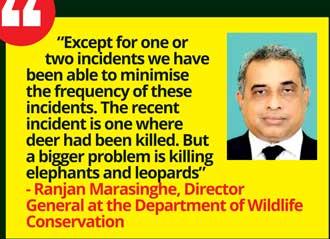 disruption of predator-prey dynamics, the source said.
Park warden confirms Ritta’s presence, complains of staff shortage
But when inquired from Buddhika Vidanage, Park Warden at Kumana National Park, he denied claims about Ritta’s disappearance. “It was spotted on February 16 morning around 6.00am near the abandoned school where it usually frequents. There are certain claims on social media about Ritta not being spotted, but these are false,” he added.
Responding to a query on the recent poaching incident Vidanage said that an investigation is underway. “Fishing activities are frequently carried out near Yakala, Itikala and Kumbukan Oya lagoons. Suspects had entered via the Itikala lagoon. One deer was shot and butchered, another deer carcass was found and it was confirmed as a leopard kill. There was a third deer carcass, but its cause of death wasn’t determined. These are not regular incidents. The previous incident took place about a year ago where poachers had hunted down buffaloes,” he added.
Vidanage said that in response to this incident they have decided to increase day and night anti-poaching patrols in addition to tightening security near the lagoons. He said that there’s a shortage of staff especially due to the fact that many vacancies are yet to be filled as a result of officials going on transfers. “We need more wildlife guards, assistant range assistants and trackers. Sometimes one official has to do multiple tasks and it’s difficult to assign them for additional tasks such as patrolling. But we are doing our best to manage the situation,” he further said.
DWC taking steps to minimise poaching : Director General
When contacted, Ranjan Marasinghe, Director General at the Department of Wildlife Conservation said that the department is taking all steps to minimise poaching incidents. “Except for one or two incidents we have been able to minimise the frequency of these incidents. The recent incident is one where deer had been killed. But a bigger problem is killing elephants and leopards because they don’t reproduce every six months like deer,” he added.
Responding to a question on staff shortages, Marasinghe said that most wildlife officials were deployed to translocate elephants. “As a result there’s a shortage of staff. Hence there is no staff to be assigned for other tasks such as anti-poaching patrols and so on. The keyboard warriors in Colombo won’t come to volunteer at national parks which are often thick jungles dominated by wildlife. So we need to find people from surrounding villages. But if there’s a need to increase security near lagoon areas at Kumana and officials are required for night patrols, we will look into it,” he further said.
Marasinghe further noted that it is highly unlikely that poachers would come to hunt down a leopard at a national park. “Most people find it easy to hunt a deer or a buffalo and consume it or sell it for some additional income. They supply to meet the demand. If there are less quantities of say animal body parts from this region or a specific animal species, the demand tends to shift,” he added.
Even though Ritta’s presence was verbally confirmed there is no photographic evidence obtained on February 16 morning to justify this claim. Several other sources have also claimed that Ritta is still missing.
One of the biggest concerns with regards to the recent incidents is the disappearance of one of the most commonly sighted leopards in Kumana by the name Ritta. He is the leopard that is known to occupy the abandoned school. The source further said that it is a very habituated male and that everyone knows him. It had given ample insights into leopard behaviour. However, its last sighting was on a track that these poachers took and. He’s missing since February 7. “We looked at every single point in the past four and a half years we have seen Ritta. But we couldn’t spot any pug marks. After rains, leopards do a patrol because scent marks get diluted and they have to go and mark their territory again. But Ritta has still not passed through his territory. So if another week or month passes by without a sighting it could be that he is dead, the source warned.
Ritta is a habituated leopard. Habituated leopards in national parks that have regular visitors have an adaptive advantage, said Rukshan Jayawardene, a leading conservationist who has studied leopards and their behaviour. “They don’t have to come and hide every time a vehicle comes along. Their natural instinct is to hide or duck if they are in long grass and are walking through. A shy leopard will duck hoping it hasn’t been spotted. But leopards like Ritta don’t have to do that. They go about their business ignoring people’s presence. During their younger days, perhaps because of their mother’s habituation or mother teaching them the presence of humans and vehicles in the park, they just ignore you like part of the furniture. So this an adaptive advantage,” he explained.
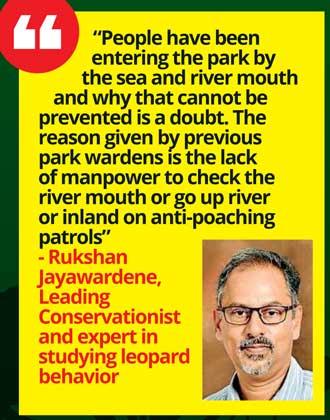
According to Jayawardene, Ritta is far more vulnerable to poaching than any other leopard that isn’t habituated. “It takes a leopard a while to realise that it’s people who are travelling in a vehicle and that people and vehicles are not an amalgam and there’s a mechanical jeep that goes around which is harmless. People have been entering the park by the sea and river mouth and why that cannot be prevented is a doubt. The reason given by previous park wardens is the lack of manpower to check the river mouth or go up river or inland on anti-poaching patrols,” Jayawardene added.