Reply To:
Name - Reply Comment

 The third prediction is the most detailed and dramatic. Jesus explains: “They will mock him, spit on him, flog him and kill him. And after three days, he will rise.” Here, the brutality of what lies ahead is laid bare

As the world commemorates Easter Sunday, Manushya Puththraya (Marcan Jesus: Passion Play) offers a profound reflection on one of the most striking yet often overlooked aspects of Jesus’ journey—his repeated predictions of his own death and the disciples’ consistent failure to understand them. The drama presents Jesus not as an ignorant victim, but as a conscious reformer who clearly foresaw his fate. More importantly, it highlights a tragic irony: even those closest to him failed to grasp his message.
The first prediction emerges as a moment of clarity. Jesus openly declares: “The Son of Man must suffer many things… be rejected… be killed, and after three days rise again.” This is not symbolic or vague language; it is direct and unambiguous. Yet, instead of understanding, the disciples react with discomfort. Their expectations of a powerful, triumphant leader clash with Jesus’ vision of suffering and sacrifice.
This moment reveals a deeper issue. The disciples are not simply confused—they are unwilling to accept a reality that contradicts their hopes. They imagine a Messiah who will overthrow rulers and establish dominance, not one who speaks of rejection and death. Their misunderstanding reflects a broader human tendency to reshape truth according to personal desires. The second prediction reinforces this tension. Jesus again states: “The Son of Man is to be delivered into the hands of men, and they will kill him.” The repetition suggests urgency, yet the response remains unchanged. The script emphasises that the disciples “did not understand what he was saying and were afraid to ask him.” Their silence becomes significant. It shows not only confusion but fear—fear of confronting a truth that challenges their expectations.
This fear-driven silence can be interpreted as a form of denial. Instead of seeking clarity, the disciples avoid the conversation altogether. In doing so, they miss the deeper meaning of Jesus’ mission. His words are not merely about death; they are about the cost of standing against injustice and the inevitability of sacrifice in the pursuit of truth.
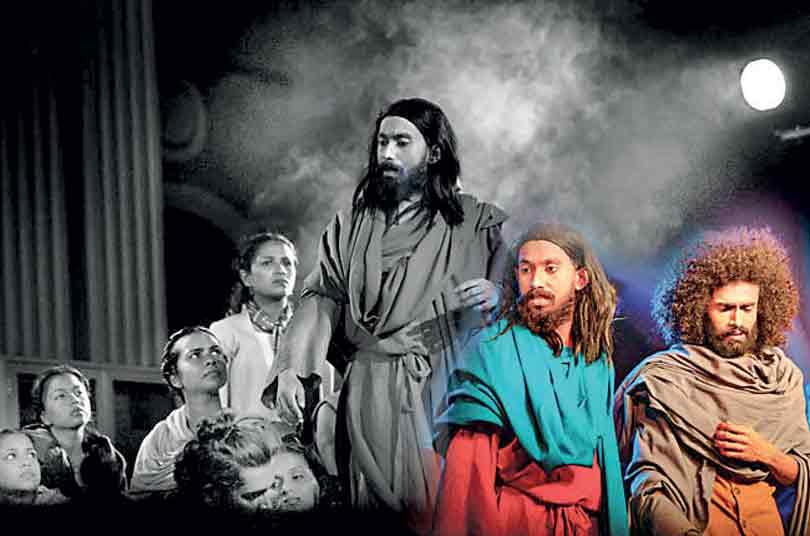
The drama presents Jesus not as an ignorant victim, but as a conscious reformer who clearly foresaw his fate
The third prediction is the most detailed and dramatic. Jesus explains: “They will mock him, spit on him, flog him and kill him. And after three days, he will rise.” Here, the brutality of what lies ahead is laid bare. It is not just death but humiliation and suffering. Yet, even this vivid description fails to awaken understanding among the disciples. Instead, their response exposes the depth of their misunderstanding. Shortly after this prediction, they begin to argue among themselves: “Who among us is the greatest?” This question stands in stark contrast to Jesus’ message. While he speaks of sacrifice, they are concerned with status. While he prepares for suffering, they seek power.
This moment is perhaps the most revealing in the script. It shows that the disciples are not merely confused—they are focused on the wrong priorities. Their ambitions blind them to the reality of Jesus’ mission. This is not just a historical detail but a symbolic reflection of humanity’s ongoing struggle to understand true leadership and purpose. Jesus responds to this misunderstanding with a transformative teaching: “Whoever wants to be first must be the servant of all.” In this statement, he redefines greatness. Leadership, according to Jesus, is not about authority or dominance but about humility and service. This idea directly challenges the disciples’ mindset and, by extension, the values of society.
The three predictions, when viewed together, form a powerful narrative. They show that Jesus was fully aware of his fate and that his death was not accidental. It was the result of his mission — a mission that challenged unjust systems and threatened those in power. At the same time, these predictions reveal the disciples’ failure to understand the true nature of his work.
Deeply significant
From an interpretative perspective, this failure is deeply significant. It suggests that understanding Jesus requires more than physical proximity or verbal instruction. It requires a willingness to let go of personal expectations and embrace a radically different vision of life. The disciples’ journey, therefore, mirrors the journey of every believer—a movement from misunderstanding to realisation.
Easter Sunday brings this journey to its climax. The resurrection is not just a miraculous event but a moment of revelation. It confirms that Jesus’ predictions were true and that his mission extends beyond death. What the disciples could not understand before the crucifixion becomes clear after the resurrection.
In today’s context, this message remains highly relevant. Many people continue to misunderstand the teachings of Jesus, focusing on external aspects of religion while ignoring its deeper call to justice, humility, and service. Like the disciples, society often prioritises power over compassion and status over sacrifice.
The story of the three predictions challenges this mindset. It invites us to listen more carefully, to question our assumptions, and to seek a deeper understanding of faith. It reminds us that true transformation begins when we are willing to confront uncomfortable truths.
Easter Sunday Message:
This Easter, let us move beyond misunderstanding. Let us not be like the disciples who heard but did not listen. Instead, may we open our hearts to the true message of Jesus—a message of sacrifice, service, and love. May we learn to value humility over power and compassion over ambition. For in truly understanding his words, we not only celebrate the resurrection—we become part of its living meaning.
R. D. Kasuni Pokunegoda is a lecturer in English at the Sri Lankan International Buddhist Academy (SIBA Campus), Pallekale