Reply To:
Name - Reply Comment

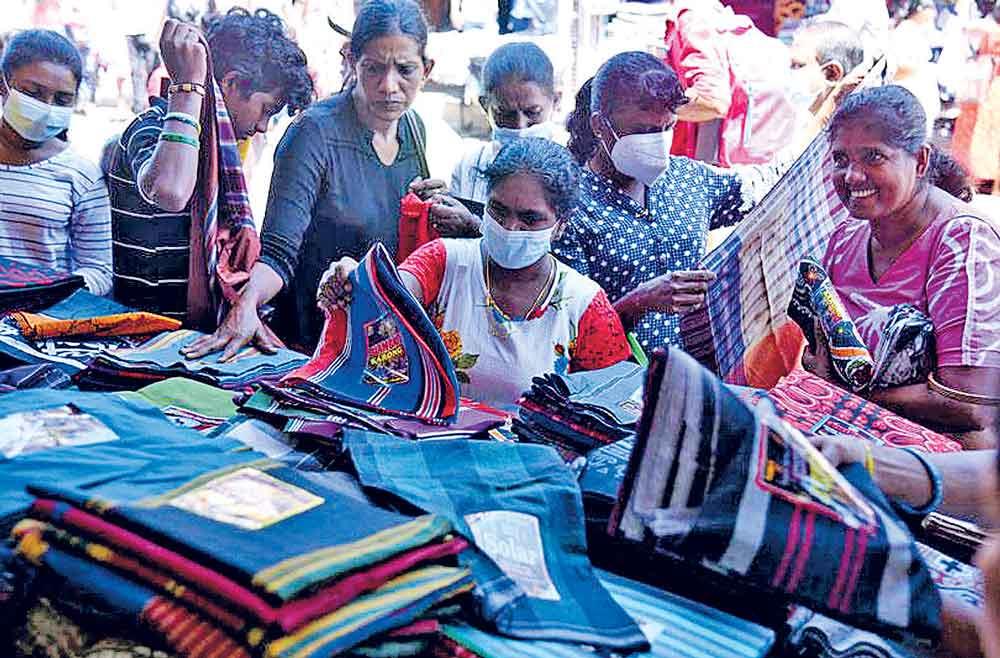
Sellers in the Pamunuwa textile market hail from all corners of the island, representing different religions and cultures (File Photo)
|
Customers even from neighbouring India, Maldives and Nepal visit Pamunuwa in search of the best deals on bulk fabric Pamunuwa stands as a testament to the resilience of Sri Lanka’s textile trade Despite the mounting challenges, Pamunuwa’s role in the country’s apparel sector is undeniable |
 Much like Moratuwa, renowned for its woodworking, and Nawala, a hub for ceramics, Pamunuwa stands proudly as the textile capital of the island. Located near Maharagama junction in Colombo district, this suburb draws buyers from all parts of the island. Customers even from neighbouring India, Maldives and Nepal visit Pamunuwa in search of the best deals on bulk fabric as its reputation for cheap prices has extended beyond the island.
 The origins of how Pamunuwa’s rise as a textile city can be traced back to the 1980s. As Sri Lanka’s apparel industry began to flourish in the 1980s, garment factories experienced significant financial success. With the rise of these factories, ready-made garments and fabrics that didn’t meet export standards found their way back to the local market. These items were sold to local consumers at reasonable prices, paving the way for the growth of textile trading hubs such as Pamunuwa. As time passed, the number of traders and buyers increased and Pamunuwa evolved into the bustling market it is today.
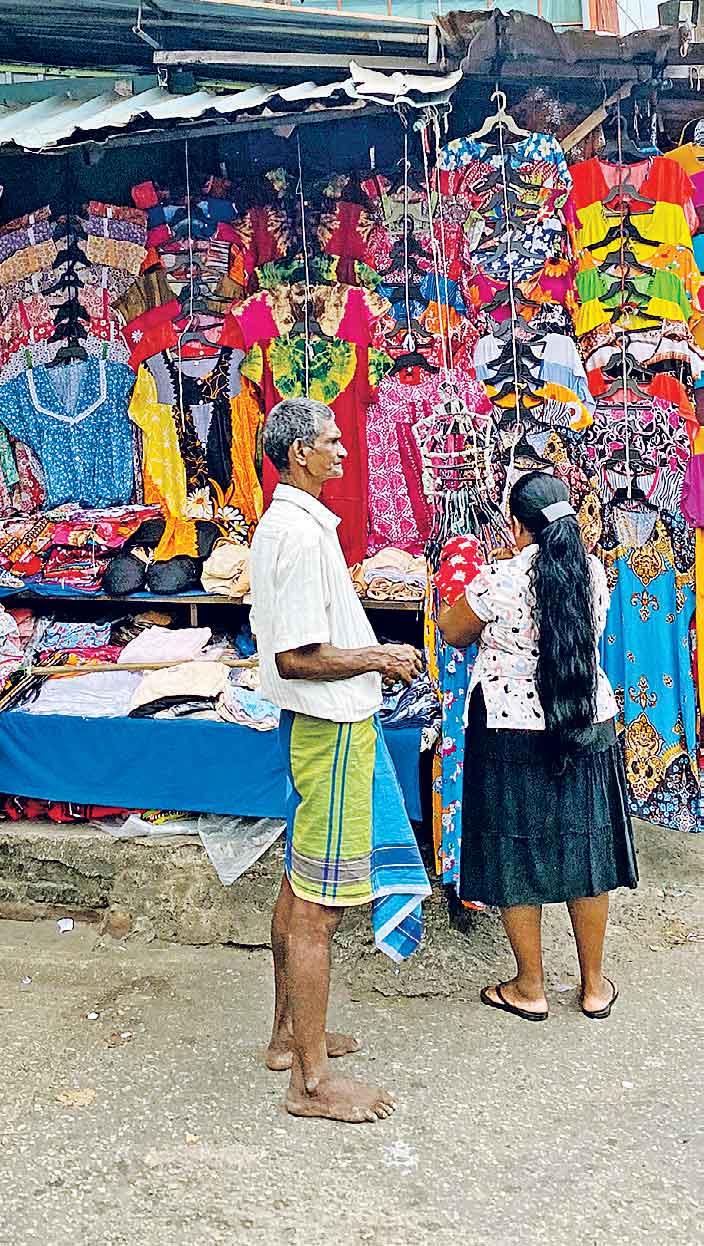
A ready-made garments seller stands by the pamunuwa road, watching customers pass by without a second glance
 While the rest of the city sleeps, Pamunuwa comes alive as wholesale sellers arrive with bulks of garments as early as 2 a.m to get started with doing business. By the time the first rooster crows, several deals have already been made for the day. As the sun starts to rise, these wholesale traders pack up their items and leave the premises, passing the baton to ready-made garment sellers who take over to continue the bustling trade of Pamunuwa.
Unique market
Pamunuwa is a unique market in many ways, and one striking characteristic is the sight of some sellers conducting business from small tents set up along the railway tracks. As a train approaches, they quickly move their tents aside; only to return as soon as the locomotive passes. This highlights the daily risks they take, flirting with danger in their relentless struggle to make ends meet.
Pamunuwa sees a significant presence of women on any given weekday. The streets of this little suburb are often filled with women spanning generations—from spirited Gen Z to grandmothers in the twilight years of their lives. They spend hours visiting traders, from sunbaked huts on the pavement to air-conditioned showrooms lining the roads of Pamunuwa, all in search of the finest fabrics to fuel their small businesses and creative pursuits.
 Despite the drastic shifts in societal norms across generations over the years, women’s enduring interest in the ‘art of the needle’ seemed to have persisted as a constant and Pamunuwa stands as a testament to this.
Beyond those seeking fabrics, yarn, and other raw material for their businesses, there’s another significant group—specially during the festive seasons—managing tight budgets that hold them back from splurging on posh brands at upscale clothing stores. These shopers stroll the streets of Pamunuwa on the lookout for ready-made garments, with the hope of saving a few pennies.
Throughout the year sellers in Pamunuwa work tirelessly. However the dusk of the year brings a surge in the business as the shops overflow with bargaining customers, all intent on buying at least one new item—be it a T-shirt, blouse, or even a pair of socks—as part of the tradition of welcoming the new year with fresh attire. While the majority of the workforce in the country is on annual leave and enjoying their vacations, the textile traders work overtime during festive seasons such as the New Year and Sinhala and Tamil Avurudu.
Sellers in the Pamunuwa textile market hail from all corners of the island, representing different religions and cultures. You might see a young man shouting in Sinhala as to how cheap the trousers he sells on a pavement stall are, a woman wearing a pottu and rattling away in broken Sinhala to haggle with customers and be a competitor to another or a business owner with a Taqiyah on his head behind a cash register. On the surface, they seem to have little in common, yet their voices unite in lamenting the difficult state of the business.
During a visit to Pamunuwa, the Daily Mirror spoke to a few sellers to learn about their challenges, experiences, and how the festive season has influenced their sales.
Sarath Chandana, who has been in the ready-made garment business for 12 years in Pamunuwa, had much to share. He operates from a small space dimly lit by sunlight nestled in a narrow lane off Old road near the Bo tree.
“Customers expect quality products at low prices, but we can’t meet their expectations in terms of price because, as third-party traders, we also need to make a profit,” he explained. Sarath who sources clothes from free trade zones noted that “During the festive season, some traders set up as early as midnight. I usually arrive around 4 a.m. I don’t typically stay past midday, but since business hasn’t been great and there’s still stock to sell, I have to stay much longer,” he added.
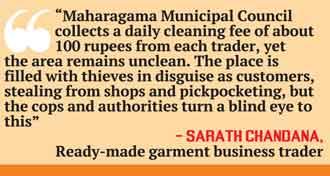
Sarath also criticised the authorities for their failure to monitor and maintain Pamunuwa. “Maharagama Municipal Council collects a daily cleaning fee of about 100 rupees from each trader, yet the area remains unclean. The place is filled with thieves in disguise as customers, stealing from shops and pickpocketing, but the cops and authorities turn a blind eye to this.” Sarath further suggested that offering small-scale business owners loans at lower interest rates would be a significant help in sustaining their livelihoods.
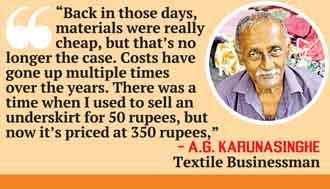
Turning back the clock as he spoke, 76-year-old A.G. Karunasinghe recounted how Pamunuwa became a paradise of textiles. Karunasinghe has been in the textile business around Pamunuwa for about 40 years. He has witnessed how this once quiet suburb, known for nothing but merely existing, transformed into the heart of textile trading. “In the 1980s, people living in Pamunuwa began taking cut pieces from garments and sewing clothes, which they would then sell along the road. Over time, more people joined in, and Pamunuwa grew into what it is today.”
He reflected on the increasing cost of the industry, “Back in those days, materials were really cheap, but that’s no longer the case. Costs have gone up multiple times over the years. There was a time when I used to sell an underskirt for 50 rupees, but now it’s priced at 350 rupees,” he said.
Karunasinghe has set up his stall in front of a restaurant on Pamunuwa Road, for which he pays a monthly rental of 35,000 rupees to the owner. Looking to the future, he added “During Gotabaya Rajapaksa’s tenure, there was a plan to widen the Pamunuwa Road and make the market more organised. Measurements were taken, and the plan was set in motion, but with the transfer of power, it never became a reality. However, now there are speculations that this programme would be implemented by the new government.”
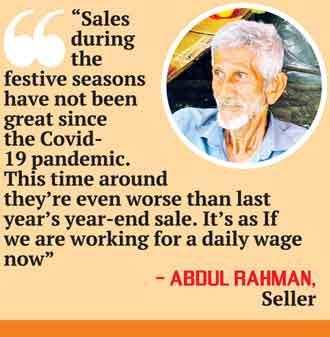
69-year-old Abdul Rahman is a seller who stands apart from the mainstream traders of Pamunuwa, focusing on a somewhat niche business that sells items such as door mats and teddy bears. While the teddy bears on display smiled in the background, Abdul shared his disappointment about the current season’s performance “Sales during the festive seasons have not been great since the Covid-19 pandemic. This time around they’re even worse than last year’s year-end sale. It’s as If we are working for a daily wage now,” he complained.
 Stanley Silva is a fabric trader who, along with his friend, has been in the business field for over 12 years in Pamunuwa. He briefly explained how the pandemic and the economic crisis have taken a toll on the textile business. “If someone used to buy 100 yards before, now that person is only able to afford 25 yards. The profit we make now is about 50% less than what we had before the pandemic,” said Silva. Amidst all these challenging circumstances, Silva admitted that his sales do tend to improve slightly during November and December.
Customers, too, had much to say about Pamunuwa and their experiences with the market.
38-year-old Dammika Priyadarshini from Homagama, a mother of a 13-year-old, shared her thoughts about Pamunuwa, her go-to place for clothing. “Either New Year or during Sinhala Avurudu is the only time of the year we get ourselves a piece of cloth. Without a place like Pamunuwa, where the clothes are relatively cheaper than elsewhere, even that one time might not have been possible,” said Priyadarshini.
With a teenage daughter in her early adolescence clinging to Priyadarshini’s hand, it is not an easy task to satisfy her growing desire for fashion with just one piece of cloth. However, parents like Priyadarshini are willing to make sacrifices to temporarily halt their kids’ relentless demands, even if it means cutting down on other items from the New Year’s list to afford another frock or t-shirt for their kids.
Another customer, who preferred to remain anonymous, spoke about the crowded and chaotic atmosphere this place was during festive seasons before the COVID-19 pandemic. “There used to be a massive crowd toward the end of the year, to the point where you couldn’t even lift a finger. But now, prices have gone up, and the crowds are shrinking at the same rate,” the customer said.
Pamunuwa stands as a testament to the resilience of Sri Lanka’s textile trade.The hardworking men and women connected to this textile market continue to fight for their livelihoods, despite economic fluctuations,lingering effects of the covid-19 pandemic and countless other hardships thrown their way. Pamunuwa’s role in the country’s apparel sector is undeniable. If the right investments and policies are implemented by authorities, it has the potential to continue extending this lifeline to thousands of small-scale sellers and uphold its legacy as the country’s textile capital for generations to come.