
Reply To:
Name - Reply Comment
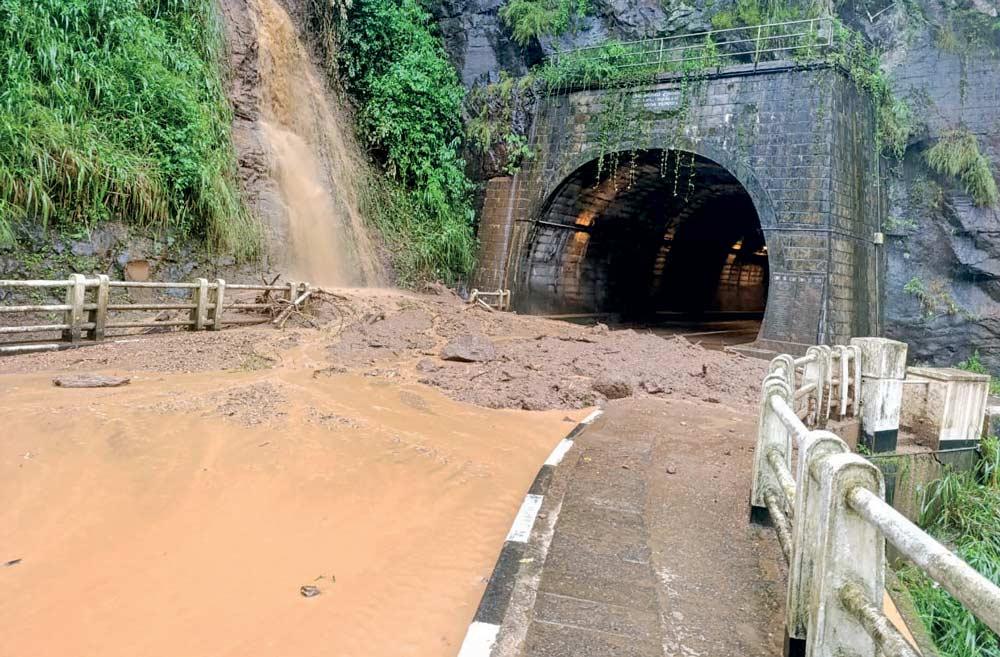
The Ramboda tunnel during the disaster
 Clearing obstructions caused by the huge amounts of earth and rocks washed down the hills onto the roads and their surroundings is a formidable task
By Shantha Chandrasiri
|
Nuwara-Eliya District Coordinating Committee Chairman MP Manjula Suraweeraarachchi |
Nuwara-Eliya District, the worst affected by the Ditwah cyclone followed by floods and landslides, looks like a wrecked landscape with mounds of earth and rocks obstructing the main highways and access roads leading to places of tourist attraction
Owing to the salubrious climate and scenic beauty of highly sensitive environmental zones rich in bio-diversity, it has been one of the most popular tourist destinations and a health resort in the country. Not a single foreigner visiting Sri Lanka would want to miss an enjoyable trip along winding roads skirted with lush green tea estates and cascading waterfalls.
However the extensive damage caused to Nuwara-Eliya District is unprecedented and unestimable, and has a serious impact on the tourist industry. Government authorities have been able to open the roads to provide single-lane traffic, creating bottlenecks at several locations. The authorities are not precise as to when normalcy could be restored.
Clearing obstructions caused by the huge amounts of earth and rocks washed down the hills onto the roads and their surroundings is a formidable task. They have estimated that the earth and rocks waiting to be removed are approximately 400,000 cubes. They also fear further earthslips while earth clearing is going on.
The gravity of the devastation caused by the Ditwah cyclone could be judged from the mass of earth obstructing highways in the Nuwara-Eliya District.
Although the Government has the capacity to manage the disaster and to restore the road network, the damage caused to the environment by the erosion of hillsides would be an irreparable loss.
Nuwara-Eliya, in the heart of the central hills, is a highly sensitive environmental zone, and the catchment area of water resources that enriches the rivers feeding hydropower complexes, providing irrigation facilities for agriculture, drinking water, and facilities for boating and fishing.
The water resources have been endangered by silting with sand and mud eroded from hills.
The disaster has wrecked the Nuwara Eliya-Gampola road that links several other towns to Nuwara-Eliya and is used by tens of thousands of local and foreign tourists regularly. The highway had been in fragments at Labukele, Katukitula, Thawalanthenna, Ramboda, and Gerandi-Ella areas, and it was with great difficulty that the road was opened for traffic on a single lane 15 days after the cyclone.
The 54 kilometre-long highway constructed in 1828 during British rule runs through a lovely and attractive countryside with lofty mountain ranges and smiling tea estates stretching over a vast area as far as the eye could see, and shrouded in intermittent mist.The steep climb through Ramboda Pass starts from Thawalanthenna where the road branches off to Kotmale. It is a thrilling and sensational journey for the tourist travelling from Gampola to Nuwara-Eliya. However, the Ditwah cyclone has ruined this beautiful environment and buried it under huge mounds of earth.
Credit for the Gampola-Nuwara Eliya highway goes to Major Thomas Skinner who undertook the challenge of constructing a road through hard terrain, covered with thick jungle and teeming with wild animals. The most formidable task before him was to proceed beyond the huge rock at Ramboda. He first constructed a cart track to Gampola town which was later extended to Nuwara-Eliya. He realised that the area below the rock would be susceptible to landslides if the rock was blasted. He decided to pierce the rock carefully to develop the cart track into a macadamised road
In 2008, the highway was developed with two lanes avoiding the old road through the pierced rock. It is unfortunate to see that this stretch of road through the pierced rock, which is of historical importance as a clear indication of the challenges and hardships faced by the British engineers, has been left to the mercy of the jungle.
Commenting on plans to clear obstructions caused by huge mounds of earth still remaining, Chairman of Nuwara-Eliya District Coordinating Committee Parliamentarian Manjula Suraweeraarachchi said about 150,000 cubes of earth have been already removed and there is a lot more to be cleared. “Ditwah cyclone has caused, apart from loss of life, a massive environmental damage to Nuwara-Eliya District. More than 300,000 cubes of earth obstructing the roads has yet to be cleared for want of dumping sites. Rivers, streams and canals would be endangered with silting if earth was dumped in the lowlying areas. However, an effective mechanism would be worked out with the help of the State and private sector institutions to overcome this challenge,” he said.