Reply To:
Name - Reply Comment
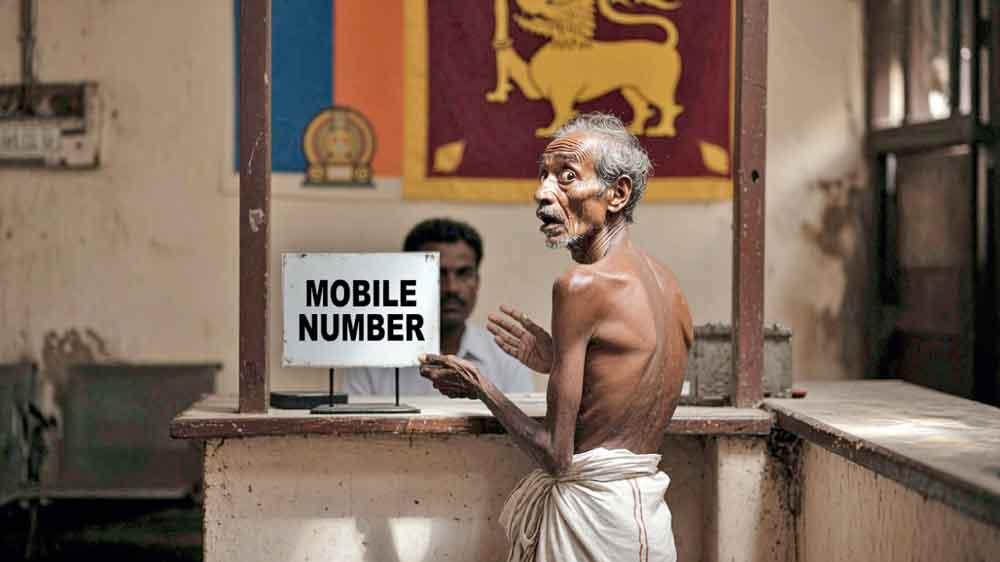
 An ordinary citizen who prefers not to use digital mobile devices recently struggled to obtain an appointment at a Sri Lankan government department because he did not have a mobile phone number.
A security guard issuing token numbers asked for a phone number to register the appointment. The citizen explained that he does not use a mobile device, but the guard refused to accept the explanation: everyone has a mobile phone, he insisted, and without one no token could be issued.
The exchange grew heated before a senior officer intervened and resolved the matter. The underlying question, however, remains: Can a government institution deny a citizen access to a public service simply because he does not carry a mobile device?
On another occasion, a customer at one of Sri Lanka’s most prominent banks was refused a printed deposit slip, the bank claiming it no longer stocked them. The customer was offered two alternatives: the cash deposit machine or the digital slip available through the bank’s app. A bank officer eventually helped him operate the machine, but the questions stay here too. Can the bank’s approach be justified? Is it discriminatory, and should such methods be permissible?
The two incidents fall on different sides of an important legal line. The first involved a state institution denying equal access to a public service, a situation that raises a serious question under Article 12(1) of the Constitution, which guarantees every person equality before the law and the equal protection of the law.
The second is more complicated. Because the bank is a private institution, its conduct sits beyond the conventional reach of Fundamental Rights doctrine, however unfair it may appear, particularly to customers who opened their accounts long before digital services existed.
Yet, that is precisely the point. The gap between what a citizen experiences as a denial of dignity and what the law currently recognises as a violation is the gap that a broader guarantee must close.
Nor is Sri Lanka alone. Similar incidents occur across many countries, especially in the Global South, and they should be understood within a broad human rights framework rather than treated as isolated inconveniences requiring isolated remedies.
Most Global South nations are currently pursuing digitalisation with enthusiasm. In this process, the digital rights conversation has developed along two familiar tracks: promoting and facilitating digital access on the one hand, and preventing digital harm while protecting personal data and privacy on the other.
What has received far less attention is the position of people who wish to stand apart from rapid digitalisation altogether. A person who avoids smart digital devices is entitled to do so, and his basic rights deserve respect whether or not he ever touches a screen.
In response, several nations, mainly in the Global North, have begun to discuss the right to be disconnected, or the right to be offline. Although the right has developed predominantly as an employment or workplace right, it is now expanding into a civil right of public life.
As an employment right, it means a legal entitlement to refrain from work-related communications, emails, telephone calls and messages, outside normal working hours.
Its object is to safeguard personal time from the encroachment of pervasive workplace connectivity and its adverse consequences.
France originated the right under Law No. 2016-1088 of 8 August 2016, which requires employers with fifty or more employees to negotiate disconnection policies with workers’ representatives.
The right has since gained remarkable acceptance. In Europe, several countries including Belgium, Spain, Portugal, Greece, Ireland and Luxembourg have adopted statutory or regulatory frameworks protecting it.
Beyond Europe, Australia, Thailand, Mexico, Argentina, Brazil, Chile, Colombia and Peru have developed legal frameworks to establish the right, and Kenya’s Senate has passed legislation to the same effect.
The right to be disconnected, in other words, is being recognised not only in the Global North but across the Global South as well.
The broader idea, a right to be offline in public life has not yet been comprehensively developed. But the time has come to assert it, because incidents like those described above belong squarely within the framework of human rights.
The people of the Canton of Geneva, Switzerland, showed the way in June 2023, approving a new constitutional provision, Article 21A, by an extraordinary 94 per cent of the vote.
The provision guarantees what it calls digital integrity: protection of personal data, digital security, the right to be forgotten and, most significantly, the right to an offline life.
Its practical meaning is simple. The State cannot make an app, a website or a mobile number the only door into an essential public service. There must always be an analogue alternative a paper form or a human being.
Other jurisdictions have reached the same standard by different routes.
The Supreme Court of India, in the Aadhaar case (Justice K.S. Puttaswamy v. Union of India, 2018), refused to allow the biometric digital identity system to become a precondition for welfare entitlements and basic services.
In effect, the Court held that the State cannot starve a citizen into connectivity. In the United States, several cities and states, New York, New Jersey, Massachusetts, San Francisco and Philadelphia have prohibited cashless only businesses, reasoning that legal tender must work for everyone, not only for those carrying cards and smartphones.
And in 2021 the European Parliament called for an EU-wide right to disconnect, a signal that the concept is steadily evolving into a civil right of public life.
The main point is this: Digitalisation is a convenience, not a requirement of citizenship. A citizen who cannot afford a smartphone, who cannot operate one, or who simply chooses to live without one deserves the same access and the same respect as anyone else.
Their right to a pension, a court hearing, a bank account or a token number at a government office must be protected.
The freedom to remain offline protects two groups at once: those who choose disconnection, and the far larger number who never had a genuine choice older person, low-income households and rural communities. At the same time, the right to be offline must never become an excuse for poor digitalisation or for failing to expand digital access; the positive and negative dimensions of digital rights must advance together.
For Sri Lanka, the question is timely. The country is pursuing digital transformation across its courts, banks, welfare systems and government departments. But every service that moves online without keeping its offline door open pushes someone outside and it is always the most vulnerable who are pushed first.
The incidents at the government department and the bank are early warnings, not isolated inconveniences. They will multiply as digitalisation accelerates.
The remedy lies in recognition. As Sri Lanka debates constitutional reform, the right to be offline deserves a place in the conversation: a guarantee that no citizen shall be denied access to public services, civic participation or due process merely because they are not digitally connected, and a corresponding duty on the state to preserve analogue alternatives wherever essential services are digitalised.
(Dr Viranjana Herath is a Colombo-based Attorney-at-Law and an independent researcher and academic in media and human rights law and mass communication.)