Reply To:
Name - Reply Comment
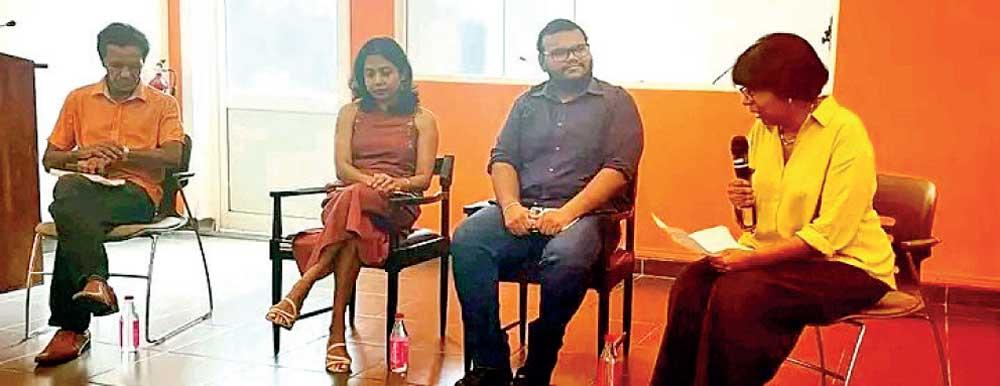
The author of this article Gamini Akmeemana (Extreme left) who won the Gratiaen Award in 1995- for penning ‘The Mirage’- got an opportunity to speak about his latest novel ‘The Shark Binder’ at the literary event organised by New Ink 5 and held at the International Centre for Ethnic Studies
 It’s not easy to find a full house these days for literary activities, but there was a packed auditorium at the International Centre for Ethnic Studies for New Ink 5. It came like rain in the desert.
New Ink 5 consisted of three sessions. The first session discussed contemporary poetry and fiction. The second session had more contemporary poetry, while the third was dedicated to the poetry and legacy of the late Richard de Zoysa.
Before we go into that, those behind the New Ink initiative should be introduced.
New Ink was launched in 2020 by five enthusiasts on a voluntary, non-profit basis. They are Vihanga Perera, Tinaz Amit, Shez Cuttilan, Chiranthi Rajapakse and Nelani de Silva.
Vihanga is an author and literature scholar, teaching English at the University of Sri Jayewardhanapura. Tinaz is a poet (‘Anarwa’) and works in the PR domain. Shez is the author of “Meraki/Soul”, a collection of poems. Chiranthi won the Gratiaen Prize in 2022 and has published two short story collections - “Keeping Time and Other Stories” and “Names and Numbers”.
Nelani De Costa is currently attached to the University of New South Wales (UNSW). She was formerly at University of Sri Jayewardenepura as an English lecturer.
Back to New Ink 5. The first session featured my historical romance novel ‘The Shark Binder’, together with the poetry of Lawanya Wijesekara (‘Muse, Martyr and Epiphany’) and Ruchira Fernando (‘Whispers of a Love’). It was moderated by Carmel Miranda, a novelist who won the Gratiaen award in 2020 for her novel ‘Crossmatch.’
Part two involved discussions with poets Dilantha Gunawardane (‘Cell Cycles and Donuts’), Palitha Ranatunga (Paulownia Dear, We May Not be That Lucky’) moderated by Hasitha Wickremasinghe (‘Connected by a Breath’).
In memory of Richard
Part Three was dedicated to the memory of the late Richard de Zoysa. Rehan Amaratunga, who played Richard in the film Rani, and stage actor Purnima Pilapitiya, read Richard’s poems, while Prof. Prabha Manuratna elaborated on ways in which Richard has been represented in Lankan writing. This session was hosted by Crystal Baines.
At a time when Richard de Zoysa has become the focus of so much attention due to the controversy surrounding ‘Rani,’ discussing his legacy was something eagerly awaited by the audience, but let’s go one by one, looking at the contemporary fiction and poetry first.
Mine was the only novel to be discussed during New Ink 5. I was asked why my first novel ‘The Mirage’- which won the Gratiaen in 1995- wasn’t published, and why I selected a French character for ‘The Shark Binder’ rather than someone British, as this book is a historical romance set in the colonial period. The third question was how I managed to do the research for the novel.
The answers have already been given in other contexts, and I’m not going to elaborate on them again in this limited space as the poets and their poetry need to be introduced.
As I listened to the new voices (new in the sense that I have some catching up to do), I realised that there has been a revival of sorts since the new millennium. From the 1960s to the 90s, when the richly textured voices of Patrick Fernando, Lakdasa Wickremasinghe, Richard de Zoysa, Jean Arasanayam, Jasmine Gunaratne, Anne Ranasinha, Lakshmi de Silva and others formed a ‘golden age’ of English poetry.
This stream seemed to lose its steam as the new millennium began. But these new voices have put that old electricity back into Lankan poetry with new and varied themes. Let’s take a few examples (these are selected randomly, and not necessarily from those read at New Ink 5).
Lavanya Wijesekara writes about love in her poem ‘Falling.’
“It’s the same feeling/of a rollercoaster ride/descending the heights/ascending apprehension/rapid heart beats/of fear and exhilaration..../ecstasy in arms reach...”
The breathless pace of these lines convey the poet’s excitement and agitation. It’s a close felt, very physical kind of poetry. Richira Ferando approaches the same theme in a different way. His poem ‘Ember Flesh of a Stitched Heart’ begins like this:
‘Draped in love like a silken shroud/Waiting longing murmuring your name/Heart pulled apart/Stitched together with vows/Stitches threaded fine, knitted only to fray.”
The tone is sombre, almost funereal. The overall tone is dark, with images of injury and hurt (stitches, shroud, fraying thread). But the poem ends on a hopeful note, albeit with a question mark – ‘Waiting for a breeze to bring back the fire?’
These lines took me back to Sinhala poet Mahangama Sekara’s ‘Sannaliyane, Sannaliyane, kaatada anduma viyanne,’ which is about a shroud being stitched for the body of someone loved. This is how good poetry is connected by a fine thread for all time.
Palitha Ranatunge is a poet whose themes are startlingly wide, as these titles suggest – Venus de Milo, Mother, Colour of the Morgue, A Writer’s Block, Along the Shore of the River Thames, Baobab Tree, and Paulownia Dear, We May Not be So Lucky. To quote from that poem:
‘Roots grow deep/Seeds dive deep/Ants hide your eggs/Bees fly away/Birds light-winged flee/Your world, your hope, and your future are all/are about to perish by the heat, blast, and Gamma rays, etc.’
This is about nuclear Armageddon. Thus, one can see from the above examples contemporary Lankan poetry exploring traditional themes as well as venturing into new territory.
Dilantha Gunawardhane, a cancer survivor, writes in his poem ‘A Story of Cancer’:
‘I bear an uncanny resemblance/To the man in the dressing table mirror/The one who navigates the rarely straight footsteps/Unpretentious eyes/A probing mouth/The gullible heart/The claustrophobic soul…’
Lack of space prevents me from citing examples of the other poets’ work. They work is equally interesting. But we must look at the poetry of Richard de Zoysa before concluding. The examples read during New Ink 5 show that he was almost prescient, even prophetic in what he wrote in the very violent 1980s. That violence claimed him when he was only …., but he left behind a legacy of poetry important enough for him to be considered one of the foremost poetic talents of Sri Lanka.
The following lines are quoted from ‘Lepidoptera’, one of his best known poems which explores mental illness, which can be seen as a metaphor for the rabid violence which consumed this country during his final years.
‘On broken butterfly wing, your crippled mind/fluttered into my schoolroom/Failed/And died/I couldn’t do a thing/to stir its organs/of poor maimed sense to life again.’
That’s how we felt when Richard was murdered.