Reply To:
Name - Reply Comment
“I will tell the Galle engineer to remove it”
- Director General of Irrigation Department
“I have informed the Irrigation Department about the public protest”
- Neluwa Divisional Secretary
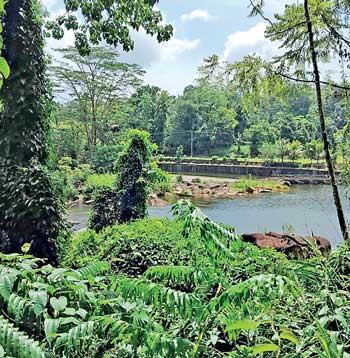 |
| Under Section 20 of the Forest Conservation Ordinance destructive activities within protected reserves are considered illegal. The picture shows a stone embankment built across a section of Gin Ganga |
By Prageeth Sampath Karunaratne and Sudharika Gurusinghe
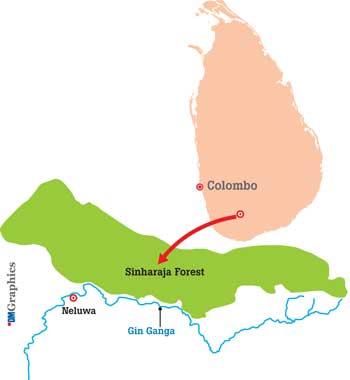
Gin Ganga originates at the southwestern border of Sinharaja, a UNESCO World Heritage Site. Flowing through the districts of Ratnapura, Galle, and Matara, it empties into the sea at Gintota estuary in Galle. The river basin is composed of Charnockite and granite gneiss belonging to the Vijayan Series, which consist of various formations from the Pre-Cambrian era. The flow of Gin Ganga, which includes 86 main tributaries, is currently in a very unfortunate state. Stretching 115.9 kilometres, Gin Ganga begins in Gongala mountain range near Deniyaya, adjacent to Sinharaja protected forest. It is now evident that Gin Ganga has become highly destructive largely due to the misguided actions of government officials.
In the 1970s, Sinharaja Forest and its surrounding areas were leased to Canada under an agreement signed during the Sirimavo Bandaranaike administration. As a result of the lease, many of the forest’s valuable plants, animals, and other elements of biodiversity were taken to Canada. Two or three kilometres above Sinha Rock in Sinharaja, a sixty-foot-wide road built during that time still remains. Roads were built to connect all the hills by compacting the soil layer from a foot down to an inch. Tipper trucks and other heavy vehicles used those roads to transport valuable trees, plants, and other elements of biodiversity from Sinharaja to Canada.
Culverts and bridges were constructed across natural streams and rivers, many of which still remain today. These structures were made of concrete and appear to have been built for permanent use. When travelling along that road, one can see stones laid along the hilly sections to ease the journey. The agreement signed with Canada during the Sirimavo Bandaranaike Government was later canceled by the J.R. Jayewardene administration, which came into power after 1977.
Sand mining activities
This shows that the plan to destroy Sinharaja—one of the most ecologically sensitive areas in the country—was not conceived yesterday. The residents of Neluwa and Lankagama believe that the first politician to interfere with Sinharaja was Prime Minister Sirimavo Bandaranaike. According to the villagers, the roads built during that time extend to Kalawana and Suriyakanda. Although these roads are now overgrown with forest, their remnants are still visible. Following that incident, it is now evident—based on the story this newspaper is about to relate—that government officials are the ones facilitating the ongoing destruction of the Sinharaja Forest and its streams and rivers.
As Gin Ganga flows from the Gongala Mountain range toward Gintota in Galle, numerous small hydroelectric power plants have been built along its course. As a result, the catchment area of Gin Ganga is now divided into protected and unprotected zones. The depletion of water in the protected areas and the excessive accumulation in unprotected zones have given rise to serious environmental problems. These development projects have significantly lowered the groundwater level. Additionally, sand mining activities have further contributed to its decline. The widening and deepening of the river, the deterioration of water quality, and the destruction of many native fish species are all threats stemming from these developments.
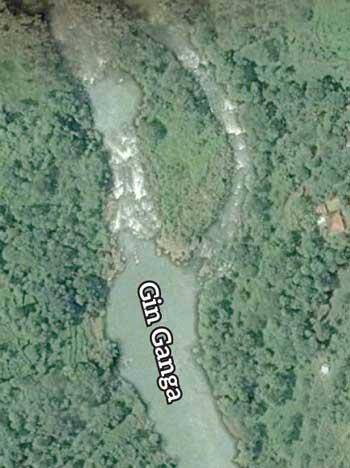 |
| An image taken by Google Photos shows how a construction has been built across Gin Ganga |
Currently, people who rely on Gin Ganga to meet their water needs are facing many difficulties. The decline in the river’s groundwater level has affected water quality. Numerous issues have emerged, such as murky water, rusty discoloration, and saltwater intrusion into wells located near the coast. This is largely due to small hydropower plant operators attempting to retain water in one place, rather than allowing its flow.
According to international environmental standards, constructing power plants by damming rivers and streams within natural ecosystems is not permitted. These standards emphasise that such actions are highly unreasonable and cause severe environmental damage. Under Section 20 of the Forest Conservation Ordinance No. 06 of 1907, as last amended by Act No. 65 of 2009, activities such as clearing proposed protected reserves, removing soil, excavation, rock blasting using explosives, and constructing permanent structures are considered illegal. Any individual or group who assists or encourages such illegal acts is deemed a criminal offence. They can be arrested without a warrant and brought before a Magistrate’s Court, where they may face imprisonment, a fine between Rs. 5,000 and Rs. 50,000, or both. Additionally, the court may impose separate fines to compensate for the environmental damage caused to the forest.
Despite these laws, authorities have failed to take action regarding the construction of a dam across Gin Ganga in the Mawanana area under Neluwa Divisional Secretariat. As a result, significant environmental degradation and an increased risk of flooding have already emerged in the Neluwa region.
Power plant
Earlier this year, the Divisional Secretary was informed by the people of Mawanana that a power plant, owned by a private company, and built in the area caused serious environmental harm. Somaweera Senanayake, the patron of Mawanana Farmers’ Organization, said, “During the initial stages of construction in 2012, I was assured that no further development would take place across Gin Ganga. However, after the power plant was constructed and its operations were underway, a stone embankment was built across Gin Ganga to divert water for hydroelectric generation”. He said that as a result, the Mawanana area in Neluwa is now exposed to the risk of flooding.
Development activities were resumed in the middle of Gin Ganga, where backhoes were used to construct a stone embankment. As a result, the natural flow of the river was disrupted, causing water to accumulate and making it impossible to carry out paddy cultivation in the Mawanana area. The dam across the Gin Ganga has led to flooding in the surrounding paddy fields. These fields, which have remained uncultivated for nearly two seasons, are constantly submerged. This region, already affected by minor floods, has been further endangered by the construction of the stone embankment.
Somaweera Senanayake stated that although both Galle Irrigation Department and Neluwa Divisional Secretary were informed about the issue, no proper solution has been provided to date. Following a complaint submitted to Neluwa Divisional Secretary, the residents of Mawanana were summoned to the Divisional Secretariat. During that meeting, the Divisional Secretary promised to remove the stone embankment and resolve the problem. However, the people of Neluwa alleged that no effective action has been taken so far. After a complaint was also lodged with the OIC of the Neluwa Police, both parties were summoned to the police station. The power plant officials promised the police that the stone embankment would be removed within a week. However, the local residents pointed out that no action has been taken to date.
The people of Mawanana said that it is deeply concerning that the Department of Agrarian Development, the Irrigation Department, the Divisional Secretariat, and the police have yet to find a solution to this matter—and they question the reason for such inaction. In letter No NEL/DS/LND/14/06/232/05 dated 10/02/2025, Neluwa Divisional Secretary informed the Director of Irrigation, Colombo the follows: “The development work mentioned in the above letter has been temporarily halted due to public protests. I kindly request that the people of the area be informed about the proposed activities and that the said work be carried out under the direct supervision of your officer.” However, according to the residents no response has been received.
When this newspaper inquired about this issue from the Colombo Irrigation Department, an officer from its legal division pointed out that there may be a clause allowing development activities to be carried out in the middle of the river during the construction of the relevant power plant. According to this officer, if such activities are carried out in a manner that harms the environment, both parties have the authority to amend that clause. He went on to state that if any development work is conducted in the middle of a river outside the scope of the Memorandum of Understanding, it would be considered an illegal act. The water required for electricity generation must be taken into the plant and then returned to the river after use. If electricity is generated in a way that causes loss to the wider community and harm to the environment, legal action can be taken, according to this officer.
Explanation section of Chapter 18 of the Penal Code, which addresses offenses related to property, specifically, Section 413, under the subheading “Mischief and Illegal Removal of Wrecks.” outlines legal actions to be taken when mischief is caused by damaging irrigation works or diverting water unnecessarily.
“Whoever commits mischief by doing any act which causes, or which he knows to be likely to cause, a diminution of the supply of water for agricultural purposes, or for food or drink for human beings, or for animals which are property, or for cleanliness, or for carrying, on any manufacture, shall be punished with imprisonment of either description for a term which may extend to five years, or with fine, or with both.
“Such misconduct can be brought directly before a court following a complaint made to the police. Alternatively, the legal officer confirmed that the public can also obtain justice by making a direct complaint to the Irrigation Department”.
Villagers of Mawanna complain
It raises a serious concers as to why no action has been taken under the Penal Code, despite the residents of Mawanana filing complaints with the Irrigation Department, the police, the Divisional Secretariat, and the Department of Agrarian Services regarding the injustice they have suffered. According to Somaweera Senanayake if the owners of private power plants have committed any offence under the Penal Code, the law should be enforced without hesitation based on the complaint made to the police. Although it was promised that the embankment would be removed within a week following the complaint made with the Police, it has not been taken down to date. He also added that the police have failed to deliver justice to the villagers of Mawanana.
Attempts made by this newspaper to contact the Neluwa Police and the Galle Agrarian Services Department to inquire about this issue were futile. Meanwhile, a current government politician representing the Galle District has also promised the public that the stone embankment will be removed. Yet, to this day, that promise has not been fulfilled. Critics point out that instead of serving the people, efforts are being made to quickly assign Ministry Secretary positions to state officials.