Reply To:
Name - Reply Comment
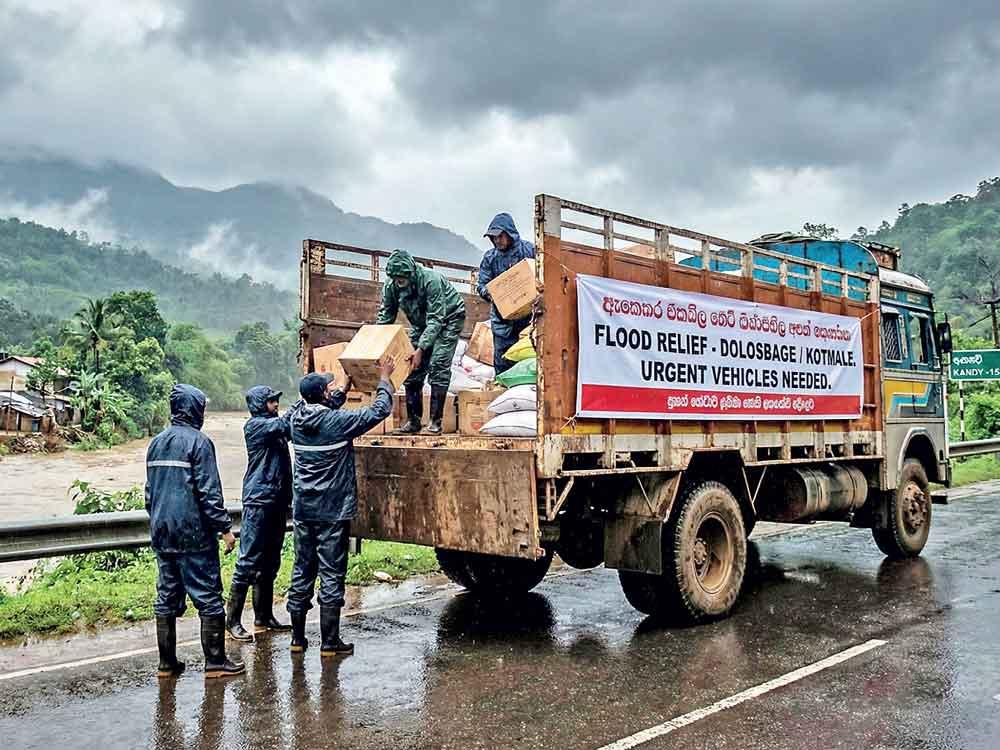
Whilst recognising the efforts and humanitarian motives of all rescue efforts underway, we note for the future the need to move towards civilian systems. (Picture courtesy social media)
Feminist Collective for Economic Justice, a collective of feminist economists, scholars, feminist activists, university students and lawyers, through a press release demands prioritising marginalised communities in disaster preparedness, equitable relief and economic justice.
The following is an excerpt of the release:
It’s been many days of relentless rains and winds devastating the island as Cyclonic Storm Ditwah approached and made landfalls in Sri Lanka. At the time of writing, we are heartbroken that close to 355 people have lost their lives and as many as 366 people are missing. Nearly 15,000 to 25,000 homes are damaged, and more than 59,000 families have been displaced.
The highest casualties were reported from Badulla, Kandy, Kegalle, Matale and Nuwara Eliya districts; areas especially prone to landslides and home to already marginalised and vulnerable working class tea plantation workers. Telecommunication lines are down in many districts, leaving people without a way to call for help. A state of emergency was declared on November 28, 2025. First responders working tirelessly have been providing support. However, with the prevailing conditions, the human impact and death toll are expected to increase.
The lack of information, transparency and coordination have left communities in the most vulnerable areas stranded with no help. Although dedicated disaster management systems have been in place in Sri Lanka since the 2004 Indian Ocean Tsunami, these systems turned out to be ill-prepared. Evacuation notices were issued, often only after roads were flooded.
Official government communications, including those from Disaster Management Centers and the Meteorology Department, are issued in Sinhala, even when addressing affected regions that were primarily Tamil-speaking. Default practices of institutional racism creeped in even at a time of dire need. The lack of a trained and equipped civilian disaster response cadre has meant dependence on the military at this time. Whilst recognising the efforts and humanitarian motives of all rescue efforts underway, we note for the future the need to move towards civilian systems.
Vulnerable communities
Communities who are already marginalised and vulnerable are the worst hit by the disaster. Low-income and working-class households are bearing the brunt. Households’ dependent on fishing are unable to go out to fish; those who have home-based livelihoods such as food preparation, basket-weaving, packing spices, sewing, etc., cannot earn due to disruption to transport and access to markets. Those dependent on agriculture have lost their entire crop.
Free Trade Zone workers are adversely affected. Workers living and working in and around the industrial waste canals are exposed to deteriorating water sanitation and severe hygiene risks. It is shocking that even in these extremely perilous conditions, workers are being forced to work.
Plantation workers have lost homes, loved ones and continue to battle landslides occurring in close proximity to one another. Women workers, especially domestic workers, have to juggle the unthinkable choice between going to work and addressing structural damage to their homes.
The impact on low-income and working-class households is not short term as incomes of the entire season’s produce are lost.
Along with the poor and working class communities, other marginalised groups are entirely invibilised. Queer and trans people, especially those living without familial support or are forced to live in unsafe homes, are neglected at times of disaster. Access to shelter and evacuation is challenging at best and often an acid test for many reasons. The lack of identity documents that affirm their preferred gender/name adds to the challenges faced. Along with such obstacles, the wrath of social stigma puts this group at the very bottom of the rung, especially during crises when many are scrambling for the limited support being provided.
In post-disaster contexts, there is often an increase in domestic and sexual violence. While existing hotlines have been publicised by the state, they are ill-equipped to deal with the increased demand. Women who attempted to access emergency support were sent away showing the unpreparedness of the response structures.
The climate crisis is further aggravated by an economic structure that marginalises the poor.
In this context, we are disappointed that the NPP Government’s policies reflected in the 2026 budget have failed, yet again, to prioritise social protection. Cutting off people from social protection or describing the cash transfers as begging, as Minister Sunil Handunetti has done, demonstrates the disconnect between policymakers and people’s needs.
Universal social protection must be considered as part and parcel of disaster preparedness and post-disaster economic and social resilience. This resilience is built through these systems as a sustainable and reliable connection between the state and citizens.
The global debt burden mirrors the climate crisis and is disproportionately upon the feeble shoulders of poorer countries such as Sri Lanka. People are barely surviving the economic crisis and rising costs of living while more than 50% of households are heavily in debt.
As FCEJ, we strongly reiterate that the NPP Government must renegotiate the conditions stipulated by the IMF and other lenders in the coming months. The Government must choose to be on the side of its people and not side with its creditors as the nation struggles to emerge from this disaster.
Urgent demands: