Reply To:
Name - Reply Comment
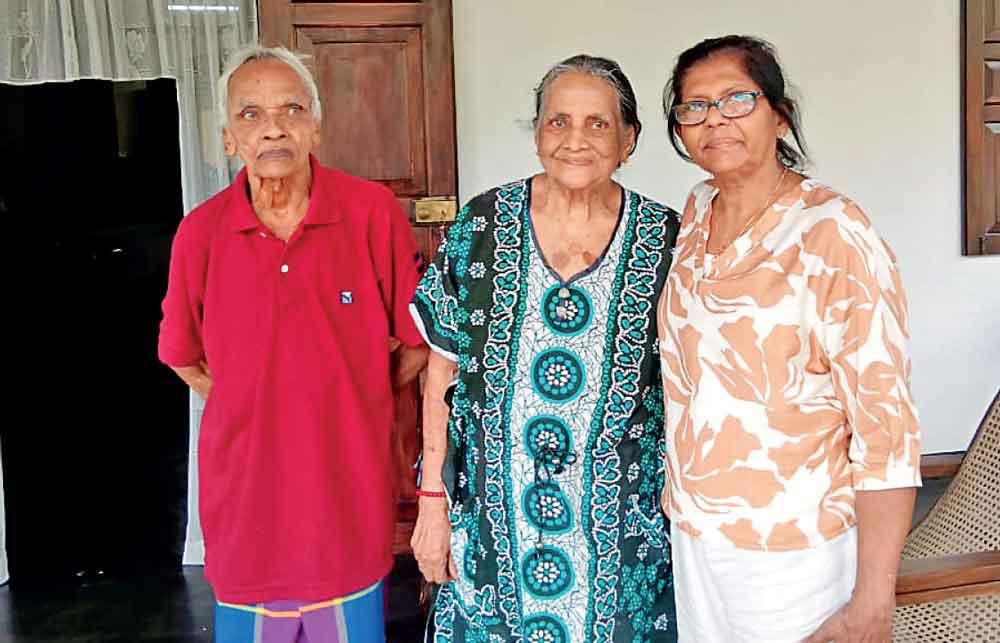
Dr. N.M. Perera’s devoted helper Saranelis (left) with Mrs. Ekneligoda. (Centre) who shelters him today. Onto the extreme right is a relative of Mrs. Ekneligoda.
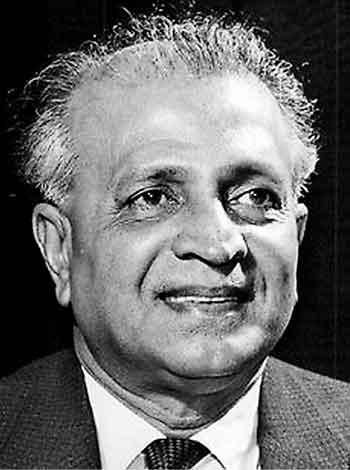 |
| Dr. N. M. Perera, charismatic leftist politician |
By Ravi Perera
“Sara”, short and sweet for “Saranelis”, moves with an energy that belies his age; a spry little man who has witnessed ninety years of social as well as political evolution in his beloved “Thun Korale” now.
A fulcrum of leftist politics for several decades, from the distant pre-independence State Council days, the sprawling Ruwanwella seat was the home base of Dr. N.M. Perera, the famous LSSP leader, a hold unbroken until 1977.
Barely 100 kms from the capital city of Colombo, Ruwanwella is still pastoral, the rolling countryside a carpet of rich green, lush forests, plantations and agriculture. The winding roads are wide, and sealed, the little townships dotting the area buzz with life; there is a sense of sufficiency. It has not always been good. In the 1930s, the infamous Malaria epidemic ravaged the district, and a few feudal families held complete sway over the land. Poverty was grinding. There were only a few motorable roads in the district, the infrastructure was primitive and the people were doomed to a hard, dark and ignorant life. This was the time when young N.M. Perera, fresh after his studies in England, began his political career as a volunteer worker in the anti-malaria campaign in the area.
It was hard going for him. The colonial government was dead set against the LSSP which was viewed as subversive (they had learnt their Marxism in the UK!). Even more hostile were the leading families of the district, instinctively opposed to his leftist ideology, often unleashing thuggery and intimidation on the young radicals. Meanwhile the peasantry, poor and ignorant, were generally uncomprehending or indifferent. However, the charisma of N.M. prevailed, winning the Ruwanwella seat in 1936 and going onto hold it until 1977.
“It is a massive sacrifice that he made for the country and its people. He was threatened that he would not be allowed to the area,” recalls N. H. Saraneris, describing how N. M. Perera’s entry to Thunkorale was opposed by those who held power, political and otherwise.
“It was not fair. There should be room for anyone to enter politics,” Sara reasons out.
“Those days, there was no law and order, and those powerful could decide the law. It was a time of wild justice,” Sara says.
“But the time has changed now. The children of those powerful, as well as those of the least powerful in the village are equal.It is this change that the politics of ‘Appo’ brought to this area. Now the coconut plucker’s child and the child from a Walawwa could go to the same university,” says the dutiful helper of N. M., reasoning out the social and political revolution that had taken place in his surroundings over the years.
Not all feudal families of the district opposed N.M. and the LSSP. There were a few exceptions, particularly of the famous Ekneligoda family who were won over by the charm and erudition of the young N. M. They provided the up-and-coming politician with accommodation, a support base and introductions to the outlying rural communities of the vast electorate. Many of these hamlets could only be reached on foot, through thick forests, over steep hills and fast flowing rivers.
It was the Ekneligoda family that introduced the village lad “Sara” to the NM Perera establishment in Ruwanwella (Rathu Wallawwa). Sara was then about 20 years old. N.M.’s busy schedule demanded constant travel, much work in Colombo, and he needed a reliable housekeeper to attend to numerous domestic matters, manage the other chores, look after his visitors and generally ensure that his Ruwanwella residence ran smoothly.
When young Sara, inexperienced and unexposed, met NM, the latter was already a big star on the national stage: outstanding parliamentarian, leader of the opposition and formidable labour leader. Sara served NM for many years, remembering that period with nostalgia and even reverence. Now frail, Sara yet recalls a time of a golden hue, when men of stature -- upright, broad-minded and learned -- dominated our public life. Their personalities fitted the public roles they played, even enriching the offices they held.
Sara sees the poverty of our times, square pegs in round holes everywhere; the superficialities and the incongruities of the holders of public office making a mockery of the system.
N.M. led a simple life, his meals were spartan, mainly rice with a few curried vegetables. “He never complained about the food, whatever was on the table would suffice. Compared to what is available now, the choices of food then were limited”.
“Sometimes he would come to the kitchen and serve himself what Kussi Amma has cooked, sit in any chair there. For him everyone was equal.”
NM enjoyed the simple things in life; he would often walk to the river flowing close by for a dip. There were children from estate line rooms nearby enjoying themselves in the water. They would play, splash water on him and laugh with N.M., unaware of who he was.
When N.M. was not attending to the numerous matters of his electorate, his time was spent on books and other literature, which he would bring from Colombo.
“Late into the night, N.M. was at his desk,” recalls Sara. “Party Booty Mokuth Nehe (There were no parties at his house). Everything was serious and responsible, a life wholly dedicated to a cause. N.M. never spoke harshly to us. He was a gentleman in every sense.”
As N.M.’s time was at a premium, Sara was instructed to leave notes on any house requirements, provisions and even emoluments. NM would pick it up on his way out and attend to them when time permitted
When NM used an official car as a minister, he would scrupulously keep records of the mileage.
“Before he got down from the car, he used to keep all records of his travel. When he is going for his personal journeys, he used a private vehicle,” Sara described.
“Sometimes, I would accompany the boss to Colombo. It is then that I realised how big he was and how respected he was in Sri Lankan politics. I have seen all leading politicians visit him at his Borella house and sometime the discussions would go for hours and hours. Though they were from different political lines, J. R. Jayewardene was his friend, and I have seen J. R. coming to meet him.”
Although Sara was not by any means on an equal footing with N.M., that connection seems to have enlarged him, given him a certain self-awareness and a dignity.
Dr. N. M. Perera passed away in 1979.
N.M. was comfortably off though not a wealthy man, whatever material possessions he had were donated to the LSSP. There was no money or land he could bequeath to his minders like Sara. Sara did not follow N.M. for the benefits he could have, to get a job in a state institution or have his child admitted to a prestigious school. Their idea of politics was very different.
Sara has the highest regard for N.M., holding a memory of a man he will cherish to his last days.
Today, Sara has been provided a sanctuary by the Ekneligoda family, living the evening of his life restfully in their Ruwanwella residence.