Reply To:
Name - Reply Comment
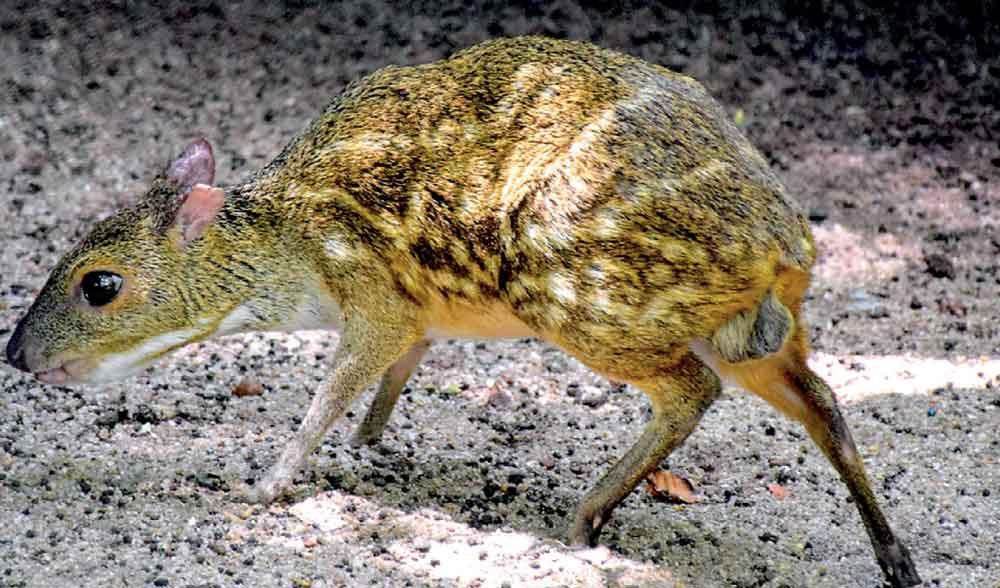
The elusive ‘Mi Minna’ on the move: shifty yet vulnerable in nature. Pix by Dulan Jayasekara
 Watching an adorable critter like the mouse deer or chevrotain prance across the first floor in the moonlight; if you’re lucky enough to witness this spectacle is a lesson in patience, perseverance and the joys of nocturnal wildlife viewing all at once. They add to Sri Lanka’s plethora of unique ecological diversity but prefer to stay away from us in an almost mythical way.
Zoologist Dulan Jayasekara says that “Despite having few offspring per litter and their diminutive size, they still evade predation due to their ‘elusive behaviour’ coupled with the fact that they are most active at night and dusk. Their cryptic behavioural adaptations are why they have survived so well.” He added “I had to do research and observation with the use of camera traps to study these nocturnal forest dwellers that frolic in the dark since they are too shy to be seen by humans”.
Mouse deer are despite the name, not rodents but small hoofed animals around the size of a rabbit and possess fangs instead of horns, unlike true deer. But they are probably more closely related to camelids than the true deer species. Their Sinhala name ‘Mi Minna’ literally means ‘mouse deer’ and the animal’s Tamil name ‘Sarukuman’ translates to ‘leaf litter deer’.
Other similar-sized forest dwellers such as rabbits produce multiple babies during each pregnancy and this offsets the fact that many fall to predators and get eaten. Conversely, the larger deer usually have only one offspring but live in large herds for defence and this phenomenon can be seen in Yala and other national parks where they congregate in massive groups. The stealthy little mouse deer however avoids the hunters efficiently even though they have just one offspring or occasionally, twins. They prefer to live in smaller groups and are more solitary and yet despite the dangers of the great outdoors, this adaptation keeps them safe.
“This is a highly specialised strategy they’ve used,” says Dr Kalinga Padmalal an ecologist at Open University who believes that they can be seen in Wilpattu and Horton plains mostly around March and October in the breeding season.
The mouse deer also has a unique bark or cry that one can distinguish right away. Padmalal suggests that different species of mouse deer across the world may possess different sounds at different wavelengths which needs more research.
Jayasekara noted that there are a “few differences” among the two native species of mouse deer: the Sri Lankan spotted chevrotain and yellow-striped chevrotain. Members of the mouse deer family also live in India, southeast Asia, upto Indonesia and parts of the African continent.
Also adding to their evasion skills, mouse deer also are good swimmers and can take a dive if the need arises and stay submerged for up to four minutes to escape scot-free from would-be pursuers. They also use their teeth to fight if the need arises as they don’t possess horns.
“They know how to use the canopy and terrain to their advantage,” Jayasekara said, describing how this critter has adapted to survive in Sri Lanka’s pristine forest habitat by staying elusive like the fabled leprechaun.
Despite being masters of escape and disguise that rival Harry Houdini, they occasionally fall to predators and some get taken by leopards and sometimes jackals unfortunately that are more than happy to feast on them.
In a tragic turn of events in 2015, a feral dog strayed into the chevrotain enclosure in Dehiwala Zoological Gardens and 13 deer were killed. This incident made headlines in the news and few knew about this elusive critter. Also, 4 years ago it made news when a mouse deer with a golden fur mutation was spotted in Puttalam district.
The mouse deer eats leaves, buds and shoots and hides in crevices and burrows during the daytime sometimes near water bodies. It also eats fallen fruit and vegetation. Studies have been done on its scat and that adds to our knowledge of its diet. They have no strict group hierarchy as such, but they mark their territory. “We don’t know how many of them exist in the wild”, Padmalal said, “we only know their spatial distribution; where they live.” He said that nobody has conducted a recent census.
The spotted chevrotain is truly a remarkable and mysterious species indeed that adds to Sri Lanka’s biodiversity. But its cryptic behaviour also makes it a challenge for science to fathom and few have seen it. Padmalal added “The mouse deer is a very unique animal and more research has to be done. It truly adds to Sri Lanka’s amazing wildlife experience.”