Reply To:
Name - Reply Comment
 From the ‘bisokotuwa’ to today: 78 years’ journey toward true independence and a quest for authenticity
As Sri Lanka marks 78 years of independence, a deeper question emerges: are we truly free in how we think and teach? For decades, our education and management systems have leaned heavily on global models like Toyota and IKEA, often ignoring the indigenous brilliance of the “bisokotuwa” or traditional sustainable fishing. True independence is not merely a political milestone; it is the courage to move away from cognitive dissonance and embrace a position of confidence over imitation.
Every year on 4 February, we celebrate Sri Lanka’s independence. We recall history, remember political milestones, and raise flags. Seventy-eight years on, however, it is worth asking a quieter question: how independent are we in the way we think, teach, work, and make decisions?
This question came to mind during a recent curriculum review discussion. A senior colleague shared an incident from his PhD days at a UK university.
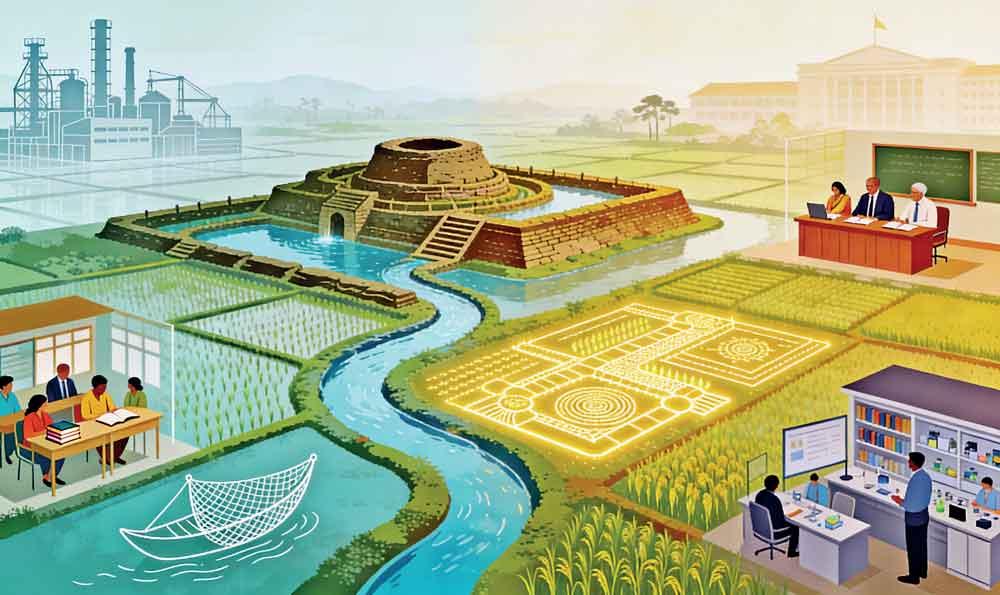
During a lecture on the theory and practice of management, a well-known sociologist compared the Netherlands and Sri Lanka, highlighting the bisokotuwa in ancient tank systems.
He even sketched Sri Lanka on the board, unaware that a Sri Lankan student was sitting in the classroom. What struck my colleague was not just the recognition of an indigenous system, but the realisation that something developed here, centuries ago, was being explained back to us through someone else’s lens.
We often teach using global examples such as Toyota’s production system, IKEA’s customer-centric design, Starbucks’ international expansion, or Johnson & Johnson’s credo. These are valuable, particularly in showing how companies scale globally.
Yet, what is often overlooked and what is most relevant for our own context is the local adaptation these companies make in different markets. In practice, we focus almost exclusively on the global expansion itself, missing the subtler insights about tailoring solutions to specific contexts.
The very insight the bisokotuwa offers
What makes this even more curious is that many of these examples are completely alien to those citing them. Most have never experienced working inside Toyota, observing IKEA’s customer design firsthand, seeing Starbucks’ operations up close, or exploring Amazon’s supply chain in practice. For some, the farthest they’ve travelled is still the roads of their own hometowns, yet they treat these global systems as models to emulate, as if case studies alone could convey the subtle lessons that only experience reveals. It’s truly absurd - studying swimming from a book and acting like you’re ready for the ocean.
I was reminded of these lessons again during an online discussion hosted by PRME–UK, a global academic initiative focused on responsible management education, where a friend and I represented our university, and were the only Sri Lankans present.
A senior academic pointed out that knowledge is most effectively shared when it draws on local examples and uses language that can genuinely connect with learners. At one of our own research conferences, my friend remembered an incident that perfectly illustrated this. A globally renowned management scholar had been invited, and during the discussion, someone asked whether he could propose a model to address a pressing issue within the university. The scholar was honest. Despite his global reputation, he admitted he knew too little about our context to offer a meaningful solution.
Many professionals live with this cognitive dissonance daily. Knowing that context matters deeply, yet operating in environments that reward abstraction over authenticity.
There is a subtle strain that comes from constantly working within systems that do not quite fit. People spend more time translating expectations, navigating hierarchy, or second-guessing decisions than actually doing meaningful work. Over time, this creates mental fatigue and blurriness. A quiet exhaustion that is neither visible nor dramatic, but deeply felt.
Authenticity offers a way out of this fog
The bisokotuwa worked because it was designed for the land, climate, and communities it served. It did not aim to be universal; it aimed to be effective. The same applies to education, leadership, and organisational life. When systems are rooted in context, people experience clarity rather than confusion, ownership rather than fatigue. Sri Lanka is full of such examples.
Traditional paddy harvesting systems embody principles of cradle-to-cradle design and resource regeneration long before the term “circular economy” became popular globally. Traditional fishing methods like karaka traps, cylindrical basket-like traps designed to allow juvenile fish to escape, and stilt fishing (riti panna) along the southern coast demonstrate sustainable, low-impact techniques perfectly suited to local ecosystems. Even Ayurvedic medicine, with its emphasis on local herbs, seasonal practices, and holistic well-being, reflects centuries of context-driven, effective knowledge. Yet, when teaching or benchmarking, we often point to Japan’s lean production, IKEA’s sustainable practices, or Scandinavian approaches to circular economy, overlooking these rich, homegrown systems.
This does not mean rejecting global knowledge. It means engaging with the world from a position of confidence rather than imitation. It means knowing when to adapt, when to question, and when to trust local wisdom.
True independence, both in thought and in action, is not about how closely we resemble others, but how clearly we understand ourselves.
As we mark another Independence Day, perhaps the challenge before us is not only political or economic, but cultural and intellectual. Independence should not be something we commemorate; but something we practise. And it begins with the courage to be authentic— in what we do, how we lead, the roles we hold , and mostly our thinking.
Ms. Jeevani Senevirathne is a Senior Lecturer, Department of Business Administration, Faculty of Management Studies and Commerce, University of Sri Jayewardenepura, [email protected]