Reply To:
Name - Reply Comment
 Meezan Hadjiar, born Sathkorale Muhamdiramlagedara Segu Abdul Cader Hajiar Mohamed Mohideen, rose from a small village in Akurana to become Matale’s foremost entrepreneur. Beginning as a young apprentice in 1925, he transformed a failing shop into Meezan Estates Ltd, owning thousands of acres of tea and rubber plantations. His influence extended beyond commerce to civic service, philanthropy, and politics, funding water schemes, mosques, and supporting the UNP. Remembered for his foresight and generosity, Meezan’s life illuminates the growth of Matale’s commercial and social fabric during a transformative era.
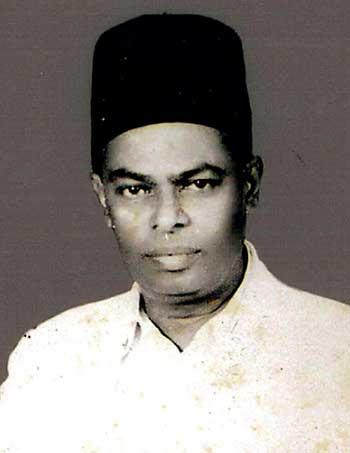 |
| Meezan Hadjiar |
I am happy that a book about the life and contribution of Sathkorale Muhamdiramlagedara Segu Abdul Cader Hajiar Mohamed Mohideen better known as Meezan Hadjiar or Meezan Mudalali of Matale [1911—1964] written by Mohammed Fuaji-a former Principal of Zahira College Matale, has now been published by a group of his admirers and relatives. It is a timely addition to the history of Matale district and the Kandyan region which is yet to be described fully as forming a part of the modern history of our country.
Coincidentally this book also marks the centenary of Meezan Hadjiars beginning of employment in Matale town which began in 1925.
Matale which was an outlier in the Kandyan Kingdom came into prominence with the growth of plantations for Coffee and, after the collapse of the Coffee plantations due to the’’Coffee blight’, for other tree crops.
Coffee was followed by the introduction of Tea by the early British investors who faced bankruptcy and ruin if they could not quickly find a substitute beverage for coffee.They turned to tea.
The rapid opening of tea plantations in the hill country demanded a large and hardworking labour force which could not be found domestically. This led to the indenturing of Tamil labour from South India on a large scale.
These helpless workers were virtually kidnapped from their native villages in India through the Kangani system and they were compelled to migrate to our hill country by the British administration.
The route of these indentured workers to the higher elevations of the hill country lay through Matale and the new plantation industry developed in that region thereby dragging it into a new commercial culture and a cash economy.
New opportunities were opened up for internal migration particularly for the more adventurous members of the Muslim community who had played a significant role in the Kandyan kingdom particularly as traders, transporters, medical specialists and military advisors.
Diaries of British officials like John D’oyly also show that the Kandyan Muslims were interlocutors between the Kandyan King and British officials of the Low Country as they had to move about across boundaries as traders of scarce commodities like salt, medicines and consumer articles for the Kandyans and arecanuts, gems and spices for the British.
Even today there are physical traces of the ‘’Battal’’or caravans of Oxon which were used by the Muslims to transport the above mentioned commodities to and from the Kandyan villages to the Low country.
Another important facet was that Kandyan Muslims were located in villages close to the entrances to the hill country attesting to their mobility unlike the Kandyan villagers.
Thus Akurana, Galagedera, Kadugannawa, Hataraliyadde and Mavanella which lay in the pathways to enter the inner territory of the Kings domain were populated by ‘Kandyan Muslims’’who had the ear of the King and his high officials.
The’’ Ge’’ names and the honorifics given by the King were a testament to their integration with the Sinhala polity.
Meezan Hadjiars’’ Ge ‘‘name of Sathkorale Mohandiramlage denotes the mobility of the family from Sathkorale, an outlier division in the Kandyan Kingdom, and Mohandiramlage attests to the higher status in the social hierarchy which probably indicated that his forebears were honoured servants of the king.
Meezan Hadjiar [SM Mohideen] was born and bred in Kurugoda which is a small village in Akurana in Kandy district.
He belonged to the family of Abdul Cader who was a patriarch and a well known religious scholar.
Cader’s children began their education in the village school but at the age of twelve young Mohideen left his native village to apprentice under a relative who had a business establishment in the heart of Matale town which was growing fast due to the economic boom. It must be stated here that this form of ‘’learning the ropes’ as an apprentice’was a common path to business undertaken by many of the later Srilankan tycoons of the pre-independence era.
But he did not remain in that position for long. When his mentor failed in his business of trading in Cocoa, Cardamoms, Cloves and Arecanuts and wanted to close up his shop young Mohideen took over and eventually made a great success of it. His enterprise succeeded because he was able to earn the trust of both his buyers and sellers.
He befriended Sinhalese and Tamil producers and the business he improved beyond measure took on the name of Meezan Estates Ltd and Mohideen soon became famous as Meezan Mudalali-perhaps the most successful businessman of his time in Matale.
He expanded his business interests to urban real estate as well as tea and rubber estates. Soon he owned over 3000 acres of tea estates making him one of the richest men in the Central Province.
With his growing influence Meezan spent generously on charitable activities including funding a water scheme for his native village of Kurugoda also serving adjoining villages like Pangollamada located in Akurana. He also gave generously to Buddhist causes in Matale together with other emerging low country businessmen like Gunasena and John Mudalali.
Matale was well known as a town in which all communities lived in harmony and tended to help each other. As a generous public figure he became strong supporter of the UNP and a personal friend of its leaders like Dudley Senanayake and Sir John Kotelawela.
UNP candidates for public office-both in the Municipality and Parliament were selected in consultation with Meezan who also bankrolled them during election time.He himself became a Municipal councillor.
The Aluvihares of several generations had close links with him.it was Meezan who mentored ACS Hameed -a fellow villager from Kurugoda-and took him to the highest echelons of Srilankan politics as Minister of Foreign Affaires. He was a supporter and financier of the UNP through thick and thin.
Though his premature death at the age fifty three in 1965 saved him from the worst political witch hunts under SWRD Bandaranaike who was his personal friend it was after 1970 and the Coalition regime that Meezans large family were deprived of their livelihood by the taking over of all their estates.
Fortunately many of his children were well educated and could hold on till relief was given by President Premadasa despite the objections of their fathers erstwhile protégé ACS Hameed who surprisingly let them down badly.
It is only fitting that we, even a hundred years later, now commemorate a great self made Srilankan business magnate and generous contributor to all religious and social causes of his time.
His name became synonymous with enterprise in Matale -a district in which I was privileged to serve as Government Agent in the late sixties.
He was a model entrepreneur and his large family have also made outstanding contributions to this country which also attest to the late Meezan Hadjiars foresight and vision of a united and prosperous Srilanka.