Reply To:
Name - Reply Comment
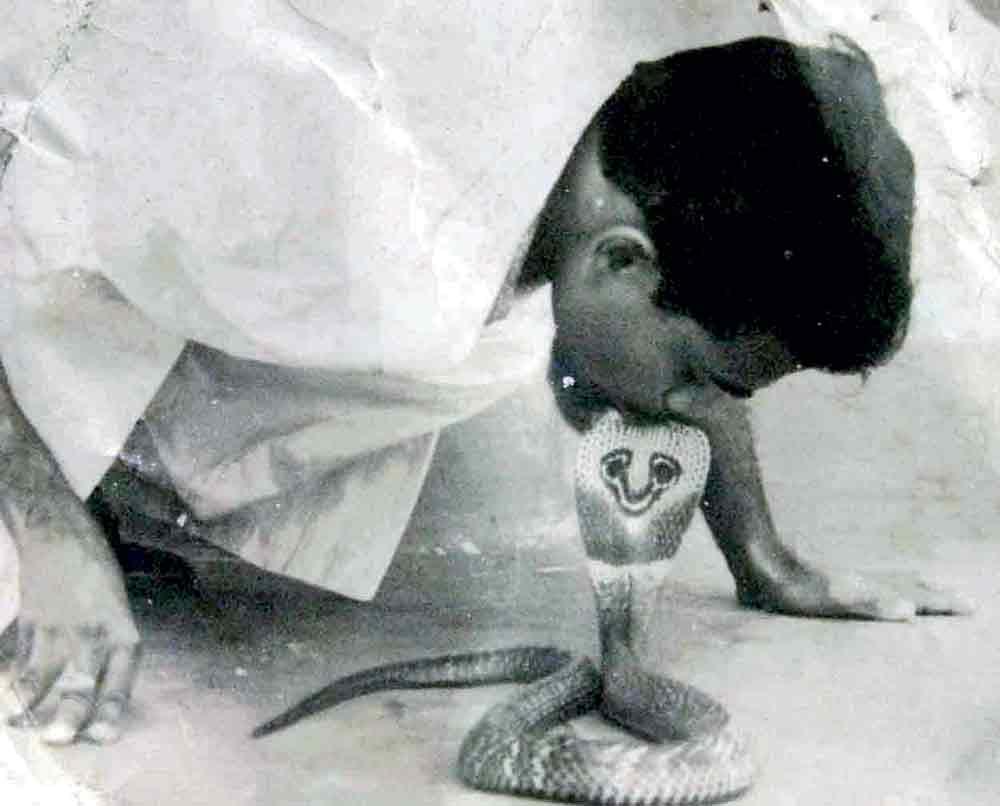
Dr. De Silva kissing a live cobra
 The younger generation has a tremendous amount of technology to study herpatology that was not available to us. I would advise the younger generation to cultivate a hobby in this field using reptiles. I encourage them to explore herpetology and develop it as both a passion and a profession
By Pinidi Attanayake
Despite the widespread fear and misunderstanding many people have toward reptiles, Dr. Anslem De Silva has spent decades researching and protecting them. In a recent interview with the Daily Mirror, he discussed his lifelong dedication to these animals, and the need to change public attitudes. Dr. De Silva is widely known as the “father of modern herpetology” in Sri Lanka.
Q: What attracted you to reptiles, and how has your view changed over time?
|
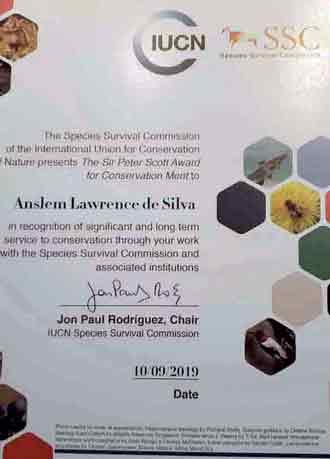
The certificate awarded to Dr. De Silva for the Peter Scott Award |
|
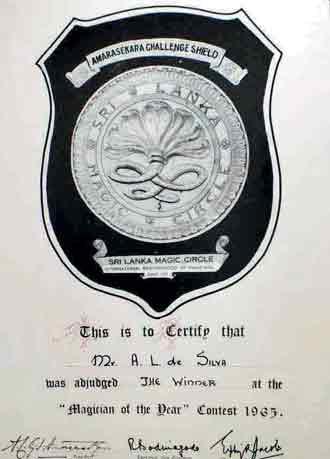
The certificate awarded to Dr. De Silva in 1965, recognizing him as Magician of the Year |
My earliest memory of animals comes from my father. He loved animals. My father raised squirrels, birds and various types of fish. But I am a little different from him. I am interested in a different type of species. I lived in Matara, near the beach. As a child, I used to collect crabs and bury them in the sand as part of what I thought was conservation. The next day, I would return to check on them. My fascination with snakes began during my time at St. Servatius’ College. One day, I saw a group of boys hitting a snake with stones. I intervened, carried the snake away, and released it.
Q: Can you recall a turning point in your life that defined your journey as a herpetologist?
My elder brother, Noel Terrance De Silva, gave me a book titled Snakes of Ceylon (1921). I began learning about different species and I still have it with me today. I studied zoology for my ordinary level examination and achieved the highest credits. Later, I received a scholarship to England for further studies. At that time, there were only a handful of people in the field in Sri Lanka. They are Ranil Senanayake, P. B. Karunarathna, Professor P. E. P. Deraniyagala, Parakrama Keerthisinghe, and myself.
Q: Was there ever a time you felt afraid of snakes or reptiles and how did you overcome that fear?
My perspective has always been different. I have never feared animals. I feel that they are like my close relatives. As a young boy in Matara, I even kept a crocodile from the Nilwala River. People used to call me “Hoonu Mahaththaya” because I caught geckos to feed the snakes I kept. I even used my mouth to catch them, trapping them between my lips without feeling disgusted. Snakes have always felt familiar to me. I understand their behaviour and can sense when they might attack.
Q: What has been your most unforgettable encounter with a snake or any reptile?
There have been many. During a crocodile survey, I was sitting at the edge of a boat when a 16-foot crocodile nearly attacked me. Another time, at Yala National Park, I was walking at night and unknowingly came very close to a large crocodile. It froze in shock when it saw me. I have been bitten by a snake several times. I used to touch the head and give a kiss. Once, while I was handling a snake and momentarily lost focus, it struck my hand. This happened at the University of Peradeniya, and I had to be rushed to the hospital.
Q:Is there a particular species you feel personally connected to?
I am especially interested in kraits, which are highly venomous snakes found in Sri Lanka. I conducted the first study on kraits in Anuradhapura. They have unique behavioural patterns. Their mating season occurs during the rainy season, and most bites happen indoors at night when people are asleep. The Kraits come between 12.00 am and 3.00 am. Interestingly, kraits often bite without being noticed. Their feeding response can lead to unusual biting patterns. They have bitten the nipples of breastfeeding mothers and ladies during their menstruation. Usually, the other snakes bite on the foot, but kraits are more interesting and quite dangerous.
Q: Do you think people fear reptiles because they don’t understand them, or is it something deeper?
Fear largely comes from misunderstanding. Many people believe all snakes are venomous and deadly. There are also myths. For example, the idea that if one snake is killed, others will come to take revenge. I tested this by tagging 25 snakes with metal rings, but none returned.
But there’s a folk story that if you kill a Krait, you should burn it. This belief has some basis in science. The krait and the snake emit pheromones. It helps the animals to recognise each other. When snakes mate, the female releases pheromones so the male recognises the female. It is also released when a snake or a krait is killed. So, if it is not burned, more snakes may come looking for that pheromone. People also believe that snakes are slimy and sluggish. But they have dry skin.
Q:When you meet someone terrified of snakes, how do you usually try to change their mindset?
During exhibitions, we use non-venomous snakes to help people overcome their fear. We first handle the snake ourselves and then encourage visitors to gently touch its body while we control the head. Step by step, this helps change their perception. Education is key. If handled correctly, a snake will not bite. When other small children used to play with plastic toys, my son Panduka used to play with snakes when he was 3 years old.
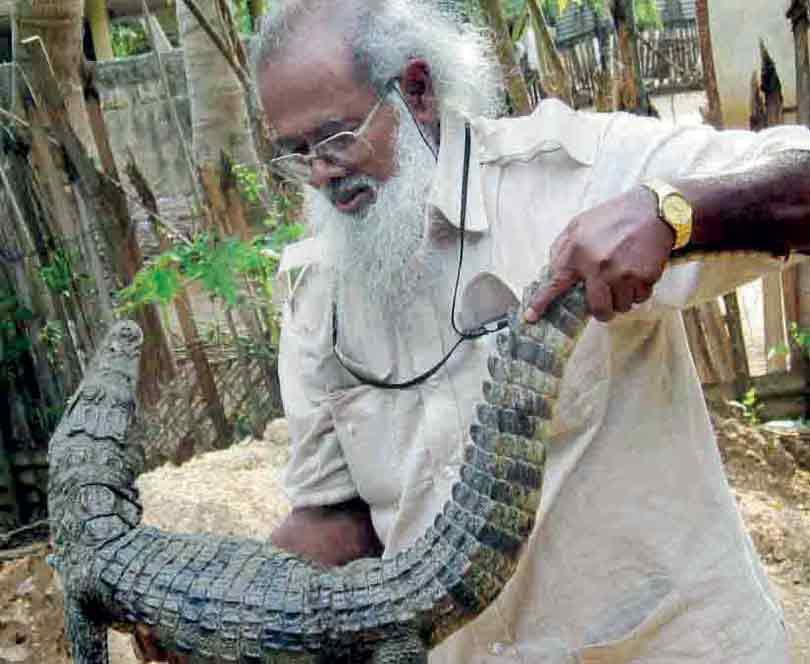
Dr. De Silva with a Jaffna mugger crocodile
Q: What are the other passions you were interested in?
Yes, I was deeply involved in magic. I used snakes when others use pigeons and rabbits in their performances. I did gymnastics and was the captain of the team. I practice the technique called bottle balancing. I bought the ballet style for the Sri Lankan magic shows. I was awarded the title of best magician in Sri Lanka for two consecutive years. Eventually, that’s how I met my wife. I practiced mass hypnotism (the psychological phenomenon where large groups of people simultaneously adopt similar beliefs, behaviours, or intense focus on a leader or issue, often losing critical self-awareness). This is done for the audience of the magic show. I was 22 years old then. One day, a group of girls came to watch the show. At night, a message came to the house I was staying at that the girls were behaving strangely. I reversed them back to normal. From that day onwards, I decided that I would never practice those types.
Once, I went to the Maadu River to do a film on the water monitor with the director of the Crocodile Conservation Centre in Madras. Before we started the film, we bought fish for the animals. They feel through their tongues. They are very poisonous. They have a sharp sense.
Five generations involved
Q:When you look back on your life one day, what would make you feel truly fulfilled?
One of my most important contributions was conducting the first island-wide survey on snakebites in Sri Lanka. I found out that 1.52 million people die annually due to snakebites. I presented the survey to the World Health Organization (WHO) in 1980. This conference was held in Japan. I was the only one representing Sri Lanka. Today, there are about five generations involved. One is my son’s generation. The fifth generation is W. Shenali Wickramanayake. It is also fulfilling to see multiple generations now taking an interest in herpetology, ensuring the field continues to grow.
Q: Tell us about the extraordinary work that you brought to Sri Lanka?
I have been involved in organising conferences since 1965. I conducted the first National Conference on Herpetology in 1995. I also conducted the first World Crocodile Conference in Sri Lanka at Negombo in the year 2013. I managed to conduct a conference on sea snakes for the first time in Sri Lanka. I have received 4 presidential awards as well. That’s a bit of what I received and part of my work in Sri Lanka. The 4th World Congress for Hepatology was conducted in Sri Lanka in 2001. And finally, the World Congress for Snakes in October this year. It is the first congress that is happening in Sri Lanka for snakes. Altogether, I have organized 15 conferences.
I was awarded the Sir Peter Scott Award for Conservation Merit in recognition of my unassuming commitment to reptile and amphibian research and conservation in Sri Lanka over many decades, understanding species, and launching many young Sri Lankans in their careers in conservation and science.
Q: What message would you give to the young people who want to follow an unconventional passion like yours?
The younger generation has a tremendous amount of technology to study herpatology that was not available to us. I would advise the younger generation to cultivate a hobby in this field using reptiles. I encourage them to explore herpetology and develop it as both a passion and a profession. This field allows the younger generation to publish various types of books after they take part in conferences. Employment in this field is always connected with nature, such as in wildlife conservation and zoological work.
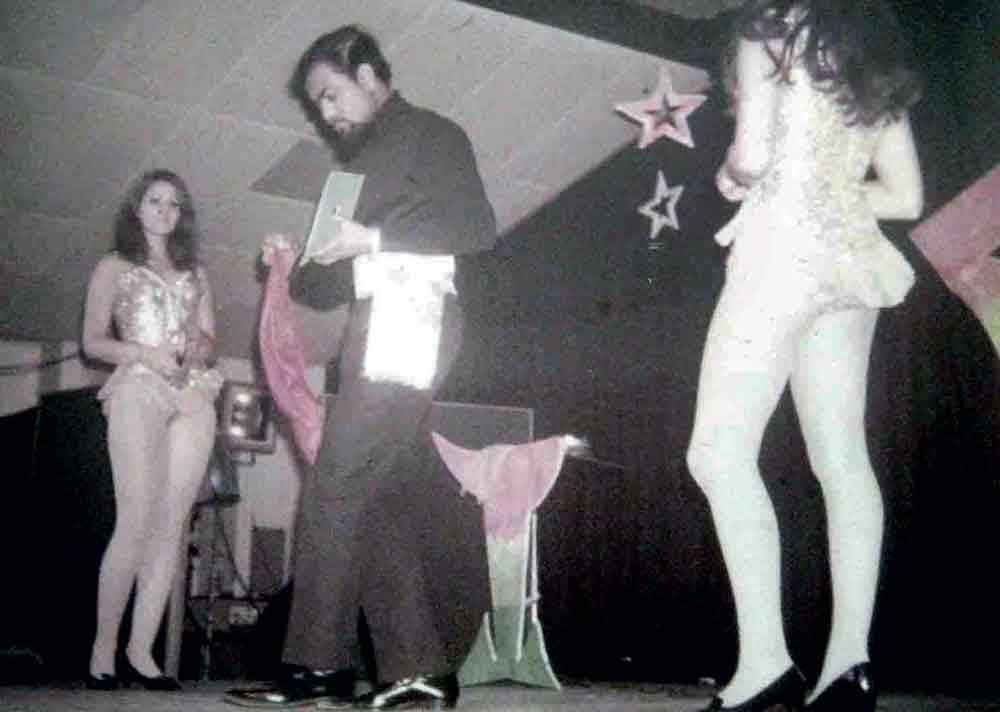
Dr. De Silva performing at a magic show in London