Reply To:
Name - Reply Comment
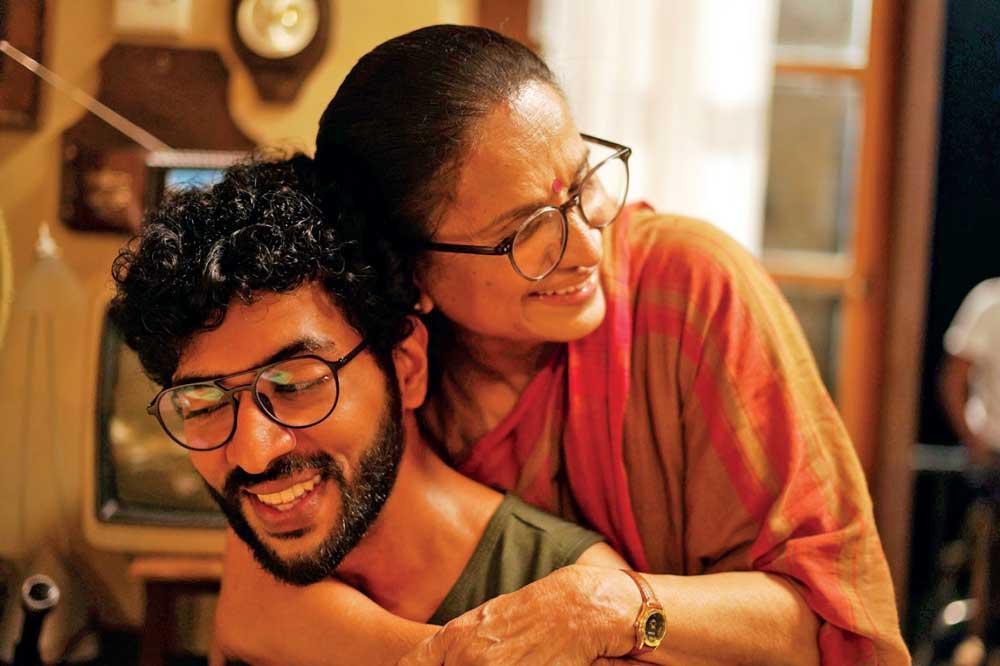
The writer opines that the film ‘Rani’ has tried to pass off an uninspired, uncharacteristic portrait of a true icon as a work of art and a piece of cultural history. And in doing so, it does a disservice to her memory

When I close my eyes I can picture Manorani. She wore jasmines in her hair, and classically Sri Lankan sarees, never Indian ones, those Nylex, floral print sarees that draped so gracefully on her tall frame. She always wore a powdered pottu. If she didn’t have time for the powder, she would smear it on with lipstick. She never carried a doctor’s bag, but she always had a stethoscope slung over her shoulder. She never kept alcohol in the house. Nor did Richard, for that matter. Their home was not that kind of place. It was the place they returned to, after work, after socializing, even after drinking! A place to read and write and rest.
When I close my eyes I can picture both Manoranis, the Manorani before Richard’s murder and the Manorani after. She never really smiled the same way again, but she retained all of her strength, all of her purpose, and all of her dignity. It is a shame that we see none of that—none of her—in this film
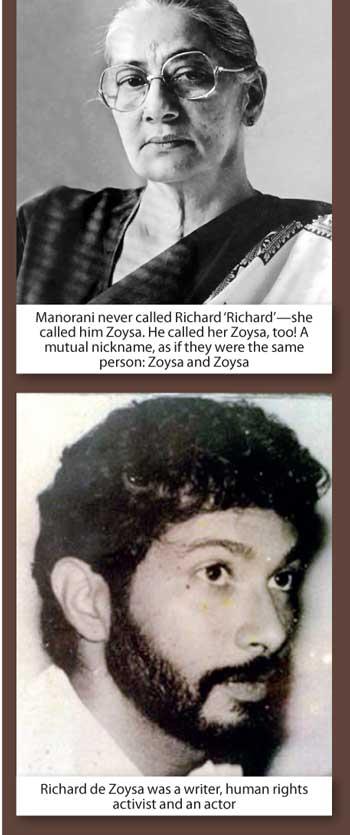 Manorani never called Richard ‘Richard’—she called him Zoysa. He called her Zoysa, too! A mutual nickname, as if they were the same person: Zoysa and Zoysa. But they never hugged. She never hugged any of us, actually. With Manorani it was always her smile. That was how she conveyed her warmth and affection for us, her love. It was all there in that smile.
Manorani Anta. That’s how she was known to us. Known to me, at least, and she has been a part of my life practically since my birth. She was one of the most dignified, most courageous woman I have known. She spoke with authority but never crudely. In her medical practice she was not just our beloved family doctor, she was the classic, the quintessential no-nonsense family doctor: sensible, practical, calm. She delivered both my daughters. She delivered the babies of a generation of women. In so many ways, she was an icon for a generation of women. For those of us who knew her intimately as well as for so many others who only glimpsed her from a distance, aspiring female medical students who would see her riding her bicycle to and from campus, and then later, all the hundreds of mothers across Sri Lanka for whom she represented a light in utter darkness. But I’m jumping ahead. Before I speak about how and why Manorani mattered so much to us—and why her memory matters to so many—let me say what mattered most to Manorani.
Zoysa, of course. Her life revolved around her work, and around him. Her relationship with him reflected her best qualities. It was a deeply intellectual relationship, nurtured in the head and stored in the heart. What they shared was not overly public. It was a very private bond, but because of the kinds of people they were, they drew scores of people to them and around them. In that sense, Manorani was never alone. She was always—even after Richard’s death—surrounded by people who loved her, even idolized her.
When Richard was killed, her world collapsed. We saw it. We watched it happen. Yet, in a way, Manorani’s core remained the same. She never descended into drink, or foul language, or anger. Even when she confronted his killers, she did so with tremendous grace and dignity.
A time of unspeakable trauma
The days following Richard’s murder was a time of unspeakable trauma, with new horrors surfacing every minute. We all lived in intense fear. We feared for our lives and the lives of our children, even sending them away to live with relatives elsewhere. We feared sleeping in our own home. It was at this time that Manorani developed a defiance we might not have expected, and it started with Zoysa’s funeral. Our family had always cremated or buried our dead. Manorani ordered a public pyre to be built. It was terrifying, spectacular. Cinematic. Any filmmaker would kill to replicate such a scene.
Then came the anti-climax. After the terror and grief, after all the press and the performances and the public outcry, then came the rest of her life. She did not embark on it as a political journey but in the same spirit of her relationship with Zoysa—as a deeply personal, almost private journey. As a mother.
Every month I accompanied her to a small village off Maho, where she worked with women who had lost their husbands during the reign of terror. Every single man in that village had been taken by the police and never seen again. Though it was the men who had been disappeared, Manorani called it the village of Lost Women, because at the time they were completely unable to fend for themselves in the absence of the breadwinners in their families. So they would come to the local temple grounds, and I would play games with the little ones while Manorani convinced the women to find ways to restart their lives. It was an uphill task, but she did it and they slowly started small businesses of their own and began to stand on their own two feet. They used to say, about her, “She’s like a goddess to us.”
To this day, there is only one small newspaper article about her work in this village. That’s because it was not politically motivated, or glamorous in any way. It was less about standing behind a banner of the Mother’s Front and more about her determination to uplift women with whom she felt a true kinship—women who had suffered a tragedy just like hers under that regime.
When I close my eyes I can picture both Manoranis, the Manorani before Richard’s murder and the Manorani after. She never really smiled the same way again, but she retained all of her strength, all of her purpose, and all of her dignity. It is a shame that we see none of that—none of her—in this film. Worse than a shame; it’s a devastating and disrespectful misrepresentation of a tremendous woman. And, strangely, a woman who was always larger than life, who was almost made for the big screen.
Although it was painful for those of us who knew her to sit through that film, we can at least find some comfort in our memories of the real Manorani. Those are unshakeable for us. The real tragedy is what this film has done for an entirely new generation—it has tried to pass off an uninspired, uncharacteristic portrait of a true icon as a work of art and a piece of cultural history. And in doing so, it does a disservice to her memory. She deserved better than this.
(Marie-Helene D’Almeida is the niece of Manorani Saravanamuttu. She is a retired teacher of Art, Drama and English)