Reply To:
Name - Reply Comment
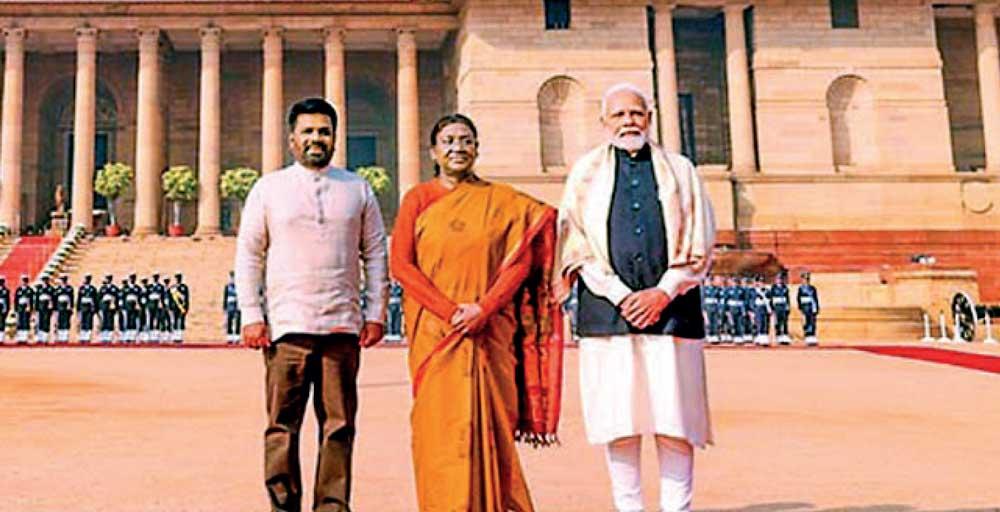
During his recent visit to India, President Dissanayake had given a firm assurance and extended unconditional support on priority basis for India to establish her interest in Sri Lanka. Image courtesy - PMD
In that context it is absolutely necessary to maintain Indo-Lanka relationship without clashing with Sino-Sri Lanka relationship. Balancing of the interests of India and China for the benefit of Sri Lanka is extremely important in this exercise
The Sri Lanka Government should have the strength to reject or to restructure bad projects at her discretion
 The geographical location of Sri Lanka in close proximity to South India, foreign policy of India, South Indian politics based on Tamil ethnicity, Indo-China power struggle in Indo Pacific region, global power politics and political situation of Sri Lanka are considered governing factors of Indo-Lanka relations invariably from its inception up to the present status.
The Indo-Lanka relationship in ancient and medieval history had become varied, consisting of different facets based on parties involved therein and their objectives. Historical sources reveal that Sri Lanka has developed a close relationship with South India much more than that of the relationship Sri Lanka had with Northern India in early history.
The relationships Sri Lanka had with Emperor Asoka of Mauryan Dynasty, Kaniska of Kushan Dynasty, Chandraguptha of Guptha Dynasty etc. in Northern part of India were based on cultural ties based on Buddhism and Buddhist culture. The relationship Sri Lanka had with South India varied from the intrusions of Tamil communities for plundering of wealth of Sri Lanka to invasions caused by Tamil kingdoms that emerged in South India such as Cholas, Pandyans, Cheras, Pallavas etc. based on expansion of their power over Sri Lanka. In addition, the relationship had been extended for procurement of mercenaries as and when required by parties involved with the power struggle for capturing of the ruling power and on the invitations on matrimonial ties in Royal families.
Consequent to the advent of Western powers such as Portuguese, Dutch, French and British in India, the traditional Indo-Lanka relationship had been drastically changed on the basis of policies those western powers had followed over India and Sri Lanka. The Indo-Lanka relationship had been restored in both countries after gaining Independence and the formation of their own Constitutions. It is wise to remember that India has formed a Federal Constitution whereas Sri Lanka has formed a Unitary State Constitution. The conflict in Indo-Lanka relationship has emerged based on the constitutional objectives and national interest of both countries.
Tamil Nadu is one of the Provincial States attached to the Union Government (Central Government) of India by Federal Constitution of India. Tamil Nadu politics based on Tamil ethnicity had been extended to Sri Lanka through the Tamil Eelam concept in concurrence with the pro-Eelam Tamil politicians in the Northern and Eastern provinces of Sri Lanka. Agitation for a separate autonomous State for Tamil Community in Sri Lanka by the Provincial State of Tamil Nadu had become a recurrent political challenge to the unity of the Union Government of India. In other words Eelam concept emerged in South India (Tamil Nadu) had become a challenge to the unity of both countries.
The situation has paved the way for the Union Government of India to intervene in Tamil Nadu politics in order to satisfy Tamil Nadu and to prevent possible break away of Tamil Nadu State from Union Government of India if Eelam concept is realised in the long run. It has also paved the way for India to intervene in internal affairs of Sri Lanka on the pretext of monitoring and safeguarding the interest of Tamil Community in Sri Lanka. The intervention on internal affairs of Sri Lanka is being used by the Union Government of India as a strategy for expansion and consolidation of her authority in Sri Lanka and to keep Sri Lanka under surveillance and in favour of India in the process of global power politics including Indo-China power struggle in the Indo-Pacific region.
At this juncture it is necessary to draw attention to the joint statement made on his state visit to India by President A.K.D. wherein he has reassured “not to allow our land (land of Sri Lanka) to be used in any way to a manner that is detrimental to the interest of India. The co-operation with India have been certainly flourished and I wanted to reassure our continued support for India”.
In order to evaluate the impact of the assurance given by AKD on the national interest of Sri Lanka it has become necessary to find out what India’s interests are from the perspective of the Indo-Lanka relationship and global power politics.
The Statement of AKD has given an impression that India has been allowed to exercise her interest on our land irrespective of its impact on national interest, national security, stability and sovereignty of Sri Lanka on the one hand and also to exercise Indian authority disregarding the interest of other friendly countries who are willing to invest in Sri Lanka. The assurance given by AKD has paved the way for a possible triangular conflict of interest between India, Sri Lanka and any other country who is interested in promoting friendly relations with Sri Lanka.
In other words AKD had given a firm assurance and extended unconditional support on priority basis for India to establish her interest in Sri Lanka disregarding the probable adverse consequences of such intervention which could jeopardise the sovereignty, security and stability of this country in the long run.
Do you remember the vehement protests and criticisms caused by the founder leader of JVP and his successors to JVP which includes AKD as well against Indian intervention on Sri Lanka three to four decades ago? All of them were of the view that Indian intervention is nothing but an aggressive expansion of Indian authority over Sri Lanka. This view of JVP had been confirmed by the aggressive behaviour of the Indian Government under the leadership of Rajiv Gandhi during the Peace Accord in 1987. They intruded the Sri Lankan Air Space by Indian Planes, dropping food parcels from air to besieged Tamil Communities, deploying IPKF in Northern and Eastern provinces of Sri Lanka, enforcing the 13th Amendment to the Constitution of Sri Lanka, providing training facilities for the Tamil Tigers in Tamil Nadu etc. on the pretext of humanitarian grounds without any request or prior consent from Sri Lanka.
So, what made AKD to change the above policy of JVP by giving an assurance to India in his statement?
Commenting on the aforementioned intervention of India, C. G Weeramanthri, Professor of Law at Monash University, Australia, formerly a Judge of Supreme Court of Sri Lanka pointed out in his article published in one of the national newspapers on 5th June 1987 that, “Humanitarian intervention by Indian Government in Northern Sri Lanka would clearly be illegal due to the facts that humanitarian intervention violates the dominant international legal principle of equality of states. The intervener must come to the intervention with complete clean hands and a total purity of motive. India was not a disinterested party and in fact contributed to the unrest by tacitly allowing the insurgents to set up training camps in Tamil Nadu. The UN Assembly’s resolutions on the Inadmissibility of Intervention on Domestic Affairs of States - 1965, Declaration of Friendly Relations -1970, and Definition of Aggression unequivocally rejected the doctrine of humanitarian intervention. All States including India are legally bound by such resolutions,” the article read.
In the above context it appears that the nature of Indo-Lanka relation has been dominated by the interest of India over Sri Lanka as and when India desires what it should be, irrespective of the national interest of Sri Lanka, even disregarding the international legal principle, UN Resolutions and Conventions ratified by Indian Government from time to time.
Having learnt a bitter lesson due to the vehement protest caused by JVP and allied forces in the South of Sri Lanka against the Peace Accord in 1987, India was compelled to withdraw the Accord and to change the Indo-Lanka relationship from coercive diplomacy to cordial relationship based on multifaceted financial, economic and socio-cultural assistance. However the prime intentions behind Indian intervention in internal affairs of Sri Lanka, namely the expansion and consolidation of authority of India over Sri Lanka in order to keep and control Sri Lanka in favour of India in the process of global power politics, more specifically in the ongoing Indo-China power struggle in Indo-Pacific region remains unchanged, along with the 13th amendment to the Constitution of Sri Lanka enforced by the Rajiv Gandhi Government which laid the foundation for autonomous status for pro Eelam Tamil Community in the Northern and Eastern Sri Lanka through the Provincial Council Mechanism in the long run.
It is extremely difficult if not impossible on the part of AKD alone to prevent repetition of such coercive interventions of India over internal affairs of Sri Lanka without the active support of a third party.
In that context it is absolutely necessary to maintain Indo-Lanka relationship without clashing with Sino-Sri Lanka relationship. Balancing of the interests of India and China for the benefit of Sri Lanka is extremely important in this exercise. The balancing of interests of India and China over Sri Lanka would be impossible if Sri Lanka gives priority to India over and above China in the ongoing geopolitical power struggle for the supremacy of Indo-Pacific region as per assurance given by AKD to India.
There is a close resemblance between the policy followed by Ranil Wickremesinghe and the policy of AKD over the relationship with India. The Wickremesinghe government approved several project proposals from India without considering their adverse impacts on the national interest of Sri Lanka in the long run. These include oil tank project in Trincomalee, the project on a so-called bridge linking South India and Northern Province of Sri Lanka, projects focused on Tamil ethnicity, projects dominated by Indian interest over Trincomalee Habour etc. although it appears that there are several other projects of India which would be immensely beneficial to Sri Lanka. In that context it is absolutely necessary to sort out good projects from bad projects. The Sri Lanka Government should have the strength to reject or to restructure bad projects at her discretion.
It is mandatory on the part of the Government of Sri Lanka to protect and safeguard the interest of India over the land of Sri Lanka as per the assurance given by AKD without jeopardising the national interest which comprise of sovereignty, security, integrity of Sri Lanka although this responsibility on the part of Sri Lankan Government had been blatantly violated by Wickremesinghe Government in the process of managing Indo-Lanka relationships.
It is noted that AKD needs sufficient time to implement his own policy in this regard, shifting from Wickremesinghe’s policy which was condemned by AKD himself at the Election Campaigns. It is nothing but fair on the part of citizens to wait and see how he is going to tackle this issue.
The writer is a former Executive Director at BOI, HRM Consultant on Fiscal Reform Program ADB – covering Sri Lanka Customs, Excise Department and Inland Revenue Department, a former Lecturer and Management Consultant.