 Kamanthi Wickramasinghe
 Reply To:
Name - Reply Comment
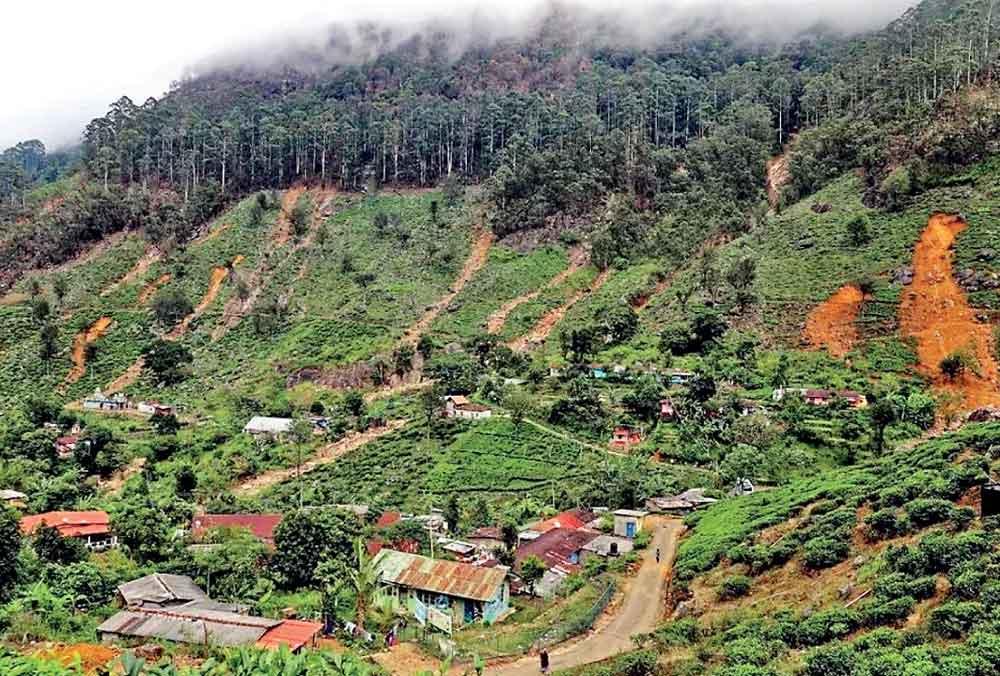
At least 13 landslides have occurred at the foot of the Namunukula mountain range, home to many families of the Malaiyaha community in the Badulla district.
Image courtesy - Selvaraja Rajasegar
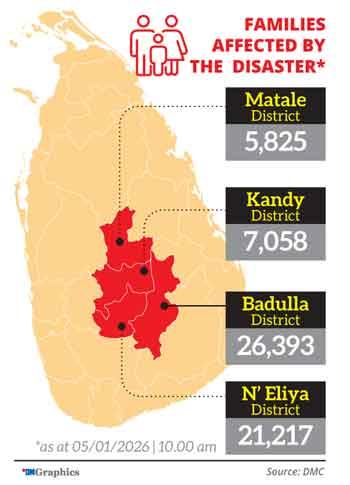 Vimalakumar Vishviya from Passara, Badulla was fortunate to escape a landslide that occurred on November 26. But her house suffered cracks following the landslide and her family now resides at a relative’s house. Landslides that occurred in the Central parts of the country impacted a majority of individuals in the Malaiyaha community. But in the aftermath of the disaster, these families are now facing challenges with regards to housing, land and are demanding the government to grant them their rights.
Living in fear
“We now live in fear because our house is uninhabitable,” Vishviya told the Daily Mirror. “This area had been frequently prone to landslides. In fact we were warned about the vulnerability of this area some 10 years ago,” she added.
Landslide hazard zonation mapping conducted by the National Building Research Organisation (NBRO) in 2016 indicates red zones in several districts of the country including Badulla. Even though evacuation alerts and red alerts became frequent in the aftermath of Cyclone Ditwah, people have been warned about the vulnerability of landslide-prone areas even before.
 The extent of road damage is not yet known. Besides, less than half of people living in plantations work for the company. The rest lives there because the property has been passed down generations. Since all this is owned by the government and all are citizens the government has some obligation to consider this community as well - Attorney-at-law and Social Activist Balachandran Gowthaman
Around 33 families are living at the Centre as their houses were entirely damaged. But we can’t stay there forever. Right now we don’t want dry rations, we want our land and our rights to build a house - Vimalakumar Vishviya from Passara, Badulla
Vishviya further said that around 18 families live at the estate in which she lives. But since some people don’t work in the same estate their names have allegedly been taken off the beneficiaries list. “We received Rs. 25,000 compensation, but nobody has told us to either evacuate or instructed us about how our house should be designed. Around 33 families are living at the Centre as their houses were entirely damaged. But we can’t stay there forever. Right now we don’t want dry rations, we want our land and our rights to build a house. We want a deed for our lands and this is our request to the government,” she added.
An urgent call to provide land rights
Apart from disruption to daily lives, the Cyclone exposed the harrowing realities faced by the Malaiyaha community including their long wait to receive a land and house of their own. Many of these have been mere election promises for decades which never saw light of day. But according to activists advocating for the rights of the Malaiyaha community, this is an opportune moment for the government to deal directly with the community and deliver their promises without any intermediaries.
“Following the cyclone, most estates coming under the purview of regional plantation companies were affected,” said Periyasamy Muthulingam, Executive Director at Institute for Social Development. “So now there’s a need for land to put up housing. If you take past events such as the Meeriyabadda landslide, some people living in estates were not granted land as they were working elsewhere. So the companies used to say that they won’t give land to these people. But all these lands are owned by the government and they come under the Land Reform Commission,” he added.
Now there’s a need for land to put up housing. If you take past events such as the Meeriyabadda landslide, some people living in estates weren’t granted land as they were working elsewhere. But all these lands are owned by the government and they come under the Land Reform Commission - Periyasamy Muthulingam, Executive Director at Institute for Social Development
He further recalled what President Dissanayake said. “When he visited Nuwara Eliya last December, he said that 611 roads in the hill country come under plantation companies and directed that steps be taken to transfer these roads under the purview of local authorities. But this position overlooks existing legal provisions,” he claimed.
The ISD had continuously lobbied for this change since 1994 and an amendment was brought to the Pradeshiya Sabha Act in 2018. Under the Pradeshiya Sabha Act 15 of 1987 (as amended) Section 2(2) empowers Pradeshiya Sabhas in plantation areas to a special resolution and consultation with estate authorities to utilise the local authority funds to construct roads, wells and other common infrastructure. Section 2(3)(a) states that such roads and amenities once constructed or maintained shall be vested in the Pradeshiya Sabha and deemed public assets.
Muthulingam further said that the National People Power’s Hatton Declaration acknowledges that the primary challenge faced by the Malaiyaha community is the housing crisis, noting that around 67.8% of the community lives in line rooms according to a census conducted in 2012/2013.
On the other hand, despite the 200-year legacy of the Malaiyaha community they are still unable to enjoy their full citizenship. “We promoted the 200 year history of this community, but now we don’t have to talk about. Sinhalese people won’t say that they have a 2500 year history and they have a right to land. They all are citizens of this country. If a person lives in a country for more than five years, he should enjoy full citizenship. During President Mahinda Rajapaksa’s period they identified 37,000 hectares of uncultivated land in plantation sector. Uncultivated areas were identified during President Premadasa’s period as well. So why can’t they grant land to this community?” Muthulingam questioned.
He said that over 37,000 houses have been built since 1987 but none of these house owners have deeds. “The government doesn’t need to build houses. They should give land and people should have the right to mortgage that land to the State Mortgage Bank. Company management claims that if they give land, people would sell them to outsiders. But if people mortgage their land for a 30-year loan they cannot sell it. There’s a need for nearly 200,000 houses and how long would it take for the government to complete them,” Muthulingam questioned further.
More bottlenecks observed
In addition, people from Malaiyaha community have been deprived of access to compensation packages. Speaking to the Daily Mirror, Attorney-at-law and Social Activist Balachandran Gowthaman said that Grama Niladhari officials are challenged with a heavy workload and there’s an issue in terms of accessibility. “This affects people who require compensation packages. On the other hand, agriculture extensions, livestock, small and medium businesses in the estate sector require some sort of approval process from the company management. If I’m living in an estate and doing a small enterprise, I can’t go and get a business registration approved from a local district secretary or Pradeshiya Sabha without the letter of approval from the company management. This has created a circumstance that makes it difficult for the state apparatus to resolve. Therefore, current procedures and processes for eligibility and certification must be made a little flexible to incorporate this community as well,” he suggested.
He further said that if infrastructure development is passed onto tea companies, these projects may not be completed soon. “The extent of road damage is not yet known. Besides, less than half of people living in plantations work for the company. The rest lives there because the property has been passed down generations. Since all this is owned by the government and all are citizens the government has some obligation to consider this community as well. So given the scale of disaster they should have a more systematic approach and allocate money for local authorities, Ministry of Plantations and other stakeholders to get the work done. But our experience is that the government usually doesn’t do it,” Gowthaman added.
Initial surveys reveal that displaced families from the Malaiyaha community would have to be in an 18-20 month transitional phase. The government had been requested to convene representatives from plantation companies, civil society and people to sit down and agree on certain conditions on how land allocations could be facilitated. Gowthaman further said that some demands require policy level decisions which are not yet forthcoming. “Right now the Malaiyaha community is not under the radar of the government and that to us is a concern. The government is not yet geared to address disasters faced by the Malaiyaha community,” he observed.
How Emergency Regulations could be used to acquire land
However, according to emergency regulations imposed by the incumbent government in wake of Cyclone Ditwah the regime is now in a position to obtain buildings, lands and other infrastructure from stakeholders and provide resettlement opportunities for any displaced family. But according to Barath Arulsamy of Democratic People’s Front, the government hasn’t taken any initiative on that and families continue to remain in relief centres.
“In some places, people are being asked to go back to their houses despite their houses being in vulnerable locations,” Arulsamy told the Daily Mirror. “The government continues to pass the burden to plantation companies and they are negating the liability. This is accepted on a normal circumstance, but in this situation the emergency regulations are still in effect. Under emergency regulation No. 8, the government can obtain land owned by a plantation company under the Land Acquisition Act and compensate the company with another land. This way, resettlement could be expedited,” he explained.

The government continues to pass the burden to plantation companies and they are negating the liability. This is accepted on a normal circumstance, but in this situation the emergency regulations are still in effect. Under emergency regulation No. 8, the government can obtain land owned by a plantation company under the Land Acquisition Act and compensate the company with another land - Barath Arulsamy of Democratic People’s Front
Arulsamy further said that it is also not yet known as to whether the plantation community is eligible to obtain the Rs. 1 million, 2.5 million and 5 million relief packages allocated by the government for damaged properties and lands.
According to Arulsamy, the government also doesn’t seem to have the actual numbers of affected families in the plantation community. “Some organisations have gathered information on their own and have identified some 1553 families and 4000 individuals from the plantation community that have been affected. We requested for an appointment to meet with the President and highlight these issues, but he still hasn’t given us an appointment. At this point, if the government cannot provide housing rights for the entire community- which they have been demanding for many years, the government could at least provide houses to affected families on humanitarian grounds,” he underscored.
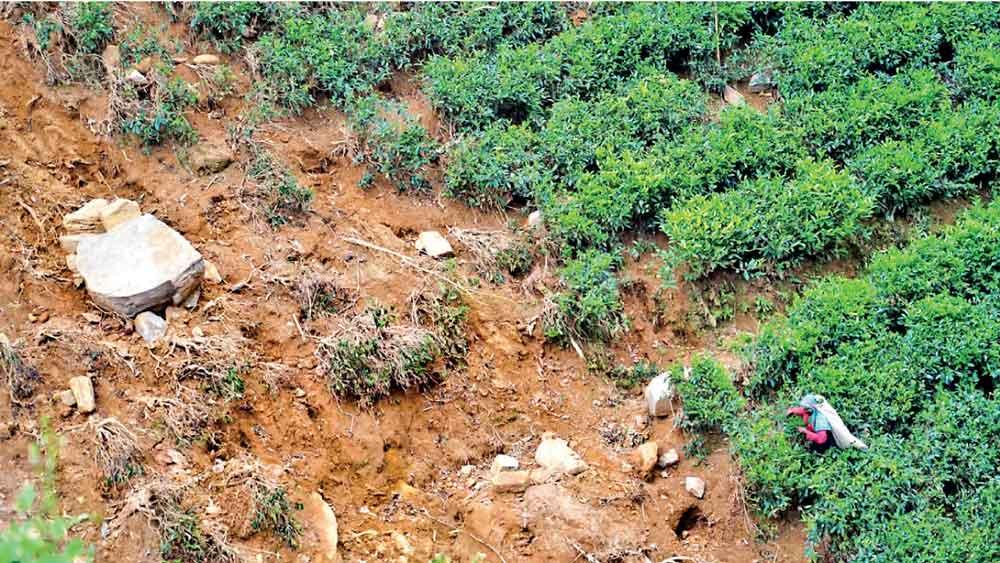
A Malaiyaha Tamil woman plucks tea at an estate in the immediate aftermath of a landslide.
Image courtesy - Sakuna M. Gamage
Several attempts to contact Minister of Plantations and Community Infrastructure Samantha Vidyaratne and Deputy Minister Sundaralingam Pradeep to inquire about government’s plans to expedite housing and lands for families of the Malaiyaha community who have been affected by landslides proved futile.