Reply To:
Name - Reply Comment
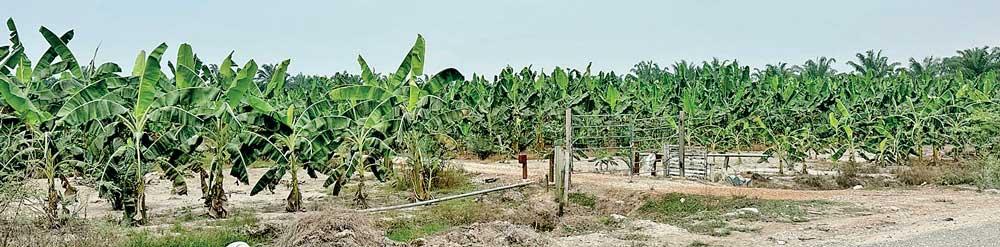
So far, 13,000 acres of oil palm have been cultivated by private land owners. Their target is to cultivate oil palm in 20,000 acres of land
 By Prageeth Sampath Karunathilaka and Sudharika Gurusinghe
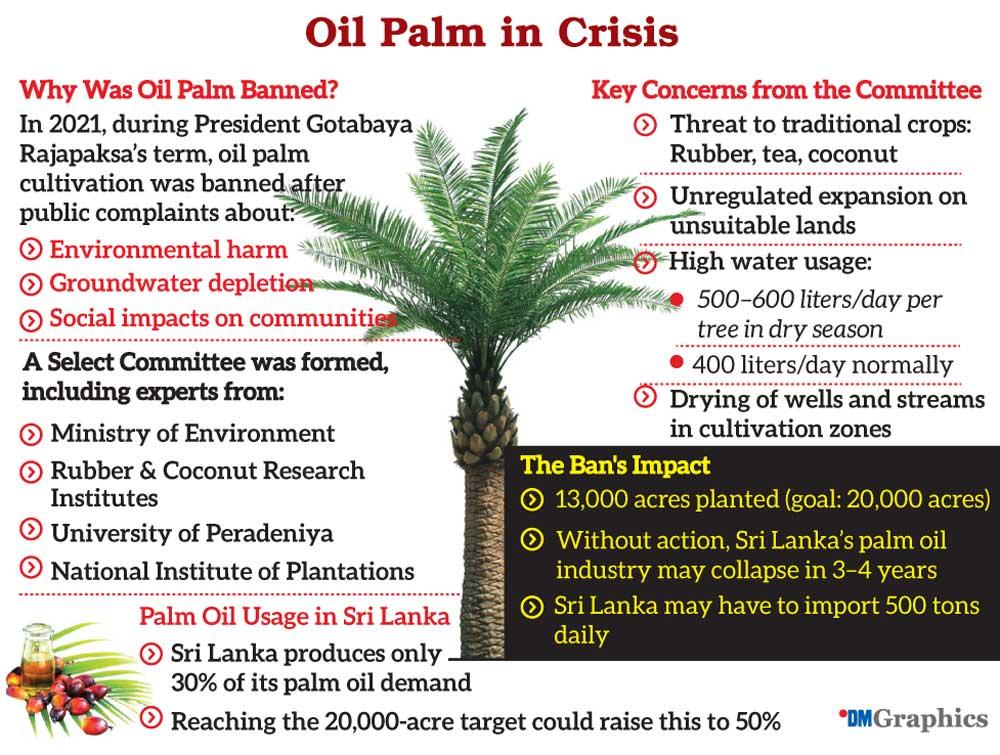
Following numerous public complaints about the adverse environmental and social impacts of oil palm cultivation that were reported to the Central Environmental Authority, steps were taken to ban oil palm cultivation in 2021, during the tenure of former President Gotabaya Rajapaksa.
So far, 13,000 acres of oil palm have been cultivated by private land owners. Their target is to cultivate oil palm in 20,000 acres of land. However, since the ban on oil palm was imposed, those targets have not been met. At that time, the Central Environmental Authority issued media releases stating that it would take steps to address the environmental damage caused by this cultivation and to hear public complaints. A Select Committee to Study was also appointed for this purpose and it comprised representatives from the Ministry of Mahaweli Development and Environment, Ministry of Plantation Industries, Faculty of Agriculture at the University of Peradeniya, Sri Lanka Rubber Research Institute, Sri Lanka Coconut Research Institute, and the National Institute of Plantations Management. This ensured that the key stakeholders associated with this matter were included in the process.
Based on international research reports, case studies and survey data from relevant areas, the committee reached several conclusions regarding the large-scale cultivation of oil palms in Sri Lanka. Key concerns included the threat to the sustainability of traditional plantation crops such as rubber, tea, and coconut, which are more environmentally and socially sustainable; the potential large-scale conversion of rubber plantations to oil palm cultivation if current trends continue; the expansion of oil palm cultivation without assessing the environmental suitability of the land; and the excessive water consumption of oil palm. In addition, international research has shown that a mature oil palm tree has an evaporation and transpiration rate of 500–600 litres per day during the dry season and around 400 litres per day on normal days.
The committee also underscored the significant impact of oil palm cultivation on groundwater sources. One of its key findings was that oil palm cultivation contributes to the rapid depletion and drying up of wells and streams in oil palm cultivation areas during the dry season.
However, oil palm cultivators argued that these decisions were not based on findings from concrete research. They claimed that oil palm cultivation doesn’t affect rainfall or impact other commercial crops including coconut. They added that, however the ban was imposed without proper consideration.
Environmentally sustainable oil palm varieties
In response, the University of Moratuwa and the University of Peradeniya jointly launched a study in 2021 to determine whether oil palm cultivation could be carried out without causing environmental harm. The research, completed in 2023, led to the introduction of environmentally sustainable oil palm varieties. While water pollution had previously been an issue due to oil palm cultivation, these new varieties were designed to allow water to be reused without contamination. Going further, researchers extracted water-soluble components from the new oil palm variety, prepared a food product, and evaporated the water to validate the experiment’s success. The experiment proved to be highly successful. However, Sri Lanka has yet to implement the findings while other countries involved in oil palm cultivation have begun studying the research outcomes from Sri Lanka.
Although the above research has helped popularise new varieties of oil palm among growers and initiate new cultivation efforts, another challenge has emerged. The complete ban on oil palm cultivation in Sri Lanka, along with the ban on oil palm imports, threatens to wipe out the country’s oil palm industry within the next 3–4 years. As a result, domestic oil palm production will also come to a halt.
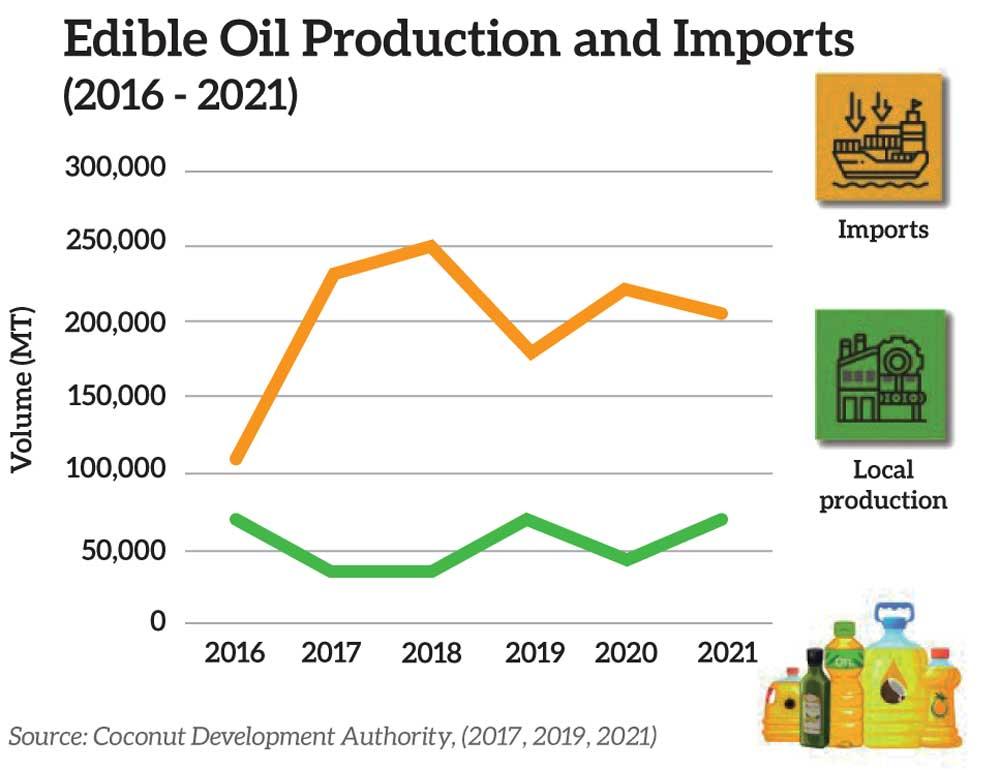
Palm oil is a key ingredient in producing soft drinks, perfumes, biscuits, and various food products. However, legal barriers preventing the establishment of new plantations using the newly developed varieties could lead to the collapse of these industries as well. If this happens, Sri Lanka will need to import 500 tons of palm oil daily. Currently, palm oil accounts for 75% of the country’s edible oil consumption, while coconut oil makes up 25%. At present, Sri Lanka produces 30% of its palm oil requirements, and expanding oil palm cultivation to 20,000 acres could increase this to 50%. Major palm oil production and importing companies are preparing to source 45–50% of the country’s demand from suppliers in Indonesia and Malaysia.
If Sri Lanka’s palm oil production collapses within the next 3–4 years, the country will be forced to import 500 tons of palm oil per day at an estimated cost of $1 million daily, $30 million monthly, and $360 million annually. Given the increasing costs of oil imports, which could range between $300 and $500 in the future, it remains uncertain whether the country’s economy can sustain this burden.
Therefore, the time has arrived to cultivate and test the newly developed oil palm varieties. If not, the country will lose significant foreign exchange. However, despite the research findings from two universities, the relevant authorities have yet to lift the ban on oil palm cultivation. Another major concern is that several of the world’s leading palm oil importing companies are collaborating in a fraudulent manner. Certain officials are being bribed to keep the restrictions in place even after the destruction of Sri Lanka’s oil palm plantations preventing the cultivation of new varieties. As a result, palm oil is imported from countries like Malaysia and Indonesia, sold at higher prices generating massive profits.
These companies gain an additional advantage by importing palm oil in this manner. They bring in unrefined palm oil, refine it, and then export it to India as processed palm oil. If palm oil is shipped directly from Indonesia, it incurs a 100 percent duty. However, when sent from Sri Lanka to India, the duty is only five percent. A customs spokesperson confirmed that the volume of palm oil imported through this process is not properly recorded by Sri Lankan customs. The spokesperson also noted that certain quantities of palm oil is being exported from Sri Lanka to India without any duty being paid at all. Although this practice is illegal, no responsible institution has taken steps to address the issue.
Several companies importing palm oil to Sri Lanka are currently re-exporting it to India, with reports indicating that another company is preparing to engage in a similar operation.
Customs data, shows that palm oil has been imported from 16 countries- that include Malaysia, Indonesia, India, China, Libya and Oman-between 2019 and 2025 bearing the associated costs. The customs data also details Sri Lanka’s palm oil exports during this period and the revenue generated. Although this data presents the import and export volumes of palm oil based on customs statistics, the customs spokesperson noted that these figures may be subject to change.
Palm oil production at risk
The government can generate a small income by importing unrefined palm oil, refining it, and exporting it to India without replanting trees. However, it has been revealed that several large-scale companies involved in this process are attempting to make significant profits through fraudulent means. As a result, Sri Lanka’s palm oil production is at risk of being completely wiped out.
Another major fraudulent practice within this racket involves mixing palm oil with coconut oil before exporting it to India. Previously, palm oil was mixed with coconut oil made from copra, but this practice declined due to rising copra prices. Now, a new scheme has emerged, where palm oil is blended with rice bran oil. Producing a litre of rice bran oil costs Rs. 550, whereas a litre of palm oil costs Rs. 800–900. Therefore fraudsters mix the two oils for higher profits.
Research conducted in Malaysia on oil palm cultivation has shown that both coconut and oil palm cultivation can coexist on the same land. It is also noteworthy to note that oil palm cultivation companies in Sri Lanka have adopted a specialised method for utilizing Palm Oil Mill Effluent (POME) with environmentally friendly high-tech solutions. As a result, Sri Lanka has become the first country in the world to meet internationally accepted environmental standards in oil palm cultivation. There were allegations that the discharge of POME, a by-product of this process, into water sources was causing pollution and environmental damage.
A specialised research in Malaysia has confirmed that oil palm cultivation does not negatively impact coconut cultivation. Moreover, the research has demonstrated that both crops can be cultivated on the same land. Advanced technological solutions have been developed for the treatment and recycling of POME, reducing water pollution. This by-product can be used to produce agricultural mulch, biogas, and organic fertilizer.
The collapse of this industry would have a significant impact on the Sri Lankan economy. Failure to grant permission for re-cultivation would further worsen the country’s foreign exchange crisis. This product is in high demand in the global market, and if Sri Lanka ceases production, the country will have to rely on imports. Consequently, foreign exchange dealings would deteriorate further. As an alternative, promoting environmentally friendly oil palm cultivation is the most effective way to strengthen the national economy.
When asked whether the cultivation of oil palm with new varieties would be allowed again in Sri Lanka and if the ban would be lifted, as well as whether the alleged mafia would be addressed, Director General of the Central Environmental Authority, Pathmasiri Moonamale, responded: “No company has requested our head office to carry out oil palm cultivation in accordance with the new environmental reports. We have also not received any reports from our regional offices regarding such requests. If a request is made, we will evaluate how the new varieties align with the research findings. Based on our assessments, we can consider whether the ban should be lifted. However, so far, no company has approached us regarding cultivation. We will also look into the irregularities occurring in the import and export of palm oil derived from oil palm trees and bring these issues to the attention of the relevant authorities.”