Reply To:
Name - Reply Comment
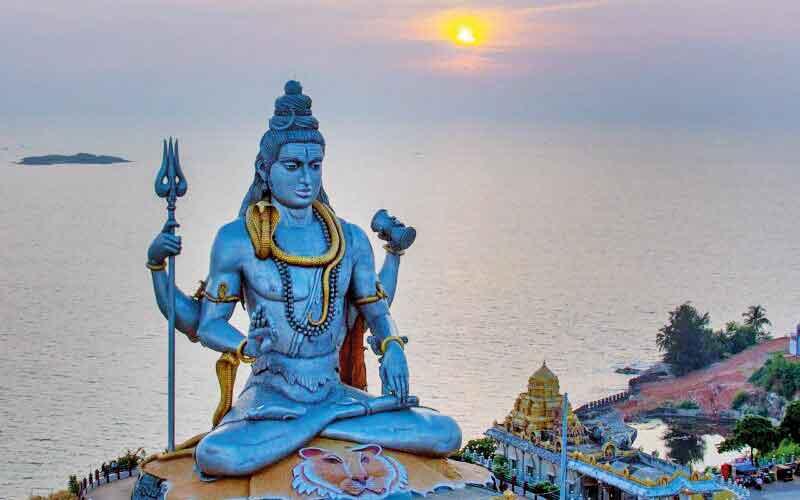
Lord Siva’

As elucidated by Indian Hindu astrologers Maha Sivarathri is a purely religious ceremony of day time fast and vigil throughout the night observed by Hindus world over to wash away the sins and pave way for eternal bliss through basic religious disciplines of ahinsa ( non injury), satya (truthfulness), brahmacarya (celibacy), daya (compassion), karuna (forgiveness) and anissa (absence of jealousy).
This ceremony is observed on the fourteenth night in the month of Phalguna (February/March) according to the Hindu calendar which is the longest night in the year.
Maha Sivarathri is a solemn occasion to worship lord Siva. he is formless (arupa). However out of compassion for devotees he appears in the form of a luminous light arising out of his lingam. He takes the form in this way for the sake of devotees who would otherwise be left in the perpetual darkness.
Lingam worship signifies that lord Siva is prevalent in Siva temples from ancient times. Trident, the three pointed spear is his weapon. Udakkiya or Udukku, the drum which is small in the middle, is his musical instrument. His vehicle is an ox. It is also believed that god Siva is normally in meditation on Mount Kailasa.
He is white in complexion and his neck is blue in colour. He is wearing an ornament of a snake. He has an additional eye which is powerful to destroy any thing with a glance. God Siva is also known as god Iswara. He is one of the triad of gods.
The triad of gods
Brahma, Vishnu and Siva are known as the triad of gods. Brahma created the world. God Vishnu who is mild, kind and gentle protects the virtuous people and build the world which is created by Brahma.
Lord Siva’s Iswara Vinsatiya, when unrighteous and unjust people are punished and righteous and just people are protected.
During Lord Siva’s period called Iswara Vinsatiya unrighteous and unjust people are punished and righteous and just people are protected by god Siva. It is he that destroys the world at the end. As such lord Siva is responsible for the prosperity and the wellbeing of the universe as well as for the destruction.
It is said that he has three wives. Uma or Umangana is the most beautiful goddess. Goddess Parwathie is excelled in dancing and music. His third wife is only a sign or gesture. The stream of water believed to be flowing from god Siva’s matted hair is believed to be his third wife, Ganga. Skanda Kumara or Karthikeya –god of war and Ganesha – the god of wisdom, are god Siva’s sons.
The origin of Sivarathri
The origin of Sivarathri is explained in ‘purana’ legends. In the war between Suras (gods) and Asuras (Demons or Titans) were likely to be defeated at one stage. So the gods got round their saviour, god Vishnu and begged him to find a way to defeat Asuras who were unrighteous and unlawful.
While contemplating as to how Asuras could be defeated a plan for that came to lord Siva’s mind. He felt that if they could find ‘amurthaya’ – the medicine of Immortality-ambrosia, the Asuras could be defeated because in that case gods could remain immortal.
Ambrosia or nectar of gods was deposited in the bed of the Milk Sea. Milk Sea had to be churned to bring the medicine of immortality to the surface. God Vishnu pulled out Mandara rock entwined it with naga king Vasuki and started churning the Milk Sea by pulling from the head and the tail of the naga king with the assistance of other gods.
A number of rare and valuable items came to the surface. Laksmi, the goddess of fortune and prosperity was one of them. The ambrosia the medicine of immortality which the gods needed most also came to the surface but with those items a virulent poison ‘Aalahala’ was also there. Lord Siva knew that this poison could be used by Asuras to destroy the whole universe if it went to their hands. Hence he gulped it down before Asuras could have an access to it. The poison disappeared in a moment but lord neck turned blue because the poison. Hence, Neela Kanda is an appellation for lord Siva.
Vilva (beli) leaves fallen on lingum
In another tale, it is said that a hunter named Siva who had killed many birds was being chased by a lion in the forest. In order to escape from the lion he had climbed a vilva (beli) tree. After the sun set too he was on the tree. To keep himself awake Siva went on plucking the leaves and dropping them down the tree. The vilva or beli leaves fell on the Siva lingam which was at the foot of the tree. This has pleased lord Siva and he had saved Siva despite his sins of killing birds. Later people started worshipping Siva lingam.
Beliefs in ancient Sri Lanka
There is legendary evidence to the effect that the ancestors of Lanka had believed in and trusted in lord Siva and worshipped him from the time of Ravana.
According to the rock inscriptions belonging to the period from the first century to the third century BC, devoted Buddhists had the prefix ‘Siva’ before their names. In those rock inscriptions it is mentioned about names such as ‘Siva Bhuti’, ‘Siva Guna’ and ‘Siva Rakina’. Such names had been used presumably because of their faith in god Siva.
Observation of Sivarathri
To mark the Maha Sivarathri festival the devotees get up early, take a ritual bath and after wearing fresh new clothes visit the nearest Siva temple for Abhishekam or anointing the Siva lingam with milk, honey, ghee, sugar and water.
At the temple the priests perform pujas every three hours with the sound of temple bells. Devotees spend the night singing hymns and chanting mantras repeating the words ‘Om Namah Sivayam.’ Flowers and leaves are used in performing pujas. Leaves of vilva tree are used in pujas. Usually puja ceremonies are conducted quarterly four times during the night.
The first quarter or the ‘Muthalaam Saamam’ commences at 8 p.m. Lotus flowers are given preference in the first quarter puja. For this one hundred and eight water ‘kumbams’ are used.
At 10.30 p.m. the second quarter ritual commences. This puja is performed with 49 water ‘kumbams’. In the second quarter puja thulasi leaves are given preference.
The most important part of Sivarathri ceremony is performed during the third quarter commencing at mid night. This is called ‘Linootpava Puja’. It is believed that Lord Siva although formless reveals himself in the form of a glowing light before devotees.
This is an exalted and holy occurrence which is a rare gift for devotees and it is the climax of the ceremony where five priests participate with five ‘kumbams’.
The fourth quarter ceremony is called ‘Naankaam Saamam’ which is the last and the auspicious part which commences at 3 a.m. and comes to an end at dawn. During this session of puja singular flowers are used.
Prayers of bajans
Apart from all night pujas devotees attend prayers or bajans in the morning and evening at home, in the parks or at the rivers flowing by the side of temples. Devotees recite Sanskrit verses throughout the day and night. Some devotees keep awake the whole night. They offer coconuts, vilva leaves, fruits and prepared food to lord Siva and his divine consort Parwathie Devi.
Liberation from the cycle of rebirth
For liberation from the cycle of rebirth and pain or suffering Gautama Buddha enunciated the Four Noble Truths (Chathurarya Satya) and showed the way for liberation by following the Eight Fold Path (Arya Atthangika Magga) and the attainment of Nibbana.
Hindus believe that the layman could achieve moksha or liberation through self realisation and spiritual development. They attempt to achieve this target through fasting and prayers which they believe to have tremendous influence over the mind and the body.
It is believed that a man who indulges himself in holy thoughts could achieve ‘moksha’ and Maha Sivarathri is the best opportunity for the layman to engage in prayers and fasting and seek divine favours and to achieve divine favours and achieve the state of Moksha through meditation.