Reply To:
Name - Reply Comment
 Lakshman’s letters suggest he could have been a good writer if he wanted to – novelist, biographer, or historian. They show a fine grasp of the human predicament as well as a person’s loneliness and vulnerability when juxtaposed against the ever-hurrying backdrop of life and world events. They also show him as someone in need of a larger, cosmopolitan operating space
 The late Lakshman Kadirgamar, Sri Lanka’s foreign minister assassinated by the LTTE in Colombo in 2005, is revealed to be a romantic judging by his letters written to wife Angela long ago, and quoted by daughter Ajitha Kadirgamar in a recent article.
Writing love letters was a literary form and de rigeur for high profile figures back in the 19th century and the 20th. In the glittering gallery of such correspondences, however, there is a glaring shortage of politicians. King Henry VIII of England and emperor Napoleon Bonaparte hardly seem to be the ideal examples, but the mercurial 16th century English king is considered romantic because of the letters he wrote to Anne Boleyn, one of his six wives whom he later beheaded. Napoleon Bonaparte, who divorced his wife Josephine when she could not bear him a child, nonetheless wrote tender letters to him from battlefields even five years after their separation.
 Writing love letters was a literary form and de rigeur for high profile figures back in the 19th century and the 20th
A young Lakshman’s romantic declarations show a vulnerable side of his persona which, if not for the discovery of these letters, would never have come to light
|
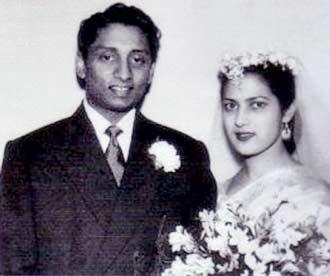
Lakshman and Angela on their wedding day, December 15, 1956, Oxford (Photo credit-Kadirgamar family) |
Former US president George H. W. Bush might seem as unlikely a candidate as the two examples given above. But he is considered a true-to-form love letter writer because of the letters he wrote to his future wife Barbara while serving in the American navy.
By and large, romantic correspondence is associated with artists, writers and poets – Frida Kahlo and Diego Rivera (painters), Georgia O’Keefe (painter) and Alfred Stieglitz (photographer), Beethoven (composer) and his as yet unidentified ‘Immortal Beloved,’ and novelist James Joyce to his devoted wife Nora Barnacle. The above mentioned politicians, kings and emperors are the exceptions which prove the rule.
Capacity for self-examination
Lakshman Kadirgamar, as revealed by these published excerpts written decades ago, was an exceptional man – not just in his romantic yearnings, but in his capacity for self-examination as an ambitious young man looking for his rightful place not just in the seamless theatre of life, but in the pressure cooker world of politics.
According to Ajitha Kadirgamar’s notes, Kadirgamar met his wife-to-be in London, in unusual circumstances. She was travelling in a cab with a Sri Lankan friend back in 1956 when a young man hurrying across the street almost got knocked over. That was Lakshman Kadirgamar.
Angela Malik (of French-Pakistani origin) was a talented sculptor and painter. It is not clear whether Kadirgamar was attracted to her because of her artistic talent, or if he had any artistic inclinations as a young man. But this seems to be a rare conjugal combination of politician and artist, perhaps an example of Newton’s third law of thermodynamics.
As Ajitha writes: “Lakshman and Angela’s was a very short courtship. The earliest letters precede the months before their marriage in December 1956, and contain proclamations of love that I could never have imagined my father capable of. Hardly an overly demonstrative or emotional man, young Lakshman’s romantic declarations show a vulnerable side of his persona which, if not for the discovery of these letters, would never have come to light.
“Her preserved correspondence written and received over a period of 65 years, has travelled from Oxford to Colombo, back again to Oxford, then on to Geneva and the French countryside, finally returning to Colombo again, to lie faded and yellowing in boxes and bags.”
These letters suggest he could have been a good writer if he wanted to – novelist, biographer, or historian. They show a fine grasp of the human predicament as well as a person’s loneliness and vulnerability when juxtaposed against the ever-hurrying backdrop of life and world events. They also show him as someone in need of a larger, cosmopolitan operating space than what this small island with its divisive racial politics could offer in the 60-70s.
But what’s most striking is his awareness of his wife’s talent, and the care he took to make sure that she did not simply disappear into his wake.
In a letter written in 1972, Kadirgamar thanks Angela for “all the sweetness you have brought to my life in better times; your unfailing support and encouragement which has sustained me in all my undertakings over these many years; the two children you have given me…”
In 1973, both were back in the UK, but living different lives. She was studying art at the Ruskin School of Art, University of Oxford, while raising two children. He was too busy to help her, commuting to work every day. But in this letter written in the same year, he encourages her to ‘proceed firmly on the basis that you must – and will – finish your course at the Ruskin. As I said in my last letter, this is too big an opportunity in your life to trifle with it.’
The following year, he writes and tells her in very touching language: ‘You are not a housewife/artist. You are an artist in your own right and on your own merits. You must be ambitious. You must create. You must excel. You must persevere. I will do everything in my power to help you. You have a great talent. And I love you.”
It wasn’t all one way letter traffic. In 1971, she wrote to him from Colombo describing the deteriorating situation with the JVP insurrection, curfews, fear and uncertainty. That year, the family left Sri Lanka. As Ajitha Kadirgamar writes: ‘Their final decision, as a result of the troubling times and the looming threat of ‘Sinhala only’ in the judicial and educational system which would have severely impacted Lakshman’s legal practice and our education, resulted in our leaving Ceylon in the summer of 1971.’ But she adds that ‘Lakshman regretted the decision throughout his life, for he felt adrift, directionless and almost homeless throughout his years in Europe.
He wrote: “As for me. I no longer have (if I ever had) any grand purpose, point or plan in my life. Like Henry V of Agincourt who cried ‘My kingdom for a horse’, I can only cry ‘give me a country, a platform’. I have neither and am not likely ever to have them,” he wrote in 1973. He was working for the UN but depressed.
In 1974, he wrote from Geneva: ‘I remind myself that the past is dead and gone and buried; that there is nothing in Ceylon now. The Bar I knew is finished. I remind myself how lucky I really am – how I have so much when my contemporaries have so many problems.’
But he found his calling twenty years later as foreign minister of the Chandrika Kumaratunga government. It’s his relentless exposure of the LTTE which led to his murder, the result of a gigantic security failure. But these letters, apart from his erudition, show a side which is rarely, if ever, seen in our politicians – tender, and a capacity for self-analysis that remains unparalleled – unless a secret diary by someone else comes to light one of these days, which I feel is highly unlikely. While our politicians are by definition thick-skinned, these letters show a man with a very thin skin under a cloak of monumental calm.
The only precedent to this in our post-independence political history is T. B. Illangaratne, a versatile man who rose from being a humble clerk to hold important ministerial portfolios such as trade and culture. An equally versatile author, he is believed to have exchanged love letters with his wife-to-be Thamara Kumari who, like her husband, was a clerk when they first met. Unfortunately, those letters don’t seem to have survived. But according to some sources, some of what he wrote to her was used in a fictionalised form in his novels such as Thilaka Saha Thilaka.