Reply To:
Name - Reply Comment
When faith becomes a fast tour package |
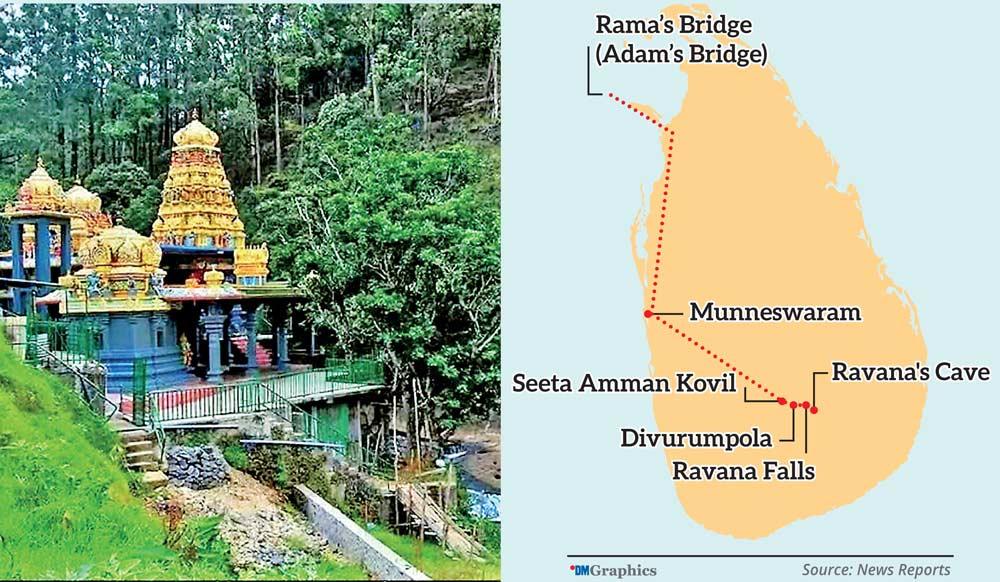
 At the heart of this issue lies the unchecked commercialisation of a cultural narrative. Many of these operators are not heritage professionals or experienced tour curators, but rather opportunistic start-ups seizing a profitable moment.
The situation has been exacerbated by the rapid expansion of Sri Lanka’s tourism sector under the National People’s Power (NPP) government’s tourism-focused policies.
What’s most unfortunate is that Sri Lanka’s Ramayana heritage is both rich and complex. Beyond the popular sites, there are dozens of lesser-known locations — caves, shrines, and mountain paths — linked to ancient folklore and regional traditions
Ms. Jamila Hussain
In recent years, Sri Lanka’s Ramayana Trail has witnessed an extraordinary surge in popularity, drawing thousands of Indian pilgrims and travellers eager to explore the island’s mythical connection to the ancient Hindu epic. Once modest shrines and quiet hilltop temples such as Seetha Eliya, Divurumpola, and Munneswaram have transformed into major spiritual landmarks.
Tour buses now wind through once-silent countryside roads, and new guesthouses and eateries have sprung up around sites long overlooked by mainstream tourism.
This sudden boom could have been a golden opportunity — a chance to promote cultural understanding, to celebrate shared South Asian heritage, and to tell Sri Lanka’s layered story through its mythological and historical tapestry. Yet, instead of fostering authenticity, the trend has become a race to monetise faith. With the growing number of visitors from India, particularly pilgrims seeking a spiritual experience, a proliferation of hastily assembled, low-quality tour packages has entered the market, many of which do little justice to either the legend or the land.
A fellow traveller I met in India recently shared his disappointing experience of a so-called Ramayana Trail organised by a travel agent he found online. What was advertised as a “spiritual journey through sacred Lanka” turned out to be a rushed series of photo stops, interspersed with generic commentary and repetitive souvenir detours. The group was hurried from temple to temple, often without context, leaving little time for reflection or understanding. Meals were indifferent, guides seemed underprepared, and at times, even basic logistics were neglected. He returned home not spiritually uplifted, but disillusioned — feeling that the sacred story had been stripped of meaning and repackaged for profit.
At the heart of this issue lies the unchecked commercialisation of a cultural narrative. Many of these operators are not heritage professionals or experienced tour curators, but rather opportunistic start-ups seizing a profitable moment.
The Ramayana Trail has, in many cases, been reduced to a checklist of locations rather than a thoughtful pilgrimage through myth, geography, and shared belief. Temples are treated as “stops” and legends as “marketing hooks.”
The situation has been exacerbated by the rapid expansion of Sri Lanka’s tourism sector under the National People’s Power (NPP) government’s tourism-focused policies.
While the intention to boost local entrepreneurship is commendable, it has inadvertently spawned a parallel economy of “quick-start” travel operators.
In principle, this new openness could help democratise tourism entrepreneurship. In practice, however, it has spawned a cottage industry of “travel academies” and “tourism institutes” offering six-week crash courses on how to start a travel agency. Conducted entirely online — often via Zoom or other conferencing platforms — these programmes primarily target non-resident Sri Lankans, many with little or no on-ground experience, who ultimately cannot be held accountable for the poor-quality services delivered under their brand names.
These “travel academies” and “tourism institutes” flood social media and YouTube with advertisements promising a complete start-up kit: everything from branding and website design to pre-packaged itineraries and ready-made social media templates. Some even manage the agent’s online presence, posting promotional content and “tour highlights” on their behalf. Today, a would-be “tour operator” can be fully operational in just two months, complete with a logo, marketing collateral, and a ready-to-sell catalogue of “spiritual” and cultural tour packages.
What’s most unfortunate is that Sri Lanka’s Ramayana heritage is both rich and complex. Beyond the popular sites, there are dozens of lesser-known locations — caves, shrines, and mountain paths — linked to ancient folklore and regional traditions. These places tell stories of human devotion, landscape, and memory that deserve careful preservation and interpretation.
Instead, the current wave of commercialisation risks flattening these nuances into a tourist cliché.
The country’s tourism authorities, too, bear responsibility. While the Ministry of Tourism and the Sri Lanka Tourism Development Authority (SLTDA) have been quick to promote the Ramayana Trail as a high-potential niche, there has been little oversight of the quality, accuracy, or ethical standards of the tours being offered. Few guides are properly trained in mythology or cultural interpretation, and even fewer operators employ historians or local scholars in designing their experiences.
If this continues unchecked, Sri Lanka risks alienating the very audience it hopes to attract — faith-driven travellers who seek connection, not convenience. Worse, it risks cheapening a centuries-old spiritual narrative that forms part of the island’s shared cultural heritage.
If Sri Lanka wishes to sustain its tourism growth without losing integrity, it is time to look beyond short-term gain. Standards must be set. Certification and training need to be meaningful, not cosmetic.
Above all, the Ramayana Trail — and other emerging thematic circuits — should be curated with depth and dignity, not diluted into quick-sell content.
Sri Lanka deserves better than mediocrity marketed as spirituality.
— Daneelo Nugara,
Colombo