Reply To:
Name - Reply Comment
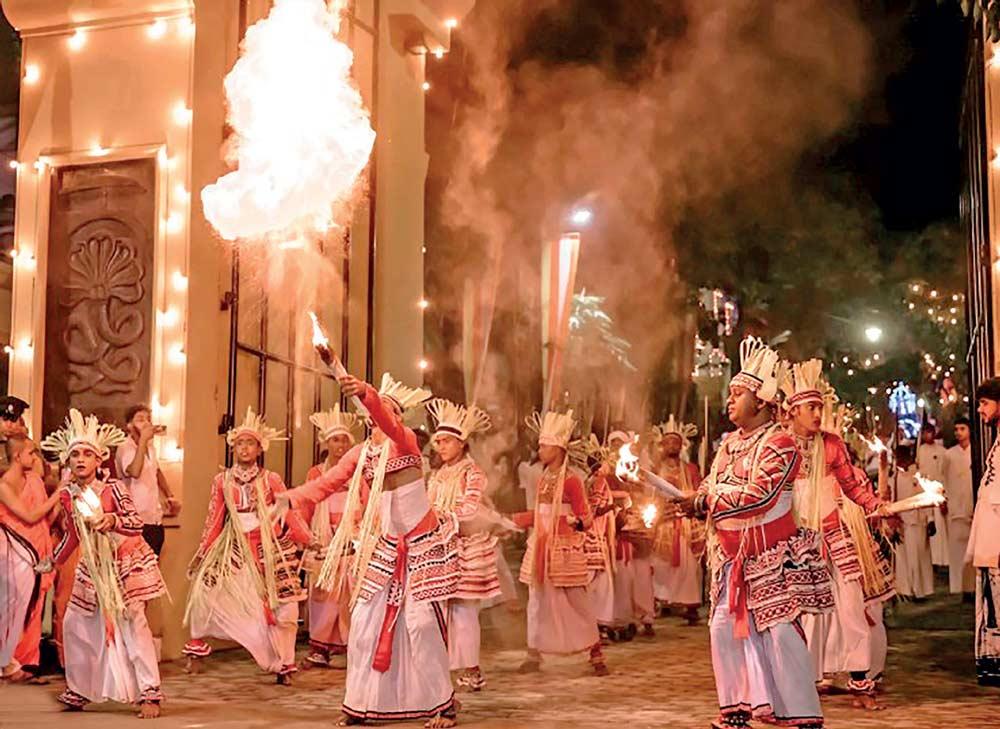
Dancers looking resplendant during the pageant

The annual Kelaniya Duruthu Perahera of the historic Kelaniya Raja MahaViharaya which started on January 8, will have its Grand Duruthu Maha Perahera today, January 10, commencing at 8.00 pm.
With the start of the New Year in January, the city of Kelaniya gets ready for the festive season of Kelaniya temple. Initiated largely due to the efforts of philanthropist Don Walter Wijewardene, son of Helena Wijewardene of Sedawatte Walawwa, the first Perahera was held in 1927; traditionally, the historical Kelaniya Duruthu Maha Peraherais is held annually on three consecutive days.
Kelaniya Duruthu Perahera is second in splendour only to the Sri Dalada Maligawa Esala Perahera in the hill capital of Kandy. This is the most colorful and popular low country procession in Sri Lanka, heralding in the New Year according to the Gregorian and Julian calendars. Hundreds of thousands of people throng the sacred town of Kelaniya to watch the colourful pageant with elephants and dancers including Kandyan dancers, low country dancers and Sabaragamuwa dancers, drummers, whip crackers, torch bearers and acrobats followed by a large number of devotees dressed in white.
Historically and religiously, Kelaniya Rajamaha Viharaya has a special place among our places of worship. Gautama Buddha’s first visit to Sri Lanka was on the first Duruthu Full Moon Poya day, exactly nine months after the Enlightenment. Kelaniya perahera commemorates this occasion. According to the chronicles, the Exalted One visited Kelaniya on the Vesak Full Moon Poya day at the invitation of Naga King Maniakkhika. This invitation was made when the Blessed One visited Naga Deepa three years earlier to quell a rebellion among the Nagas of Naga Deepa led by Chulodara and Mahodara. The Nagas offered the gem throne to the Blessed One on which He sat to preach Dhamma. The gem studded throne was enshrined in the dagaba built by king Yatalatissa who reigned in the third century B. C. In addition to the dagaba which is sixty cubits (80ft.) in height, the king built a temple at the place where the Buddha sat to preach Dhamma.The dagaba is in the shape of a heap of paddy, and its circumference is 180 ft. In the temple premises are devalayas dedicated to Kataragama, Vishnu, Natha and Vibhishana gods.
Tsunami Situation In Kelaniya Area
In the legend, there is the story of king Kelanitissa, who in the second century B.C. got angry over a love affair between his wife and the brother. The king executed an arahant by burning him alive in a cauldron of boiling oil. The story continues that the custodian deities of Sri Lanka were angered by the cruel act and caused the sea to flow inland. This was indeed a Tsunami, and floods reduced a stretch of land about seven Gawwas (28miles) from the coast to about six Gawwas (24 miles) According to legend, the king had to sacrifice his daughter, Vihara Maha Devi, by setting her afloat in the sea to appease the guardian deities. The boat carrying Vihara Maha Devi was washed ashore to the Southern coast of Sri Lanka and she was given shelter by king Kawantissa at Magama who married her. Their son Dutugamunu unified the country. The chronicles say there were many Bhikkhus in Kelaniya at the time and more than five hundred Bhikkhus from Kelaniya had participated in the relic depositing ceremony of Ruwanweliseya. According to chronicles, King Kawantissa (164/192) had constructed a poya-ge (house set apart for Buddhist monks for private confessions) at Kelaniya viharaya.
Bhikkhus From Burma For Upasampada
During the Jayawardhanapura–Kotte period, this sacred place was known as Kelani Raja Maha Viharaya. King Sri Parakkramabahu V1(1412 -1467 A.D.) had renovated Kelani Viharaya. During the reign of King Buwanekabahu V1 (1470 -1478 A.D.), King Dhamakethiya of Burma had sent some Bhikkhus from that country to attain the higher Ordination (Upasampada) in the Kelani Ganga where the Buddha had bathed during His visit. They were ordained to full priesthood by twenty five Bhikkhus led by Veedagama Maithriya Maha Thera.
Destruction Caused By Foreign Powers
Kalinga Magha from South India who invaded the island, destroyed shrines and temples in our country including the Kelaniya temple, but King Vijayabahu rebuilt almost all the temples and Kelaniya temple was returned to its former glory.
The Portuguese destroyed the temple in the 16th century, but King Keerthi Sri Rajasinghe, the reigning king of Kandy rebuilt it in 1767 A.D. It was Mrs. Helena Wijewardena and members of her family that brought this ancient sacred shrine to the preset condition. The famous artist Solius Mendis restored the interior of the temple building to its former glory. For more than 30 years, Mendis painted the frescoes depicting the lives of the Enlightened One and scenes from the Buddhist history in Sri Lanka. He also added a geometric ceiling to the temple hall.
Traditional sculpture and motifs
Kelaniya temple is a splendid example of Buddhist architecture and art. At the entrance of the temple, there is the Makara Thorana (Archway) constructed during the reign of King Keerthi Sri Rajasinghe. Makara is a symbol of protection in local mythology and it is a stylised depiction of animals combined into an elaborate pattern. Makara has a body of a fish, feet of a lion, ears of a pig, trunk of an elephant, tail of a swan and mouth and teeth of a monkey.
Kelaniya temple is built on a rock platform and the external part of the foundation has three rows of carved figures. There is a row of swans and the middle row is of carved Bahirawayas,- the terrible ones holding entire edifices with ugly expressions on the faces that shows anger, disgust and pain. The third row of figures on the outside walls are statues of Hindi deities Gana deviyo (God of wisdom), goddess Ganga, god Vishnu, god Vibhishana(Rawana’s brother), Maithri Bodhisatva, Naga king Maniakkhika and god Skandha Kumara (god Karkithikeya (Katharagama deiyo, the god of war).
At the entrance of the temple there is a traditional Sandakadapahana or Moon stone, flanked by two Gajasinghe images with a body of a lion and head of an elephant. Inside wallsof the hall are painted depicting Jataka stories, myths and legends including King Kelantissa’s execution of an Arahant in his fit of rage.
The eighteen cubits long reclining statue of the Enlightened One is the main focus of the temple. It is in the darkened hall. The only light in the day time is the stream of light peeping from the entrance of the shrine room. There are statues of Buddha, including the Buddha statue in the meditating posture in the main hall adjoining the shine room of the reclining Buddha.
Dagaba In The Shape Of A Heap Of Paddy
To the right hand side of the shrine, there is a dagaba built in the shape of a heap of paddy. Incidentally this is the best example of Dhannyakara style of dagaba. At the request of the Naga king, this dagaba is said to have been built to mark the place where the Buddha sat on the gem studded throne to preach Dhamma.
This golden throne inlaid with precious stones is believed to have been enshrined in the dagaba.
To the left of the shrine is the Bo tree of the same species of the tree which provided shelter to the Buddha during His meditation.
Since Kelaniya temple is situated close to Colombo, many visitors foreign and local are drawn to explore its architecture, statues and frescoes, specially the Dhannyakara dagaba built on the site where the Buddha sat to preach the Dhamma. The Kelaniya temple situated by the side of Kelani Ganga has an attractive environment with scenic beauty.
A Variety Of Religious Festivals
A variety of religious festivals take place for more than a week. Kelaniya Duruthu Perahera is held on three consecutive nights starting with the first procession. The Udamaluwa perahera is started in the upper terrace of the temple with the ritual of handing over the casket. Cannon fire marks the beginning of the parade.The casket is carefully placed on a colourful cushion. On the second day the procession or the Pathamaluwa perahera which is even more colourful is held at night.
The perahera is continued with elephants carrying the casket and the divine insignia. The festivities reach the climax with the Randoli Perahera, the most magnificent of the processions. Kelaniya Duruthu Perahera is now confined to the temple premises and the roads surrounding it, but in the nineteen sixties the perahera paraded streets starting from the temple premises and proceeding along Biyagama road and Pattiya junction, Kandy road to Thorana junction and back to temple premises along Pilapitiya. The curtailment is presumably due to security reasons.