Reply To:
Name - Reply Comment
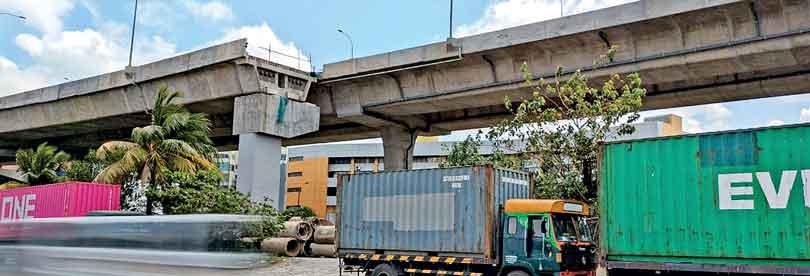
Ramp 2 which is to be connected to Pettah
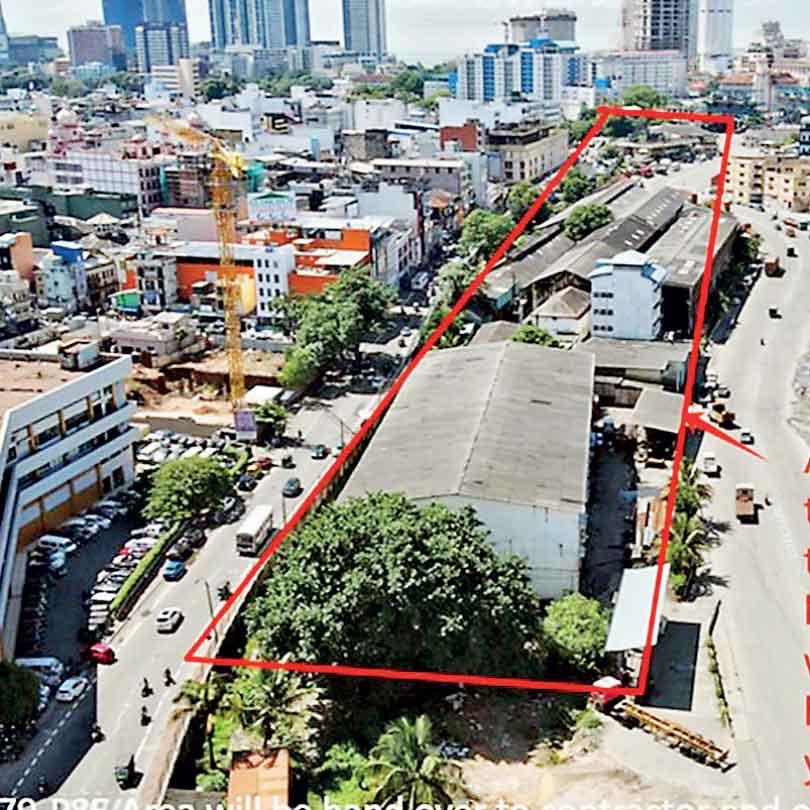
An elevated highway which passes through the SLPA workshop and the project dragged over two years due to delay of relocation.
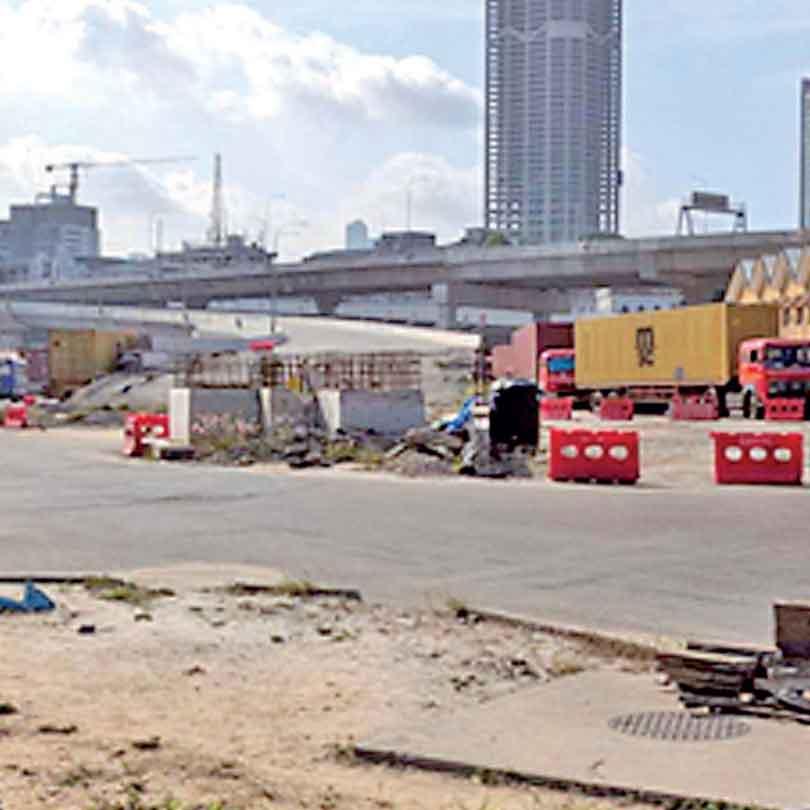
Incomplete Ramp 3
- The construction of this much anticipated road network to ease major traffic blocks in and around Colombo which will enable motorists to access the country’s expressway network, the work has come to a standstill following a dispute over delay damage of around Rs. 1.2 billion charged from the Claimant-Chinese contractor by the RDA-Respondent, followed by a decision by the Arbitration board ordering the RDA to pay back the total cost of the deducted delay damage amounting to nearly Rs. 1.2 billion
 The completion of the much awaited multimillion dollar ADB-loaned Port Access Elevated Highway (PAEH) which only needed finishing work has come again to a virtual stop with multiple issues including the Road Development Authority (RDA) announcing lack of finances for the year.
Originally started on September 27, 2019, the entire project which was scheduled to finish within 1095 days or by September 26 2022, has dragged now for more than six years, without any sign of opening for public use within the next few months.
The construction of this much anticipated road network was to ease major traffic blocks in and around Colombo and enable motorists to access the country’s expressway network. However the work has come to a standstill following a dispute over delay damage of around Rs. 1.2 billion charged from the Chinese contractor by the RDA. After an arbitration suit, the Arbitration board has ordered the RDA to pay back the total cost of the deducted delay damage amounting to nearly Rs. 1.2 billion.
In its decision dated November 28, 2025, Dispute Adjudication Board (DAB) (Sri Lanka Arbitration Centre) declared: “The Respondent shall pay the Claimant a total cost of deducted delay damages amounting to LKR 1,145,127,997. The Respondent shall pay the Claimant total interest charges computed due to non-payment of the said amount as per the provisions stated in the contract”. The decision was made by Dr. Engineer Ananda Ranasinghe (DAB Chairman) and two members representing the two parties -- Cui Jun (Contractor’s representative) and Engineer G. G. M. Wijethileke.
Three joint Chinese contractors -- China Civil Engineering Construction Corporation, Hubei Provincial Road and Bridge Group Co. Ltd and Hehan Provincial Communication Planning and Design Institute Co. Ltd -- had gone to the DAB against the earlier decision to pay delay damages.
However, following the decision by the DAB, the RDA has communicated to the Chinese Contracting joint venture that it was unable to pay the refund due to the funding restriction at the end the of the Calender year: “We regret to inform you that due to funding restrictions at the end of the calender year, we will not be able to process the payments for the refund of delay damages and associated financial charges through the current Interim Payment Certificate.
“Therefore these amounts should not be certified at this time.” This declaration was signed by Eng. R. M. J. N. Ratnayaka, Project Director (Acting) Port Access Elevated Highway Project, RDA.
With this decision by the RDA, and the crisis for funding together with escalating uncertainty on the future, the much-delayed expressway project has come to a standstill now.
The RDA’s latest communication came despite its earlier instruction to the Contractor to submit the payment application before December 5 2025.
PAEH likely to face setbacks like Central Expressway and the Airport development works
“The Contractor complied, and on December 5 2025, the Consultant Engineer certified the payment, amounting to LKR 1.2 billion and USD 4 million, including reimbursement of delay damages and related financial charges. However, just four days later, on December 9, 2025, the RDA informed that the payment could not be made due to financial constraints,” a senior Sri Lankan official representing the Chinese Contractor told the Daily Mirror.
“The Contractor was already struggling since November of the previous year, as full payments for completed work have not been released. Under the Contract, prolonged non-payment allows the Contractor to suspend or even terminate the Contract, actions that would require the Employer to bear all associated suspension or termination costs. If such a situation arises, it could mirror past setbacks seen in projects such as the Central Expressway and the Airport development works, which led to significant financial losses for the country, ” the Senior professional representing the Contractor said.
“This ongoing non-payment is a serious breach of the Contract. Under the Contractual provisions, continued failure to pay empowers the Contractor to suspend the works or terminate the Contract entirely, a step that would obligate the Employer to bear all resulting suspension or termination costs, which could be a huge amount,” he added.
He further added that this is especially alarming given that the project is virtually complete, with only the link road and ramp works remaining, less than 0.2% of the total construction. Failure to release payments at this final stage threatens to undermine years of progress and public investment.
Questioned about what would be the repercussion of non-payment of refund to the Contractor, an industry expert told the Daily Mirror the matter could end up with International Arbitration in Singapore.
“The decisions of the Dispute Adjudication Board are binding under the Contract and ignoring, undermining, or refusing to honour these decisions could push the dispute toward international arbitration in Singapore. Such proceedings typically cost between USD 500,000 and 1 million per case, a financial burden the country can ill afford,” the expert noted.
Elevated Highway to cut major traffic jam
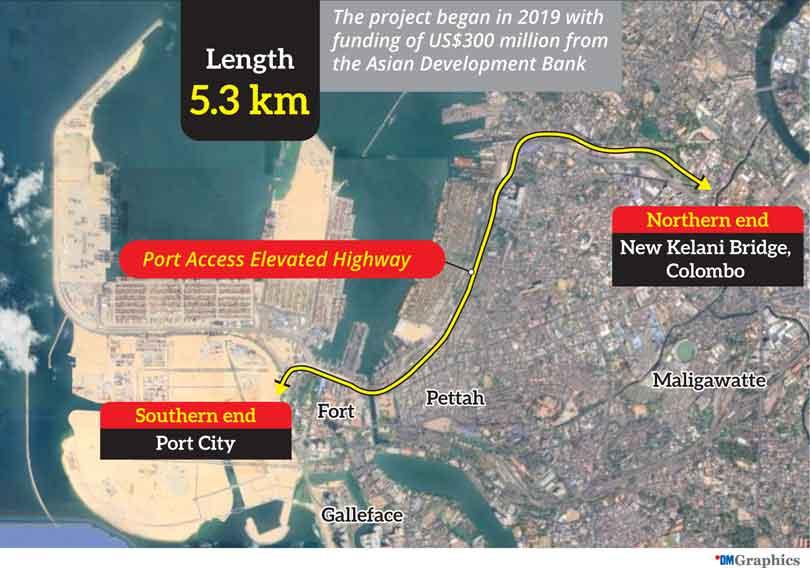
Designed to create a vital viaduct linking Galle Face with Ingurukade Junction through the Colombo Port area, the PAEH starts near the New Kelani Bridge. The route stretches east to west across the Colombo port. Planned as a four-lane structure spanning 5.27 km, with widths ranging from 23.4 m to 36 m, the elevated highway project is funded by Asian Development Bank (ADB), and the Consultant Engineer is Sheladia Associates, Inc., a Joint Venture with Roughton International Ltd and MG Consultants (Pvt.) Limited.
In addition to the main viaduct, the project includes significant ground-level improvements, including widening the external road to four lanes and expanding the Port Access Road to six lanes. It also features four ramp connections: the Bloemendhal Ramp 1 which is partially constructed, the Pettah Ramp 2 which is partially built, the Port Ramp 3, and the Galle Face Ramp 4.
The access road will also provide wide ranging benefits to the public and financial institutions, as it would help to divert thousands of container trucks away from the city’s busiest roads. This would ease daily traffic congestion, shorten travel times, and reduce pressure on routes such as Bloemendhal Road, Fort, and the Port Access Road.
The new highway will also ensure faster and more reliable access to the Port, critical for Sri Lanka’s trade-dependent economy. Smoother cargo movement means fewer delays for importers and exporters, lower transportation costs, and greater overall efficiency. Economically, the early use of the elevated highway will support businesses, boost productivity, and strengthen investor confidence. It will also reduce damage to city roads caused by heavy vehicles, lowering future maintenance costs.
The tragedy of further delays to the project is that despite finishing 99 percent of major work, the taxpayers are denied its benefit.
“Delaying the operation of this project means the Government will still be required to repay the ADB loan, with interest, even though the public is not yet receiving any benefit from the investment. This situation risks repeating the financial burden experienced with underutilised projects such as the Mattala Airport and Hambantota Harbour,” an economist said.
Delays and Delay of Express Way
The project that was to be completed towards the end of 2022 was delayed due to various reasons, including the COVID-19 pandemic. Following the first and second waves of COVID-19, major delays occurred, disrupting the project. However, the RDA had granted extensions of 105 days and later 135 days. But the Contractor claimed that the delay resulted in its repeated accelerated work getting dragged, incurring substantial additional costs.
“Not clearing the planned route for the new elevated road ran directly over the existing Sri Lanka Ports Authority (SLPA) workshop, and affecting the area required to build support pillars was another reason for the delay. The contractor was supposed to receive this site by September 27, 2021,” the representative for the Chinese contractor said. Apparently the SLPA had hired a separate contractor to build a new workshop facility to relocate the existing workshop, and that too got delayed in its task of completing the replacement building.
“Because the SLPA couldn’t relocate its operations to the new facility, it couldn’t hand over the workshop for demolition. This crucial step was delayed by almost two years, and the land was finally released in September 2023,” he noted.
On July 14 2024, work on On-Ramp 3 had to be suspended after the recovery of human skeletal remains during excavations near the Harbour Police Station. A full archaeological investigation, revealing 107 skeletons, continued until September 02, 2025.
Added to the delays were administrative issues; for example, the Consultant-Engineer who holds one of the most important roles in the project had to abandon the site in October this year. The project came to a standstill as the contactor could not continue work without the Consultant-Engineer appointed by the RDA, which represents the government.
Non-completion of ramps
Despite completion of the major work, the project is getting dragged due to non- completion of second and third ‘ramps’ or accesses to the superstructure. However, these ramps which were not in the original plan are vital to the project and for the major benefit of the public. Last year, a committee was appointed to look into the delayed PAEH and some officials within the RDA had opposed awarding the additional constructions to the existing Chinese contractor.
“If we award the additional work also to the existing contractor, we would have to pay at international rates. This is one of the reasons why we don’t want to award to the present contractor,” M. J. N. Ratnayaka, Project Director (Acting) Port Access Elevated Highway Project, who joined the project last October, told Daily Mirror. “It is much cheaper and beneficial for the country to get this done through a local contractor,” Mr. Ratnayaka said.
“Completion of this project without the additional ramps which are much beneficial for the public is useless. These roads should be for the use of the people. I don’t understand how these projects were planned without thinking about their benefit for the people,” the senior official observed.
Asked about RDA’s inability to refund the claimed delay damages to the contractor, the Project Director said that the stipulated amount that was to be released for the year had already been spent. He also explained that there is a payment of tax by the Contractor, and if that was not paid the RDA would be held accountable to country’s judicial system.