Reply To:
Name - Reply Comment
The Second International Conference on Circular Economy and Sustainable Ecosystems (IC2ESE 2025) launched in Nawala this month, positioning Sri Lanka as a regional hub for regenerative industrial strategy. Uniting global academics and policymakers, the forum addressed the urgent transition from “take-make-dispose” manufacturing to resilient, low-carbon systems. With a focus on energy transition and material recovery, the summit charted a vital course for South Asian sustainability.
The 2nd International Conference on Circular Economy and Sustainable Ecosystems (IC2ESE 2025) was successfully held on 11 December 2025 at The Open University of Sri Lanka, Nawala, Nugegoda. Organised by the Department of Mechanical Engineering, the international conference brought together academics, industry professionals, policymakers, and researchers from Sri Lanka and overseas to discuss transformative circular solutions for a regenerative and resilient world.
The conference was conducted in close alignment with the MSc in Energy for Circular Economy, an international-level master’s programme recognised as one of the most in-demand postgraduate programmes in South Asia, particularly in Sri Lanka. The programme plays a vital role in developing skilled professionals in energy transition, sustainability, and circular economy practices while strengthening the link between academic research and real-world application.
A key objective of the conference was to create a strong academic pathway for students to publish their research findings. IC2ESE 2025 provided undergraduate and postgraduate students, especially those enrolled in the MSc in Energy for Circular Economy, with a valuable opportunity to present and publish peer-reviewed research papers in the official conference proceedings. This initiative supports research-based learning, enhances international exposure, and encourages young researchers to contribute meaningfully to national and global sustainability goals.
Addressing the opening session, the Vice Chancellor of the Open University of Sri Lanka, Snr. Professor P. M. C. Thilakarathne, emphasised the urgent need to move beyond traditional linear development models in response to escalating climate risks and environmental challenges. The conference agenda included the official launch of the conference proceedings and parallel technical sessions covering material circularity, energy technologies, sustainable transport, corporate innovation, and education.
The conference featured four keynote addresses by distinguished local and international experts. Prof. Jeevan Jayasuriya from KTH Royal Institute of Technology, Sweden, highlighted the role of education in shaping responsible citizens for a circular future. Prof. Annukka Santasalo-Aarnio from Aalto University, Finland, focused on circular economy approaches for energy technologies and material recovery. Prof. Cristina Efremov discussed policy alignment and leadership required to bring circular economy transitions to life across industries.
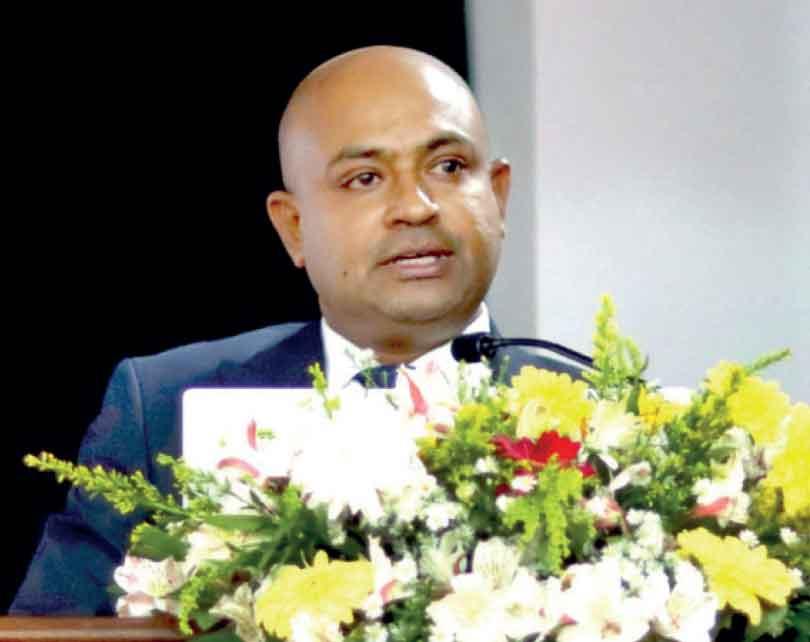
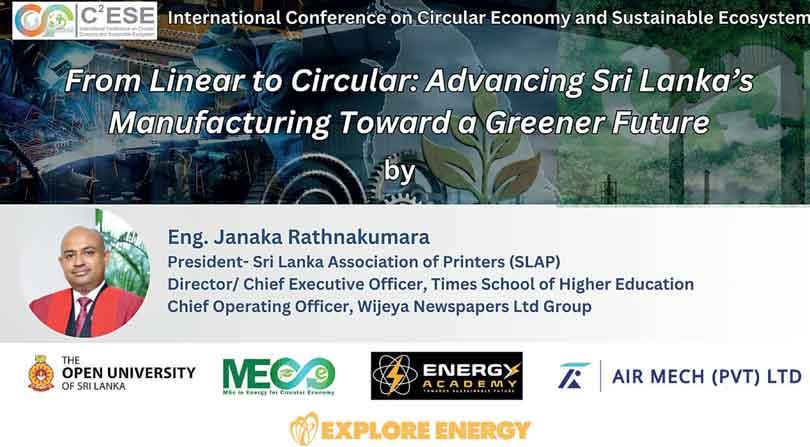
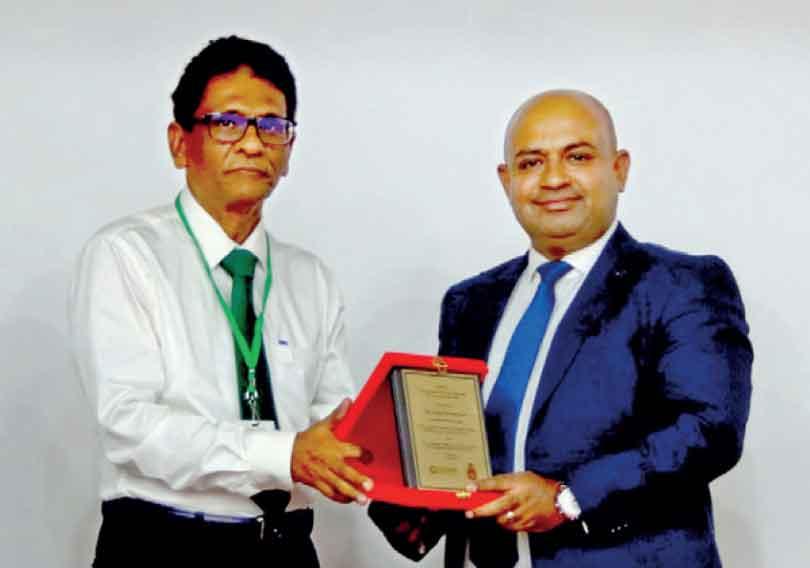
A key highlight of IC2ESE 2025 was the keynote address delivered by Eng. Janaka Rathnakumara, President of the Sri Lanka Association of Printers and senior corporate leader of the Wijeya Newspapers Ltd Group. His keynote, titled “From Linear to Circular: Advancing Sri Lanka’s Manufacturing Toward a Greener Future,” underscored the urgent need for Sri Lanka’s manufacturing sector to transition from the traditional “take–make–dispose” model to circular production systems.
He emphasised that circular manufacturing—through improved design, resource efficiency, product life extension, and material recovery—can enhance industrial competitiveness, reduce waste and emissions, and support Sri Lanka’s Nationally Determined Contributions and Sustainable Development Goals. Highlighting the importance of policy support, business leadership, finance mechanisms, and cross-sector collaboration, he called for collective action to accelerate Sri Lanka’s journey toward a low-carbon, resilient, and regenerative industrial economy.