 KELUM BANDARA
Reply To:
Name - Reply Comment
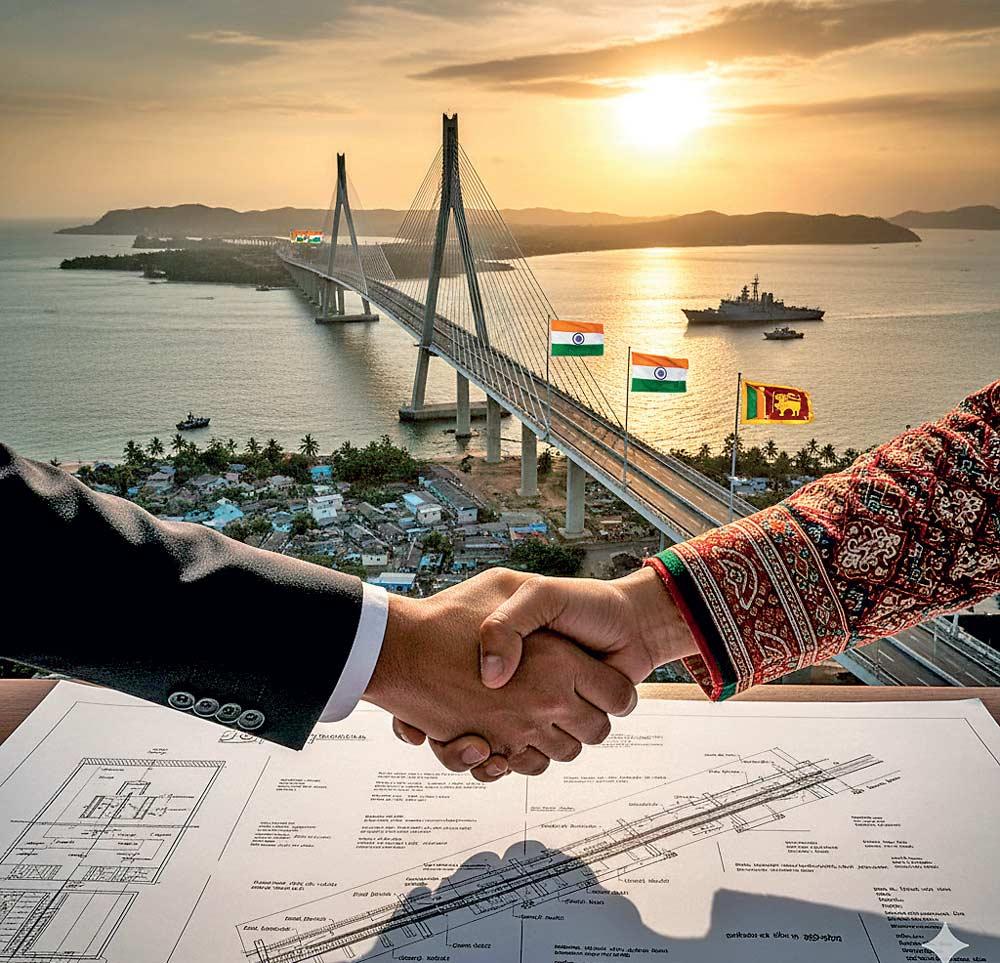
 The government led by President Anura Kumara Dissanayake... has chosen to press ahead with the agenda initiated by its predecessor, and in some respects to take it further
The election of the JVP-led government was once feared as a potential frost in Indo-Lanka relations, yet the reality has proven remarkably different. Driven by the twin pressures of IMF-mandated reforms and the devastating wake of Cyclone Ditwah, President Anura Kumara Dissanayake has embraced a foreign policy defined by strategic necessity. By maintaining continuity in engagement and accepting massive Indian aid, Colombo has signaled that economic survival now outweighs historical skepticism
The 2022 economic crisis brought about a change in Sri Lanka’s economic and foreign policy directions. Sri Lanka, as a country, sought to follow a reform agenda under the supervision of the International Monetary Fund (IMF), which offered a bailout package. Foreign relations were tailored accordingly, with major powers playing their role in restructuring the country’s external debt. India emerged in this picture as a responder. New Delhi’s sustained engagement in the difficult period that followed became a key element in Sri Lanka’s post-crisis recovery narrative.
It is against this backdrop that Sri Lanka’s new political moment unfolds. The government led by President Anura Kumara Dissanayake, anchored by the Janatha Vimukthi Peramuna (JVP), is a historic phenomenon.
For decades, before its ascent to the centre of governance, the JVP was viewed—both domestically and externally—as deeply sceptical of India, shaped by a political discourse that warned against what it termed “Indian expansionism.”
Upon election to office, the government has chosen to press ahead with the agenda initiated by its predecessor, and in some respects to take it further. It opted to build on the economic reform programme undertaken with the IMF during the previous administration.
Simultaneously, the government followed up on steps taken by the last government to strengthen ties with India. This marks a significant departure from the public perception of the JVP. Notably, the JVP had begun making overtures to India even before its ascent to power.
Ahead of the presidential election in September 2024, Mr. Dissanayake visited New Delhi and familiarised himself with key Indian leaders.
Security and economic cooperation now feature prominently in bilateral ties with India. In this equation, Sri Lanka is positioned to maintain asymmetric ties with India, even as neutrality remains the hallmark of Sri Lankan foreign policy. Geography and the relative sizes of the two economies shape this reality. Bilateral relations remain robust.
Now, as in the aftermath of the 2022 economic crisis, Cyclone Ditwah has created fresh space for engagement with India.
Indian High Commissioner Santosh Jha, in remarks to the media on Thursday, said, “If I were to summarise 2025, I would really sum it up as a year of re-energising and reaffirmation: re-energising the India–Sri Lanka bilateral agenda and reaffirming the strength of our civilisational friendship. Trust, goodwill and friendship are at an all-time high.”
“We started the year with the visit of Prime Minister Shri Narendra Modi to Sri Lanka in April 2025. Prime Minister Modi was the first foreign Head of State or Head of Government to be hosted by the President of Sri Lanka since the latter’s assumption of office in September 2024. Earlier, in December 2024, President Anura Kumara Dissanayake had chosen India as his first overseas destination for a State Visit after assuming office,” he said.
The latest highlight was the visit of Indian External Affairs Minister Dr. S. Jaishankar as the special envoy of Prime Minister Narendra Modi toward the end of last year.
Highlighting India’s response, the High Commissioner said: “As Sri Lanka’s closest neighbour, India has always been a first responder. When Cyclone Ditwah made landfall, we commenced our rescue and relief mission under Operation ‘Sagar Bandhu’ on the same day. Indian Navy aircraft carrier INS ‘Vikrant’ and Indian Naval Ship INS *Udayagiri*, which had docked in Colombo for the International Fleet Review, immediately pivoted to humanitarian assistance and disaster relief operations. These ships provided immediate rescue and relief material, including dry and fresh rations and HADR bricks. Two Chetak helicopters from INS *Vikrant* were mobilised to support rescue efforts.
“Thereafter, three Mi-17 helicopters of the Indian Air Force were active for more than two weeks in Sri Lanka, rescuing stranded persons from inaccessible areas and distributing aid. An 80-member National Disaster Response Force contingent arrived simultaneously and conducted rescue and relief operations. The Indian Army set up a field hospital with 85 medical personnel near Kandy, providing emergency care to about 8,000 people. Two modular BHISHM emergency medical care units were also airlifted to Sri Lanka and utilised in the worst-affected districts.”
Overall, Operation ‘Sagar Bandhu’, conducted from November 28 to December 22, delivered over 1,100 tonnes of relief material, including dry rations, tents, tarpaulins, hygiene kits, essential clothing and water purification kits. About 14.5 tonnes of medicines and medical equipment were also provided, along with 60 tonnes of equipment and 228 tonnes of Bailey bridge units. In addition, Indian companies in Sri Lanka contributed over US$ 1 million to the Rebuilding Sri Lanka Fund, underscoring their commitment to Sri Lanka’s recovery and long-term development.
India has now announced an assistance package of US$ 450 million. The proposed package includes US$ 350 million in concessional lines of credit and US$ 100 million in grants.
“Over the coming week, we are looking at inaugurating two bridges constructed under this package. We will also commence restoration work on the Northern Railway Line. The bridge construction is proposed to be covered under a grant of nearly US$ 30 million. Our estimates suggest this should suffice for the restoration of all bridges impacted by Ditwah. The repair of the Northern Railway Line will also be funded under grants,” he said.
He added that the package is in addition to India’s overall economic assistance to Sri Lanka to date, which exceeds US$ 7 billion.
India continues to be Sri Lanka’s principal development partner, with over US$ 780 million worth of projects—most of them currently under implementation—under grant assistance.
These grant projects include a commitment to build 10,000 houses in plantation areas under Phase IV of the Indian Housing Project. While 3,300 of these are at different stages of implementation, 6,700 houses could potentially benefit families affected by the cyclone or at risk from future disasters. Similarly, a package of nearly US$ 10 million had been committed for the upliftment of the Indian Origin Tamil community. Roughly US$ 8 million of this remains unutilised and could be deployed to supplement the government’s ongoing post-disaster recovery efforts, particularly for the Indian Origin Tamil community, which has been among the worst affected by Cyclone Ditwah, according to him.
In the meantime, the implementation of energy connectivity projects including the interconnection of two power grids is likely to be constrained because the focus has shifted to post-Ditwah rebuilding efforts.
No matter what, the policy continuity maintained by the new government in both the IMF-backed reform agenda and engagement with India shows a recognition of economic realities and strategic compulsions. The government has dropped ideological rigidity.